
Jólablót: The Norse Midwinter Feast of Sacrifice, Spirits and Renewal
In the far North, midwinter was more than a date on the calendar. It was the hinge of the year, a moment when the darkness pressed close and the sun seemed to vanish almost completely. For the people of the ‘Viking Age’, this season carried a weight that is easy to forget in our modern world of electric light and central heating. Winter was not simply cold and inconvenient; it threatened survival. Food stores were tested, storms were unpredictable, and the long dark nights could strain even the strongest communities. Yet out of this hardship came one of the most important and meaningful celebrations of the Norse world: Jólablót.
Jólablót, the midwinter sacrifice and feast, was a time when life pushed back against the darkness. It was not merely a festival of drinking and feasting, though there was plenty of that. It was a sacred ritual designed to uphold the order of the world, honour the gods, welcome the ancestors and strengthen the bonds between the living. In many ways it was the spiritual centre of the year, when people acknowledged both the harshness of winter and the promise of returning light.
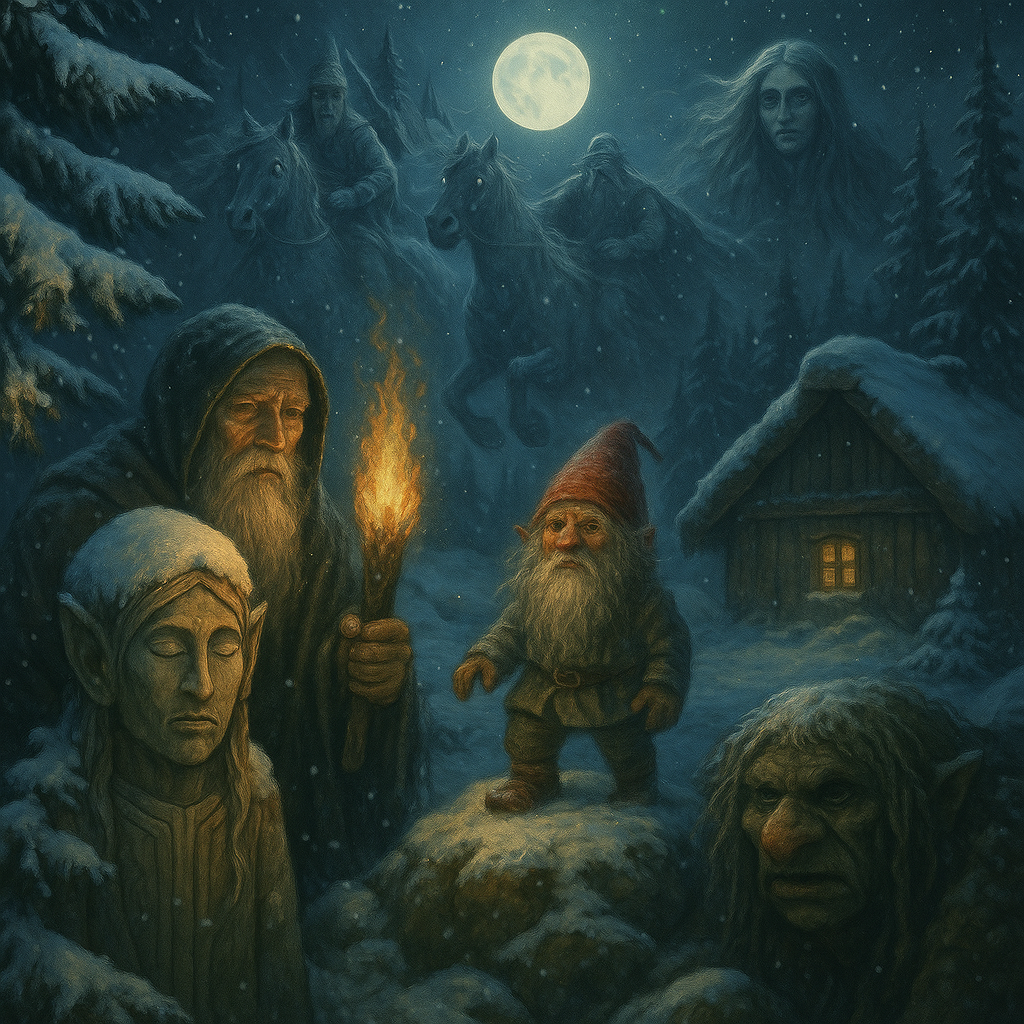
The Norse did not view midwinter as empty or quiet. They believed the world was more alive during this season than at any other time. Spirits moved more freely. Ancestors drew near to the homestead. The gods watched closely. House wights and elves needed honouring. Fires burned not only for warmth but for protection. The longhouse became a place where the human and the unseen met, and where ritual action helped ensure good luck, good harvests and safe passage through the hardest months.
Jólablót was a communal act: a gathering of kin, neighbours and friends who shared food, drink and stories deep into the night. Sacrifices were made to secure blessings for the year ahead. Toasts were spoken to gods, ancestors and the memory of the dead. Songs and tales reminded everyone that they stood in a long line of generations who had survived winters before them. In the darkest part of the year, people reaffirmed their connection to each other and to the larger forces that shaped their world.
Though Jólablót changed under Christianity and evolved into new forms, its echoes remain in Scandinavian culture today - in festive gatherings, in winter traditions, in the lingering sense that midwinter is a charged, meaningful time. Behind every modern Christmas light, every Yule custom and every cosy winter ritual lies the faint memory of ancient fires burning against the night.
To understand Jólablót is to step into a world where winter was sacred, life and death were close companions, and the turning of the year was marked with both reverence and celebration. It is a reminder that even in the harshest conditions, people found ways to create warmth, meaning and connection - a tradition that has endured for over a thousand years.
What Was Jólablót?
Jólablót was the great midwinter sacrificial feast of the Norse world - a ritual gathering that blended religion, community, ancestry and seasonal survival into one powerful event. It was not simply a party or a loose celebration. It was a structured, sacred act whose purpose was to maintain the balance between humans, gods and the unseen spirits of the land.
The word blót refers to a sacrifice or offering, usually involving food, drink and sometimes animals, given to the gods, elves, ancestors or land spirits. A blót was not an act of begging for favour. It was an exchange - a reaffirmation of mutual obligation between the living and the powers that shaped their world. In the harsh climate of the North, these relationships mattered. A failed harvest, a deadly storm or poor hunting could be disastrous. Jólablót was one of the key rituals intended to uphold luck and guard against misfortune.
Jól, from which our modern word “Yule” comes, was originally a name for the broader midwinter season. Long before Christianity, Jól marked a turning point in the cycle of the year: the moment when the sun began its slow return. For the Norse, this was not a casual observation. The sun’s re-emergence carried spiritual meaning. Jól was a time when the old year ended, the new year began and the boundary between worlds felt thinner. Darkness was at its peak, but the promise of returning light lay ahead. Jólablót helped ease this transition and ensure the world renewed itself properly.
The ritual took place in the darkest period of winter. There is no single universal date, because the Norse used a lunisolar calendar in which months followed the moon. Sources suggest that Jól lasted three nights and may have been timed around a midwinter full moon rather than a fixed date like Christmas. This means that the mood of Jólablót was tied not to a single night, but to a small season of deep darkness and heightened spiritual significance.
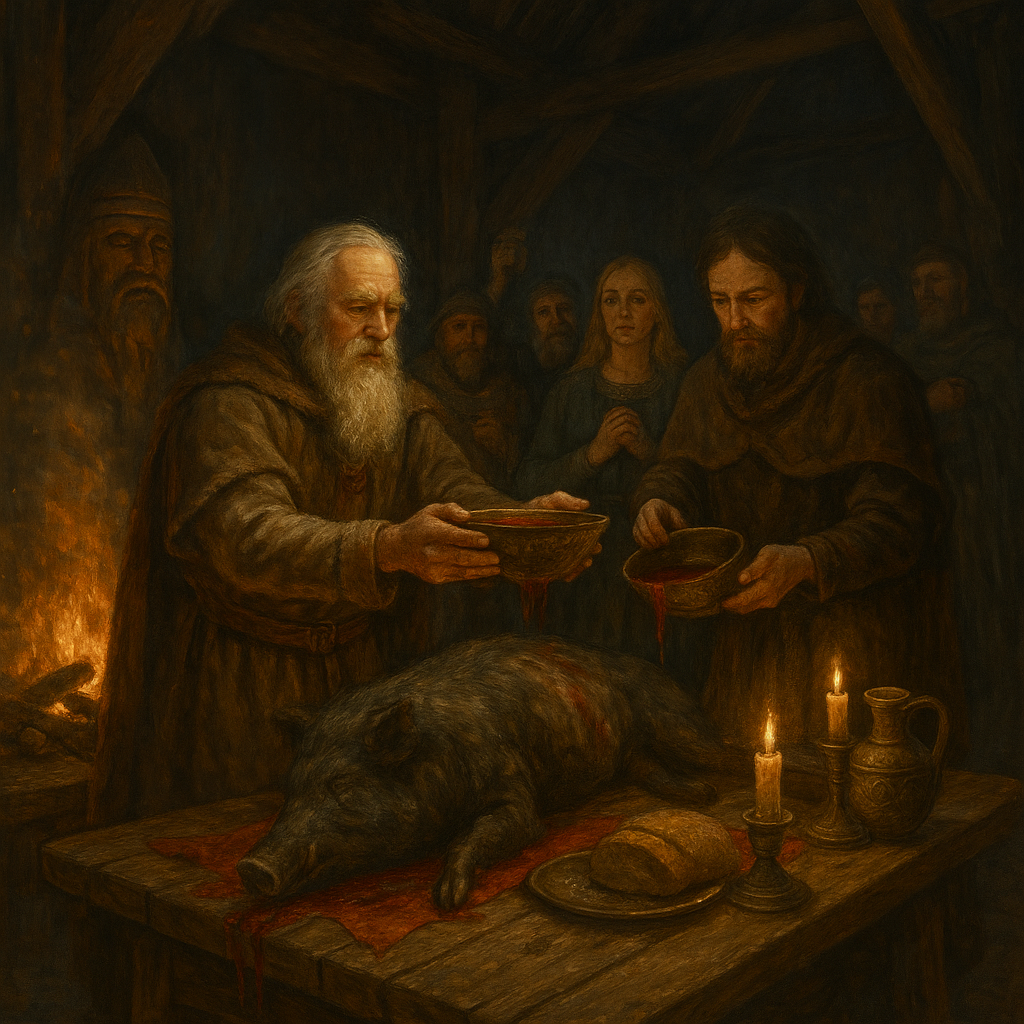
At the heart of Jólablót were the offerings. Sacrifices varied by region and by wealth, but the most common elements were ale or mead, special foods, and occasionally a boar or other livestock. The blood from an animal sacrifice (hlaut) was sprinkled as a blessing on people, buildings and ritual objects, a practice described in medieval sources. This was not viewed as violence, but as returning life force to the gods and renewing the bond between the human and divine. Everything in the ritual worked to restore luck, strengthen relationships and maintain harmony during the most dangerous time of the year.
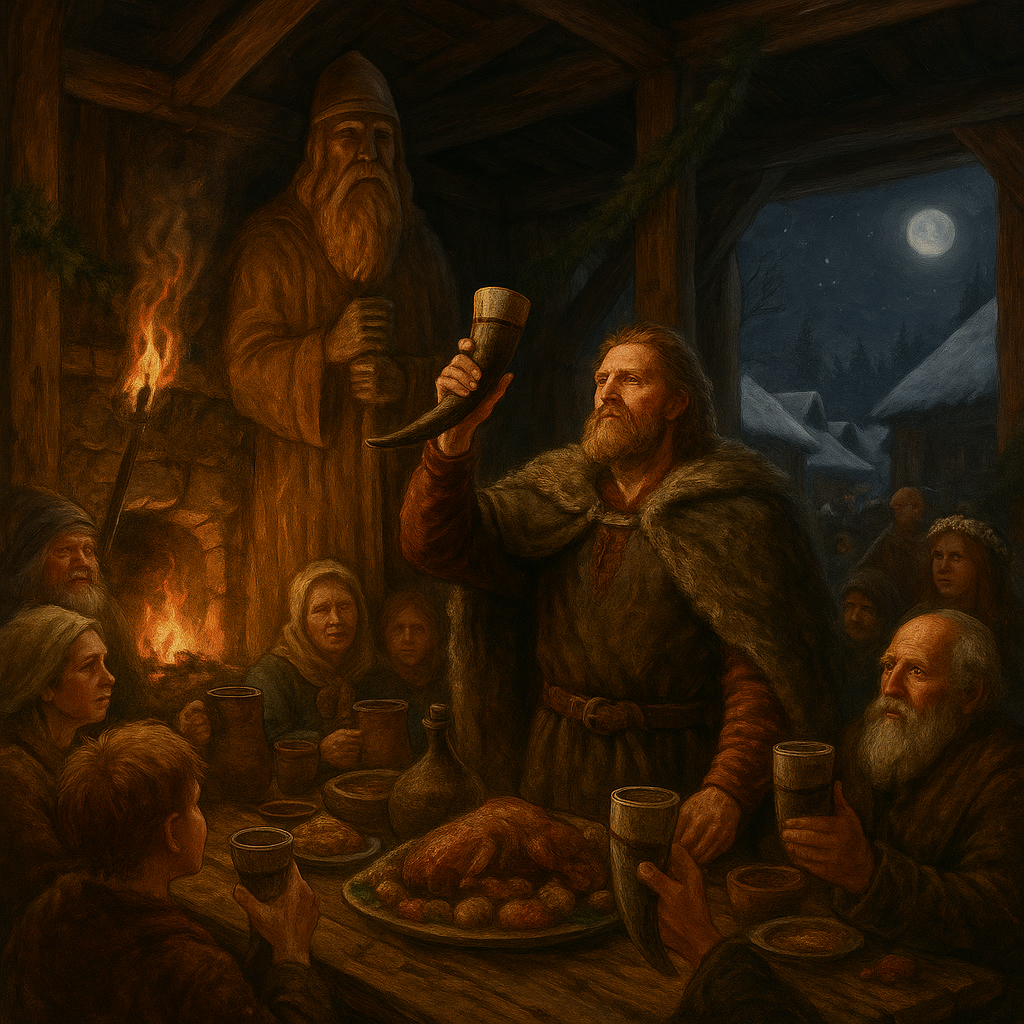
The feast that followed the blót was just as important as the offering. Eating together was a sacred act that tied all participants (living and dead) into a single community. Toasts were made to gods, ancestors and leaders, each spoken aloud so they could be witnessed by all. In some traditions, great oaths were sworn over the cup, binding people to deeds in the coming year. Jólablót was a time when decisions could be made, disputes settled and relationships renewed. It was the social heart of winter.
But Jólablót was not only about the gods. The entire spiritual landscape was involved. House spirits were given food. Ancestors were believed to draw near during midwinter, their presence felt in the home even if unseen. Fires were tended carefully, thresholds watched, and certain tasks avoided to prevent offending unseen guests. Everything during Jólablót held both practical and spiritual meaning.
Importantly, Jólablót was not a ritual performed only by kings or chieftains. Although large feasts took place in great halls, household blóts were common across farms and settlements. Each family took responsibility for honouring the forces that protected their land, livestock and lineage. Midwinter was everyone’s concern, and the rituals belonged to every level of society.
To the Norse, Jólablót was essential because it reaffirmed the continuity of life during a season when death felt closest. It was a moment when the community acknowledged the darkness but refused to be overcome by it. Through offering, feasting and remembrance, they strengthened the ties that sustained them: to their gods, their ancestors, their land and to one another.
In its deepest sense, Jólablót was the heartbeat of midwinter.. a ritual of survival, gratitude and renewal that held the old world together through its coldest, most uncertain nights.
Read more about what a Blot is here >
When Was Jólablót Celebrated?
Pinning down the exact date of Jólablót is difficult because the pre Christian Norse did not use a fixed solar calendar like we do today. Their months followed the moon but were adjusted to stay in line with the seasons. Because of this, winter festivals did not fall on the same date every year. The timing of Jól could shift depending on the moon and local custom.
In the ‘Viking Age’, winter began earlier than many people expect. The Norse divided the year into only two seasons: summer and winter. Winter began in the first half of October and by December the land had entered its darkest period. Jól took place in the middle of this season. Some medieval sources place it roughly halfway through winter, which would be late December or early January by our calendar. But it did not fall on a single fixed date.
Several texts say that Jól lasted more than one night. Icelandic writings speak of three nights of Jól, while some Norwegian traditions hint at longer celebrations. This shows that Jólablót was not a single evening, but a short midwinter festival with feasting, gatherings and offerings spread over several nights.
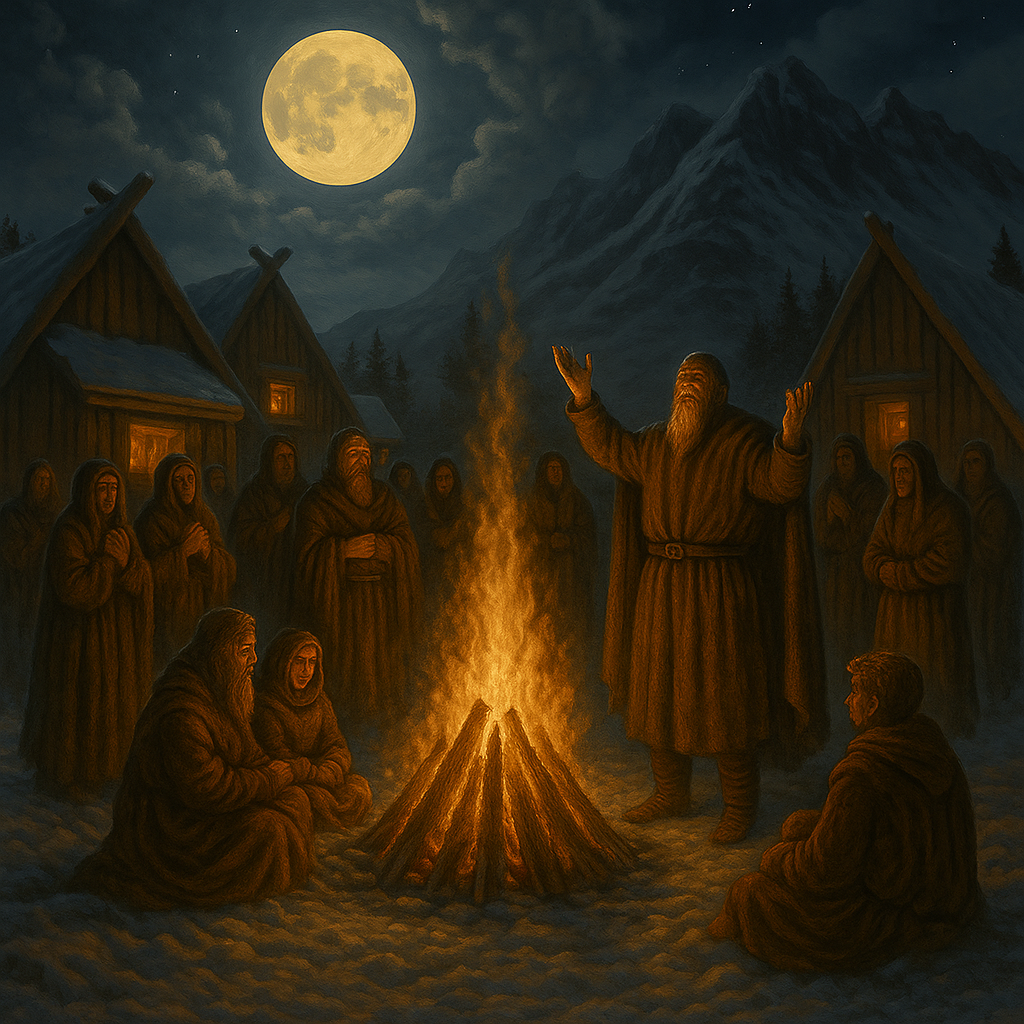
Many modern scholars believe that the most likely timing of Jólablót was the first full moon after the winter solstice. This idea comes from studies of old Scandinavian calendar systems, which show that many midwinter gatherings lined up with this full moon. The full moon also gave more light during the darkest time of year, which made travel between farms and halls safer. While this theory fits what we know about Norse timekeeping, it is still a reconstruction. No surviving source directly states that Jól had to be held on this full moon, but it is the timing that best matches the evidence we have.
One of the strongest clues that Jól originally followed a different date comes from the story of King Haakon the Good of Norway. Haakon ruled in the mid tenth century and had been raised as a Christian while living in England. When he returned to Norway to take the throne, he hoped to introduce Christianity in a gentle way. He understood that Norse people were deeply attached to their old customs, especially the midwinter feast of Jól, which was one of the most important gatherings of the year.
According to the saga writers, Haakon made a law that required people to celebrate Jól at the same time that Christians kept Christmas. This law appears in Hákonar saga góða in Heimskringla. The king ordered that people should brew ale for the new Christian feast and hold their winter celebration on the Christian date rather than the older one.
The very fact that Haakon needed to pass such a law shows that the traditional Jól was not held on 25 December. It took place at a different point in winter, most likely set by the moon. His new rule also tells us that changing the festival was not easy, because many people resisted the idea. Jól was more than a date. It involved honouring gods and ancestors, settling disputes, sharing food and ale, and keeping important bonds within the community. People did not want to break the rhythm they had followed for generations.
Haakon tried to lead by example, but the sagas say that at first he had to hide his Christian habits when attending old style feasts. He bowed to the wooden idols and followed the old customs so that he would not offend powerful families or stir up trouble. This shows how strong the older Jól traditions were. Even a king could not openly ignore them.
Over time, later kings used stronger measures to enforce Christian practices and the date of Christmas eventually replaced the older Jól calendar. Still, many features of the older festival survived. Traditions linked to ale brewing, midwinter feasting, gatherings of family and the sense of the darkest nights being a special time all continued within the Christian season. The two festivals slowly blended, but Haakon’s struggle makes it clear that the older Jól followed its own timing, most likely connected to the winter moon.
Different regions may also have held Jólablót at slightly different times. Areas further north, where winter came earlier and harder, may have adjusted their dates. Coastal communities, whose lives followed fishing cycles, may have used different patterns too. Variation was normal in Norse ritual life. What mattered was the season, the darkness and the meaning of the rite, not exact agreement on a single day.
Across all sources, one fact remains the same: Jólablót belonged to the deepest and darkest part of winter. It took place when the sun stayed low, storms were frequent, and life felt the most fragile. It was at this point that people needed the warmth of the hall, the support of their kin, the blessing of the gods and the presence of their ancestors.
Jólablót was not simply a date on a calendar. It was a moment in the winter cycle, the still point in the coldest part of the year, when people paused, came together, and carried out the rituals that helped keep their world in balance. It marked the time when darkness was deepest, but also when hope began to grow again with the slow return of the sun.
The Purpose of the Blót: Sacrifice, Blessing and Maintaining Cosmic Balance
To understand Jólablót, we have to understand the heart of any blót: the act of offering. A blót was not simply a feast, nor was it a moment of blind devotion. It was a binding exchange between humans, gods, ancestors and the unseen forces that shaped the world. In the Norse worldview, everything was based on reciprocity. Nothing came from nothing. Life flowed through give and take, promise and fulfilment. A blót was the ritual expression of that understanding.
The word blót itself carries meanings of sacrifice, worship and strengthening. The offering was not a payment but a renewal of bonds. It acknowledged that humans lived within a fragile, living cosmos where the powers of nature, luck and fate could not be taken for granted. The blót ensured balance. It reaffirmed respect. It maintained the thread between mortal life and the great forces beyond sight.
At Jólablót, this purpose became even more profound. Winter was a season of risk. The stores of food were shrinking. Storms could isolate farms for weeks. Darkness pressed against the walls, and the sun barely climbed into the sky. Every family understood that survival was not guaranteed. The gods who governed the cycle of the seasons, the ancestors who watched over the household, and the spirits of the land all had roles to play in whether the community would endure the coming months. Jólablót was a moment to strengthen those relationships.
The most traditional form of blót involved the slaughter of an animal. The blood, called hlaut, was considered powerful and sacred. It was sprinkled on the walls, idols and people using a branch or hlaut-twig. This was not symbolic decoration. Blood was life-force. To share it with the gods was to join the living and the divine in a single continuity. The meat of the animal was then cooked and eaten as part of the feast. The gods received their portion; the people consumed the rest. In this way, the blót was both sacred and communal. The whole community took part in the blessing.
But sacrifice was not only about giving something up. It was about inviting renewal. Jólablót asked the gods to return strength to the sun. It asked for good harvests when spring returned. It asked for protection against illness, hunger and misfortune. In mythic terms, it was a way of helping maintain the turning of the world. If the gods upheld their side of reality, humans upheld theirs. This balance was key to Norse cosmology.
Jólablót also had a strong connection to ancestral spirits. Winter was the season when the veil between worlds was at its thinnest, when the dead were closer. Offerings were made not only to gods but to family members who had passed on, to the dísir who watched over the bloodline, and to the land-spirits who protected the farm. In some traditions, a portion of the feast was set aside for these unseen guests. The dead were honoured and fed, invited to share warmth and light. In return, they offered luck, guidance and protection.
In many ways, Jólablót served as a renewal of the entire social and cosmic order. The darkest time of the year was not merely endured; it was transformed into a sacred interval. People gathered in halls lit by firelight. They shared roasted meat, strong drink and stories. They performed toasts to gods, ancestors and the future year. Through these acts, the community reaffirmed that they were not isolated individuals. They were part of something larger: a lineage, a landscape, a cosmos alive with intention.
Modern ideas of worship often focus on belief, but the blót focused on relationship. It was practical, physical and deeply woven into everyday life. To refuse to honour the gods or ancestors was to weaken the invisible ties that held life together. To perform the blót was to support the ongoing balance of the world, to keep luck moving, to stave off stagnation and harm.
In the context of Jólablót, this took on special meaning. The festival marked deepest winter and the turning of the year. It honoured the death of the old cycle and the fragile birth of the new. It asked for sunlight to return, for the storms to pass, for the year to grow strong. The blót was a way of placing human hands, human intentions, into the great cosmic machinery - helping ensure that the wheel of seasons continued its eternal turning.
Offerings of Jólablót: Food, Drink and Sacred Animals
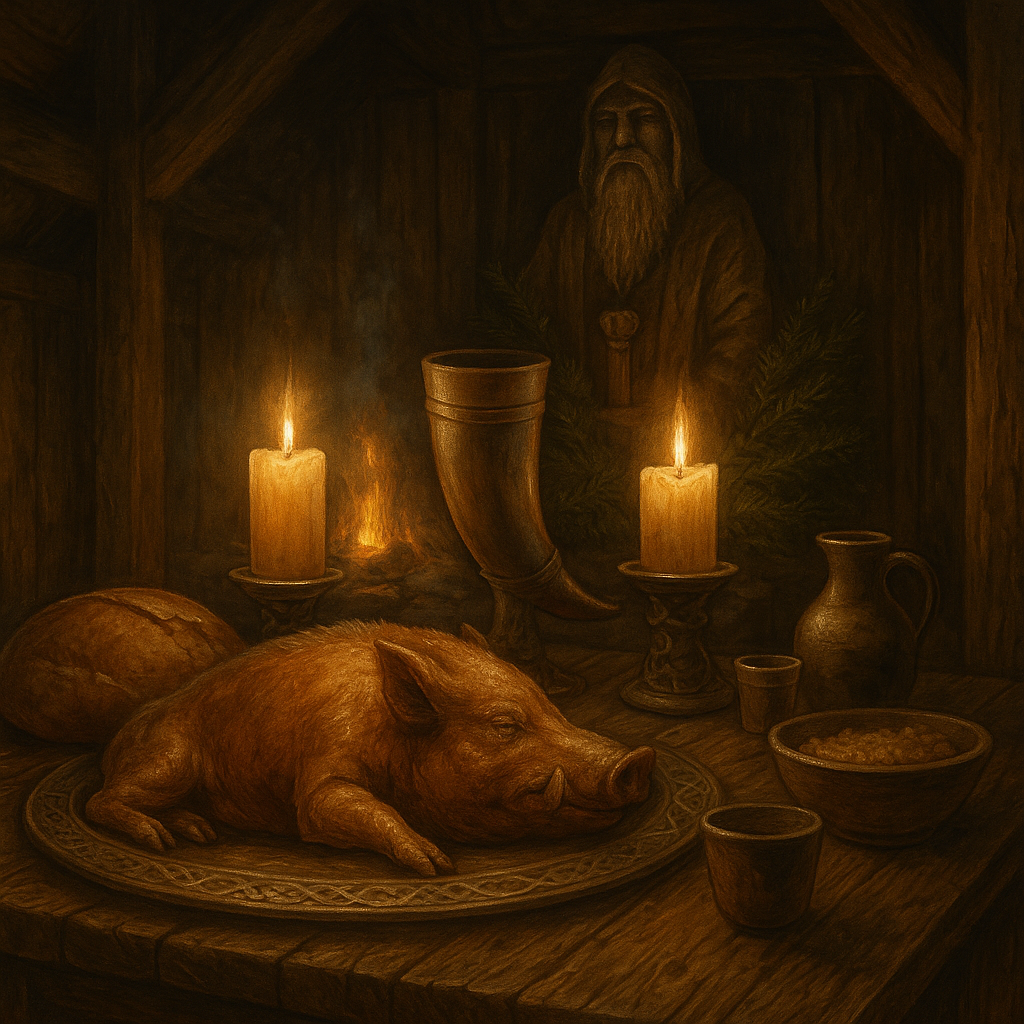
At the heart of Jólablót were the offerings themselves. These were not casual gifts or symbolic gestures; they were the lifeblood of the ritual, the means by which humans upheld their side of the cosmic relationship. What was offered during Jólablót reflected both the practical realities of winter and the deep spiritual logic of the Norse worldview. Every item placed upon the altar or shared in the hall carried meaning, memory and weight.
Food was the core of the offering. In a season when hunger was a real threat, giving food to the gods and spirits showed trust and devotion. Meat, grain and bread all played their part. The animal chosen for sacrifice was usually one that represented strength and prosperity. Pigs were especially important at midwinter. The boar had deep associations with fertility, abundance and the returning light, and its connection to the god Freyr made it one of the most meaningful offerings of the season. Eating the flesh of the sacrificed animal later in the feast symbolised a shared bond between humans and the divine.
Roasting meat on an open fire was more than a practical step; it was part of the ritual. The rising smoke carried scent and essence upward to the gods, while the heart of the animal was sometimes given as a choice portion. The blood was the most sacred element of all. It was sprinkled upon the walls, the statues of gods, the people taking part and the sacred items in the hall. This act did not simply bless; it united. Blood was life, and its presence in the ritual declared a renewal of the living bond between the human community and the powers that oversaw the world.
Drink played an equally powerful role. Ale, mead and strong beer were essential to Jólablót. Brewing was often done specifically for the festival, and the first taste of the new brew marked the start of the holiday. The drink was used in toasts, each one carrying a specific meaning. The first toast was usually to Odin, seeking wisdom, strength and good fortune. The second toast honoured ancestors and fallen kin. The third toast blessed the harvest and the year to come. Each cup was both an offering and a declaration, spoken aloud and witnessed by the community.
Sharing drink with the gods was a symbolic act of fellowship. It brought the divine into the hall as an honoured guest. It also reinforced the idea that the gods and ancestors were part of the human world during the darkest nights, sitting among the living through the power of spoken words and shared intention.
Grain offerings were also common during Jólablót. Bread, porridge and even small cakes were given to gods and spirits. In a time when agriculture was everything, grain represented survival and continuity. It connected the darkest days of winter to the promise of spring. In some traditions, a portion of grain was left for the house spirits or scattered outdoors for the land spirits, acknowledging their roles in protecting the farm.
One of the more intimate aspects of Jólablót offerings involved the ancestral dead. A share of the feast (meat, bread or drink) was sometimes left on a special table or hearth as a gift for those who had gone before. This was not seen as waste. It was understood that ancestors could bless or protect the family, and honouring them ensured that their favour continued. In winter, when the boundary between worlds was thin, such offerings were especially important.
Not all offerings were taken from the living stores. Some were crafted items: wooden carvings, woven goods, or small tokens of craftsmanship. These were less common at Jólablót but still carried meaning in households where the bond between craft, land and spirituality was strong. Handmade gifts symbolised time, effort and devotion - things just as valuable as food.
Every offering given during Jólablót served a purpose. It strengthened bonds with the gods who controlled fate and season, with the ancestors who guarded the lineage, with the land spirits who protected the farm and with the unseen forces that shaped luck. To give was to ensure the year would turn properly, the storms would pass, and life would continue. In the darkest part of winter, offerings were a way of keeping hope alive - not through blind faith, but through a shared and ancient understanding that the living must take part in the great work of sustaining the world.
The Jólablót toasts:
When we talk about ancient Norse Yule traditions, one of the most iconic practices is the series of ritual toasts described by Snorri Sturluson in Heimskringla. These “Yule toasts,” or jólskålar, formed the backbone of the Jólablót - the midwinter sacrificial feast. These toasts belonged specifically to the central feast, often an all night event that could spill into the following days.
According to Snorri, the Yule feast opened with a series of sacred drinks, each honoring a god or communal bond:
1. The Toast to Odin - Victory and Sovereignty;
The first cup was raised to Odin, king of the Æsir. This toast sought victory, strength and good fortune for the ruler and his people.
2. The Toast to Njord and Freyr - Prosperity and Good Seasons;
Next came a toast to Njord and Freyr, gods associated with peace, wealth, fertility, and safe seafaring. Their blessing was vital during the dark, risky winter months.
3. The King’s Toast / People’s Toast;
A communal toast followed, honoring the chieftain or king and reaffirming the bonds between ruler and community.
4. The Toast to Bragi - Celebration and Memory;
The fourth toast was made to Bragi, the god of poetry and storytelling, inviting eloquence, festivity and lasting memories into the hall.
5. The Oath Cup (Bragafull);
After the divine toasts came the moment of solemn intensity: warriors and esteemed guests laid hands on the oath cup and swore bold vows - promises to perform great deeds in the coming year.
6. Memorial Toasts;
Finally, toasts were made in honour of deceased ancestors and valued friends, acknowledging the presence of the dead within the circle of the living.
The Role of the Gods in Jólablót
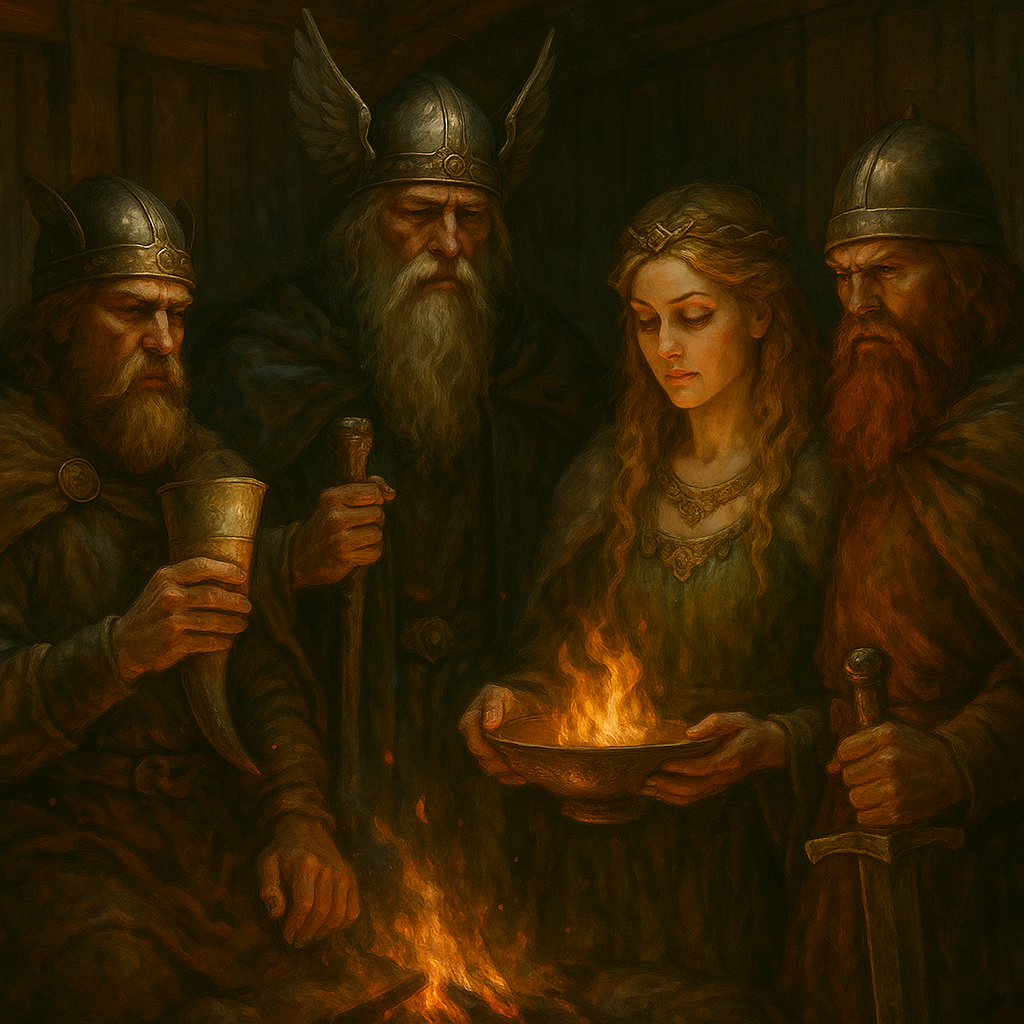
Jólablót was not a festival dedicated to a single god. It was a gathering point for many powers, each approached for their part in the survival of winter and the renewal of the year. In the Norse worldview, no god ruled alone. Each held influence over different aspects of life, and midwinter was a moment when their domains overlapped: fate, fertility, sunlight, protection, wisdom and the turning of time. Jólablót brought these threads together.
Odin often stood at the centre of the Jól toasts. As the Allfather, wanderer and master of wisdom, his presence during the darkest nights was both feared and honoured. Odin was associated with midwinter through his role as leader of the Wild Hunt and as a god who travelled between worlds. At Jól, he was invoked for protection, guidance and the strength to endure the remainder of winter. The first toast of the feast was frequently dedicated to him, acknowledging both his authority and his unpredictable nature.
But Odin was not the only god honoured. Freyr, the god of fertility, peace and prosperity, played an equally vital role. His blessing was necessary for the year to come. Without Freyr’s influence, crops would fail, herds would weaken, and spring would return grudgingly or not at all. Freyr’s sacred boar, Gullinbursti, is part of the reason the boar became such a powerful symbol of Jól. Eating the boar’s meat and dedicating a portion to Freyr ensured good harvests, healthy animals and renewed fertility in the land. In agricultural communities, he may have been the most important deity of the season.
Freyja was also honoured during Jólablót. As goddess of love, death, sorcery and household protection, her influence bridged both the living and the dead. Winter was a time when ancestors drew close, and Freyja’s presence connected families to those who had passed on. She was invoked for protection, luck in the coming year and the wellbeing of the household. In some traditions, Freyja received offerings alongside the dísir, the ancestral guardian spirits, who were especially active in midwinter.
Thor was not forgotten at Jólablót either. While he is more often associated with storms, protection and everyday luck, his strength was needed during a season when natural forces could easily overwhelm human life. Thor warded off malevolent spirits, protected livestock and shielded the homestead from harm. In parts of Scandinavia, Thor was the primary focus of winter blóts, especially among farming communities who valued his reliability and straightforward nature.
Other gods might also receive offerings depending on the region and local tradition. Njord for sea safety, Ullr for hunting success, or even local land-spirits who held sway over the farmstead. The Norse pantheon was not a distant court but a network of relationships. Each family honoured the powers most relevant to their daily life, and Jólablót amplified those bonds.
Crucially, Jólablót was not a one way act of devotion. The gods were not abstract beings who demanded worship for the sake of worship. They were partners in the survival of the community. The offering strengthened a relationship that had obligations on both sides. Humans provided sacrifice, respect and remembrance. The gods provided protection, luck and the natural rhythms that sustained life.
In this sense, the role of the gods in Jólablót was practical as much as spiritual. Their blessings were tied to real outcomes: the returning sun, the health of the herds, the fertility of the land, the survival of children and the protection of the home. To honour the gods at midwinter was to acknowledge that humans did not control everything. Some forces were larger, older and more powerful than any individual. Through the blót, the community aligned itself with these forces rather than opposing them.
Jólablót also emphasised the gods as keepers of cosmic order. Winter threatened to unbalance the world: darkness approached endlessly, activity slowed, illness spread, food diminished. The gods brought stability. Celebrating Jól with offerings reminded them and the community of their shared responsibility in maintaining that balance. Humans kept the fires burning, performed the rituals, and remembered ancient obligations. The gods in turn allowed the sun to rise again, the snows to melt and the world to continue.
The presence of the gods at Jólablót was therefore both intimate and immense. They were guests in the hall, receiving toasts and offerings, but they were also guardians of the cosmic cycle, ensuring that life would return after the long winter. Their varied roles (wisdom, fertility, protection, renewal) shaped the mood and meaning of the entire festival.
How Jólablót Shifted Under Christianity
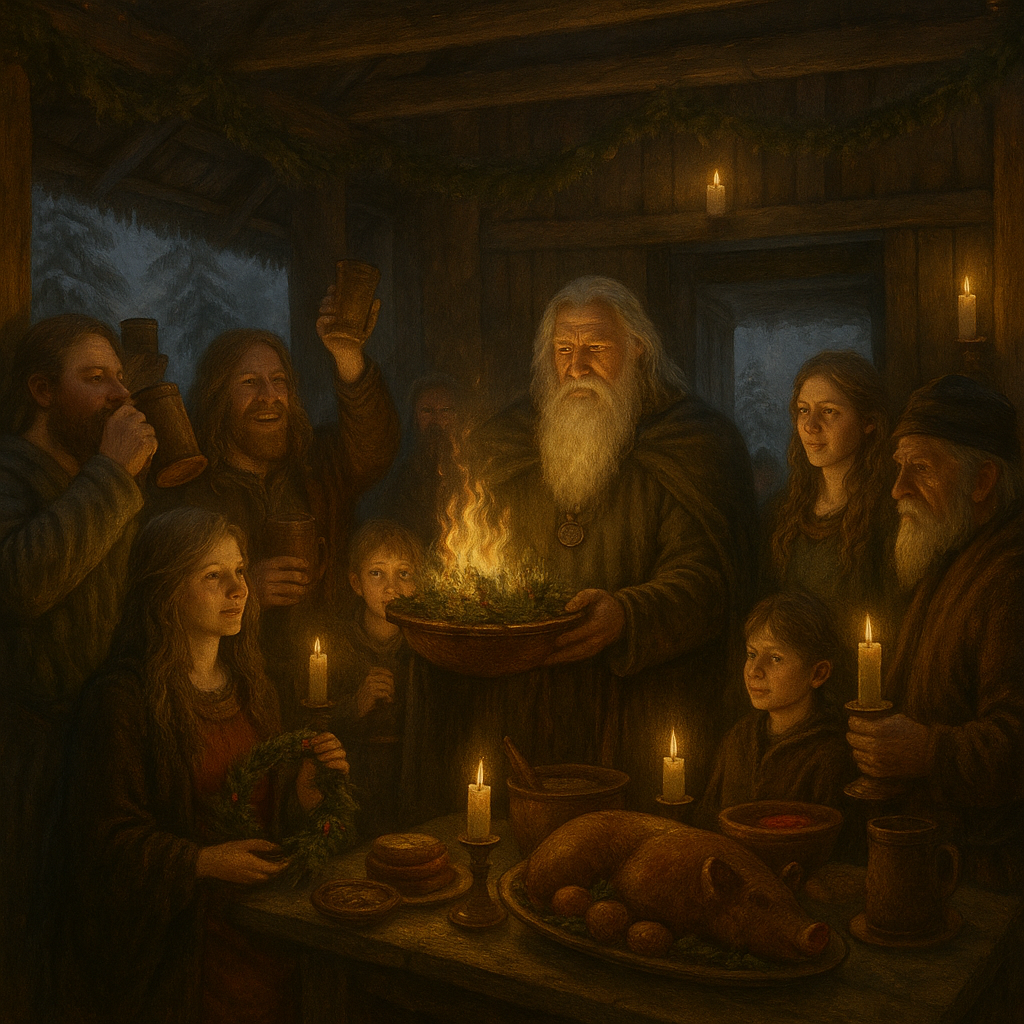
When Christianity spread through Scandinavia, it did not simply erase the older midwinter traditions. Instead, the two systems collided, merged, and reshaped each other over the course of several centuries. Jólablót, once one of the most important pagan festivals of the year, gradually changed form until it became the Christianised Yule and, eventually, the Christmas customs familiar in the region today. But beneath those later layers, the older spirit of Jól never fully disappeared.
The earliest shifts occurred at the level of law. As Christian kings gained power, they sought to replace pagan rites with Christian feasts. One of the clearest examples comes from King Haakon the Good of Norway in the mid-tenth century. According to the sagas, Haakon attempted to move Jólablót so it would coincide with the Christian celebration of Christ’s birth. He did this not only to promote Christianity but also to ensure the continuity of social gatherings, since people were deeply attached to their midwinter feast. The fact that the king had to enforce this shift suggests that Jólablót originally fell on a different date - one tied to the moon and the older seasonal rhythm.
Christianisation also targeted the blót itself. Animal sacrifice, once central to Jól, became forbidden under church law. Instead of offering blood to gods, people were encouraged to attend mass, light church candles and dedicate feasts to saints rather than to the old gods or ancestors. However, people did not abandon the feast altogether. They kept the drinking, the food, the gathering of kin and the sense of midwinter solemnity. Only the official meaning changed. The ritual structure remained, even as the religious interpretation shifted.
Ancestors, too, were gradually re-interpreted through a Christian lens. In the pagan tradition, the dead were believed to draw close during midwinter. Families left food, drink or a place at the table for them. With the spread of Christianity, such practices were discouraged or condemned as superstition. But the impulse to honour past generations persisted, transforming into visits to graveyards, lighting candles for the departed or holding quiet vigils during the dark nights. The behaviour survived even when the old explanations were replaced.
Certain midwinter spirits also shifted into new forms. House spirits and elves, once honoured with offerings, became folded into Christian folklore as nisser or tomtar - small, bearded helpers or tricksters who guarded the farm. The Christian world could not fully erase them, so they became less threatening and more domestic, appearing in stories as the keepers of barns, pantries and winter chores. What had once been sacred offerings became holiday treats left out for the household guardian.
The Wild Hunt, strongly associated with Odin, also persisted in altered form. Medieval Christian storytellers reinterpreted the Wild Hunt as a procession of cursed souls, demons or sinners doomed to ride forever. The leader of the hunt changed from Odin to various Christian figures or spectral hunters. Yet the essential image remained: a furious winter storm sweeping across the sky, accompanied by riders from another world. Even transformed, the old belief was recognisable beneath the new surface.
Over time, Christian priests and bishops sought to reframe Yule as a celebration of Christ’s birth. But they could not easily remove its older themes. Midwinter was still a time of feasting, kinship and storytelling. Fires still burned against the long dark. The idea of renewal, so central to Jólablót, survived in the Christian message of new hope. Even the practice of drinking a seasonal ale continued - only the toasts changed names.
Many elements of Jólablót eventually lived on in disguised or softened forms. The boar sacrifice became the Christmas ham. The midwinter ale became holiday brewing traditions. The twelve nights of Jól survived as the twelve days of Christmas. The idea that winter was spiritually dangerous persisted, even when wrapped in Christian morality tales rather than pagan cosmology.
By the Middle Ages, the old blót had officially ended, but its bones remained. Beneath Christmas feasts, family gatherings, winter rituals and folk beliefs, the structure of Jólablót continued quietly. It had changed shape, but it had not vanished.
In the modern era, especially with renewed interest in Norse history and pre-Christian belief, people now recognise how much of the old Jól lives on. The merging of pagan and Christian traditions created a winter season that carries echoes of both: the sacredness of midwinter, the closeness of the dead, the power of the returning sun, and the importance of community in the darkest time of the year.
Misunderstandings About Jólablót
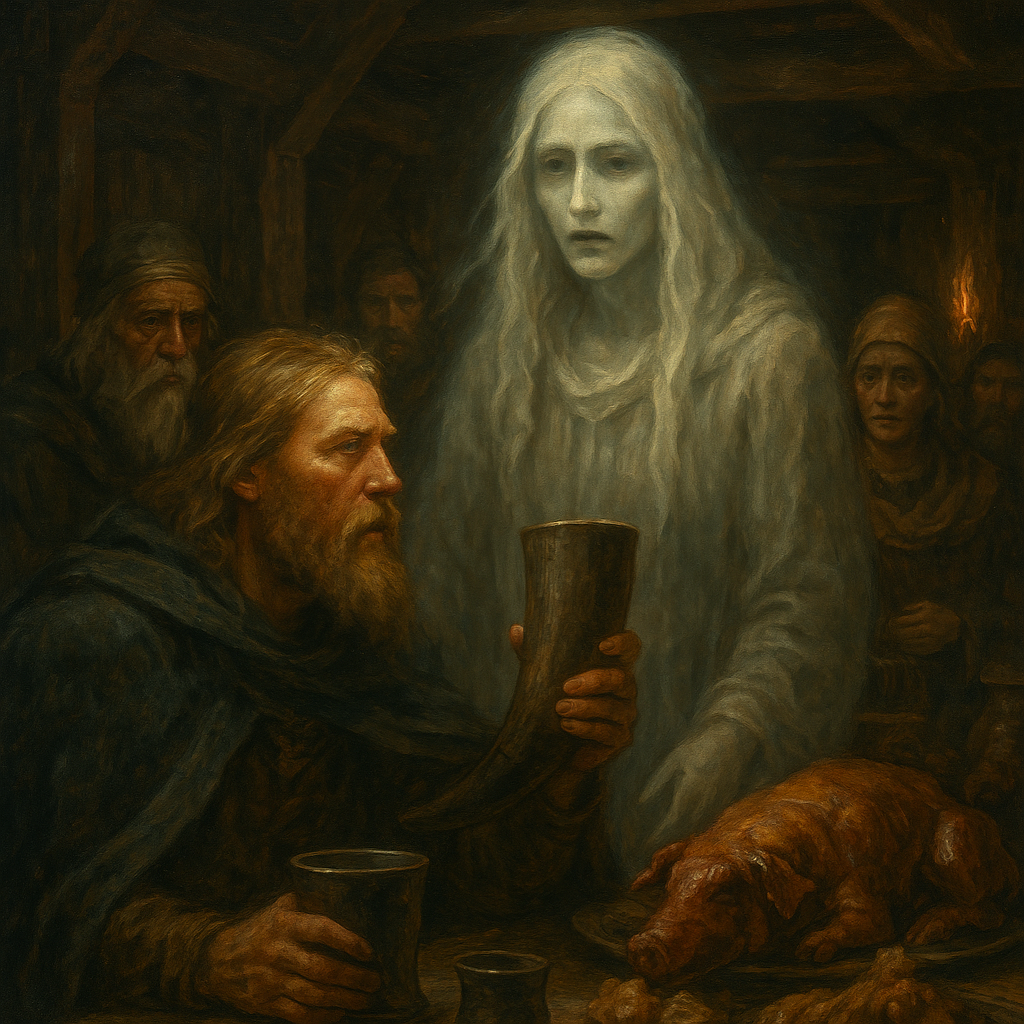
Modern ideas about Jólablót are often shaped by fragments of history, romanticised imagery and assumptions carried over from popular culture. Because so much of Norse tradition survives through later Christian sources, folklore, and reinterpretation, it is easy for misconceptions to spread. To understand Jólablót properly, it helps to clear away the myths that have grown around it.
One of the most common misunderstandings is the belief that Jólablót was a wild, chaotic festival centred entirely on drinking and violence. While ale and feasting were essential parts of the celebration, the event itself was structured, sacred and deeply meaningful. It was not a drunken free-for-all. It was a ritual designed to maintain the balance between humans, gods and the natural world at the most dangerous time of the year. Drinking was a ritual act, not mere indulgence. Toasts were made in honour of gods, ancestors and the coming year, and breaking an oath spoken over the ale cup was considered a grave moral failure.
Another misunderstanding is the idea that large-scale human sacrifice was a standard part of Jólablót. While isolated references in medieval texts suggest that human offerings may have occurred in rare or extreme circumstances, there is no evidence that they were a normal feature of midwinter rites. Animal sacrifice, especially of pigs and livestock, was the central offering. Human sacrifice is far more likely to have been ritualised in small, symbolic ways or exaggerated by Christian writers seeking to criticise pagan practices. Most communities relied on the practical offering of their food, drink and labour rather than the destruction of human life.
Jólablót is also often portrayed as a single, unified ritual across all of Scandinavia. In reality, the festival varied widely between regions, households and social groups. Some families focused heavily on ancestral offerings. Others emphasised the protection of land spirits or the fertility rites linked to Freyr. The timing, length and specific customs of Jól differed from area to area, shaped by local needs, climate and tradition. The idea of one fixed Jólablót ritual is a modern simplification.
Another misconception lies in the assumption that Jólablót was purely a religious ceremony with no social or practical importance. In truth, Jólablót was deeply intertwined with the rhythms of winter survival. It reinforced alliances, settled disputes, strengthened family bonds and ensured that the community faced the harshest months together. The feast was not only a spiritual act but a practical one: it boosted morale, redistributed food, and reaffirmed the bonds that kept a society functioning. To separate the spiritual from the social in Jólablót is to misunderstand how the Norse viewed the world.
It is also common to mistake Jólablót for an early form of Christmas. Although the modern Christmas season adopted many elements from older pagan customs, the two festivals began as very different things. Jólablót followed a lunar cycle rather than a fixed solar date. Its focus was on the ancestors, land spirits and gods of the old pantheon. Its meanings were tied to the turning of the year and the fragile renewal of life in the depths of winter. Only after Christianisation did these older customs shift, merge and adapt to fit the Christian calendar.
Popular depictions of Jólablót sometimes highlight extreme or sensational imagery: masked figures, wild hunts, animal headed costumes, or roaring bonfires lit for supernatural protection. While some of these elements have roots in medieval or later Scandinavian folklore, they were not necessarily part of the original blót. Many dramatic winter customs developed centuries after the ‘Viking Age’, shaped by Christian beliefs about ghosts, demons and the restless dead. The original Jólablót was likely simpler, more communal and more focused on offerings than spectacle.
Finally, there is a modern misconception that Jólablót was a festival only for warriors or nobles. In truth, it belonged to everyone. Every household, no matter how small, took part in midwinter rituals. Family blóts at the hearth were just as important as feasts in great halls. The gods of the old North were not distant figures accessible only to kings. They were woven into the daily life of farmers, herders, fishermen and families whose survival depended on the goodwill of the unseen.
By clearing away these misunderstandings, Jólablót becomes easier to see as it truly was: a ritual of renewal, gratitude and resilience, shaped by the rhythms of winter and the relationships that held Norse society together. The festival was neither savage nor simplistic. It was a complex, meaningful expression of how people understood the world, their place within it and the forces that stood between life and death in the darkest months of the year.
Why Jólablót Still Matters
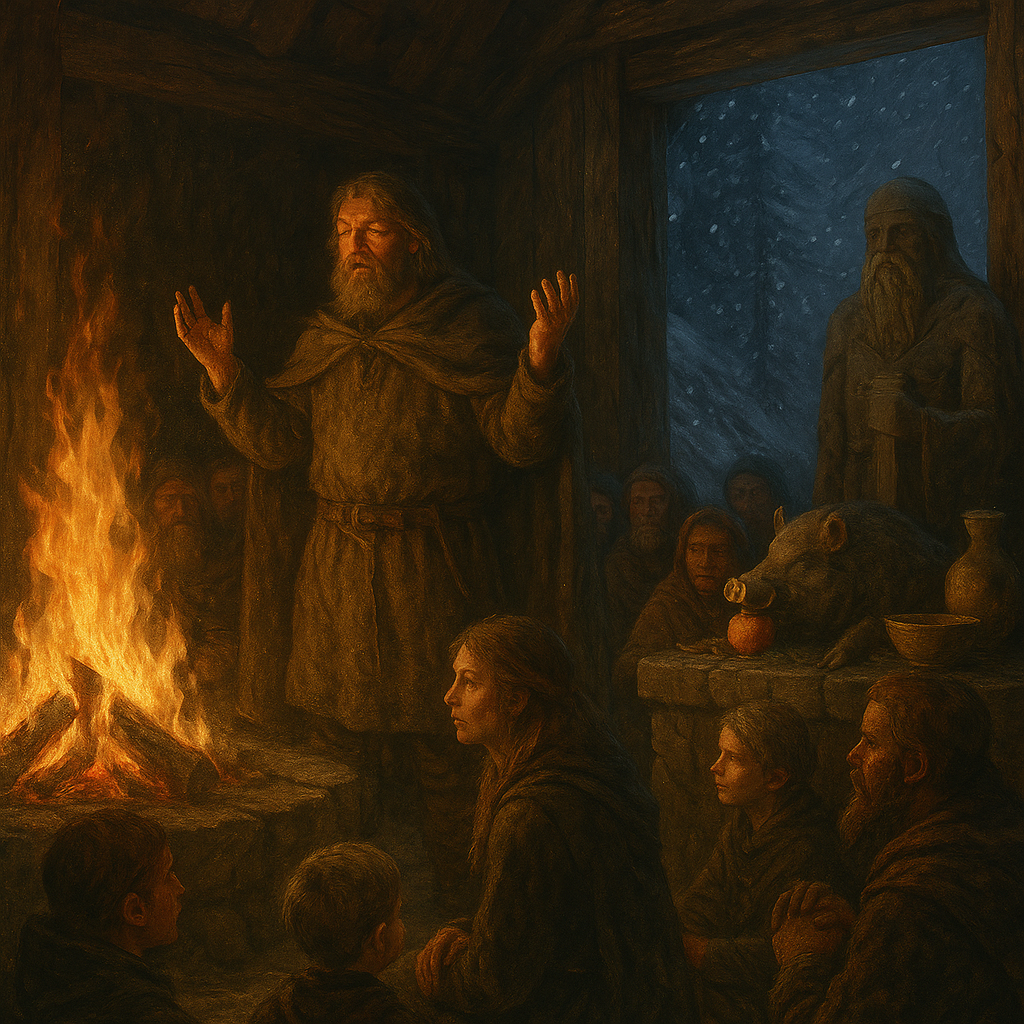
Jólablót may belong to the world of longhouses, firelit halls and frost-bright winters, but its heart still beats in modern northern culture and beyond. Even though the old sacrifices have faded, the themes of Jólablót continue to echo: renewal in darkness, honouring ancestors, strengthening the bonds that hold a community together, and recognising that life must be fed (spiritually, emotionally, and literally) if it is to continue.
At its core, Jólablót was about survival. Not just physical survival through winter, but the survival of luck, fortune, kinship and connection. The people of the North gathered at midwinter because they understood that hardship was easier to bear together. The rituals, feasts, songs and offerings were not just religious acts, but acts of solidarity. You shared warmth with others, and they shared it with you. This simple truth is still relevant now: winter is easier when people support one another.
The festival also reminds us of the importance of pausing. Midwinter was the point in the year when the old world paused in its darkness and waited for the returning light. The Norse didn’t rush this time. They embraced the night, honoured the stillness, and used the deep quiet to reflect on what needed to be released and what needed to be renewed. Jólablót teaches us that renewal begins when we accept the dark as part of the cycle - not something to fear, but something that prepares the ground for rebirth.
Jólablót also offers a powerful lesson about the dead and the living. Ancestors were invited, honoured and remembered not as distant figures, but as active members of the household. Their luck, wisdom and presence mattered. Even today, winter tends to bring reflection, nostalgia and the sense that those we have lost are somehow a little closer. Jólablót gives us a framework for this feeling, showing that remembering our ancestors is not just sentiment - it is part of maintaining the thread of identity.
Most of all, Jólablót matters because it shows how people once understood themselves as part of a larger, living world. Midwinter wasn’t a holiday invented for entertainment. It was an act of working with the world’s rhythms - acknowledging darkness, nurturing warmth, showing gratitude for life and preparing for the year to come. In a time when the world often feels rushed, disconnected and loud, the quiet wisdom of Jólablót feels strangely modern.
Midwinter, Memory and the Spirit of Jól
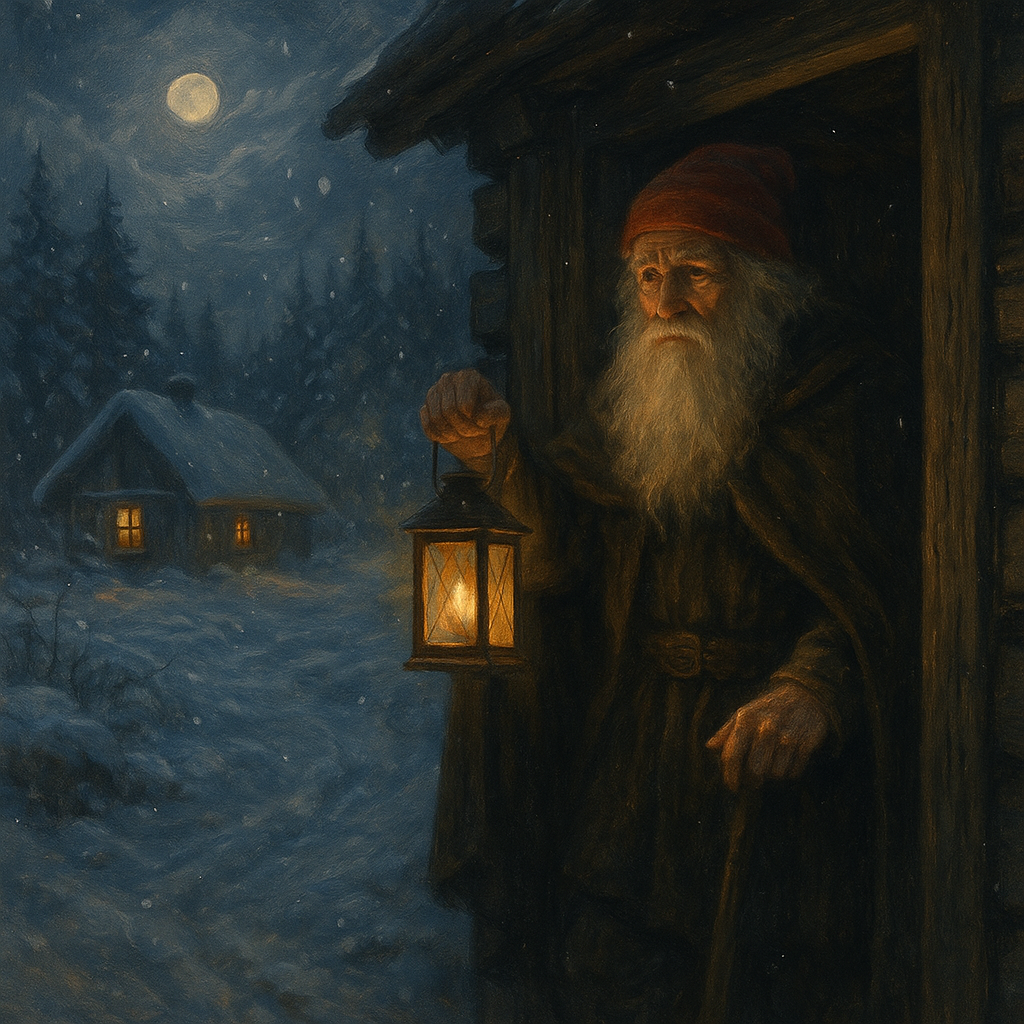
Midwinter has always been a season heavy with memory. In the old North, the darkest weeks of the year invited people to look backwards as much as forwards. The long nights, the quiet land, the bare trees and the cold all stirred something ancient - a sense that the past was close, that old paths were easier to see in the snow, and that the boundary between what has been and what is coming grew thin enough to touch.
This atmosphere is at the heart of the spirit of Jól. The festival was not only a celebration of survival or a plea for returning light. It was a time to remember. To think of the ancestors who had endured winters before. To acknowledge the stories, the struggles and the fortunes that shaped the family and the land. The dead were not believed to be distant; they were near, listening, watching, sometimes even joining the feast in the warmth of the hall. Jól carried a sense of continuity - a recognition that the living walk in the footprints of those who came before.
Memory also shaped the mood of the rituals. Every offering, every toast, every tradition repeated at the hearth was a way of linking generations. When a family slaughtered the Yule pig or brewed the season’s ale, they weren’t simply feeding themselves - they were maintaining a thread that stretched back into the deep past. In many ways, Jól was a festival of identity. It affirmed who you were because it reminded you of where you came from.
The darkness of midwinter helped this process. Without long days and constant labour, people had time to reflect on the year behind them — its victories, losses, mistakes and blessings. Winter forced stillness, and in that stillness the mind naturally turned inward. The Norse understood that the year could not begin again until the old one had been reckoned with. Memory was not a burden but a tool: something to learn from, honour and weave into the future.
The spirit of Jól also held a quiet hope. Even while honouring the past, families looked ahead to the longer days and the new cycle of growth. Memory and expectation sat side by side like guests at the feast. Jól reminded people that the world turns on a balance: night leads to day, winter to spring, old stories to new ones. The memory honoured during Jól was not meant to trap anyone in the past; it was meant to steady them as they moved into the unknown.
This mixture of remembrance and renewal is part of why the spirit of Jól still feels meaningful today. Midwinter continues to stir reflection, nostalgia and a longing for connection. People still gather with those they love, still mourn the absent, still retell stories of the year, still look ahead with cautious hope. Even in a world lit by electricity, the deep instinct remains: winter invites us to pause, remember and reconnect.
The spirit of Jól is not only ancient. It is human. It is the quiet understanding that we are part of a long story, shaped by those who came before us, and responsible for those who come after. Midwinter makes that truth easier to feel. In the stillness, the memory, the darkness and the returning promise of light, the old spirit of Jól continues its unbroken journey through time.