
Hodr: The Blind Avenger
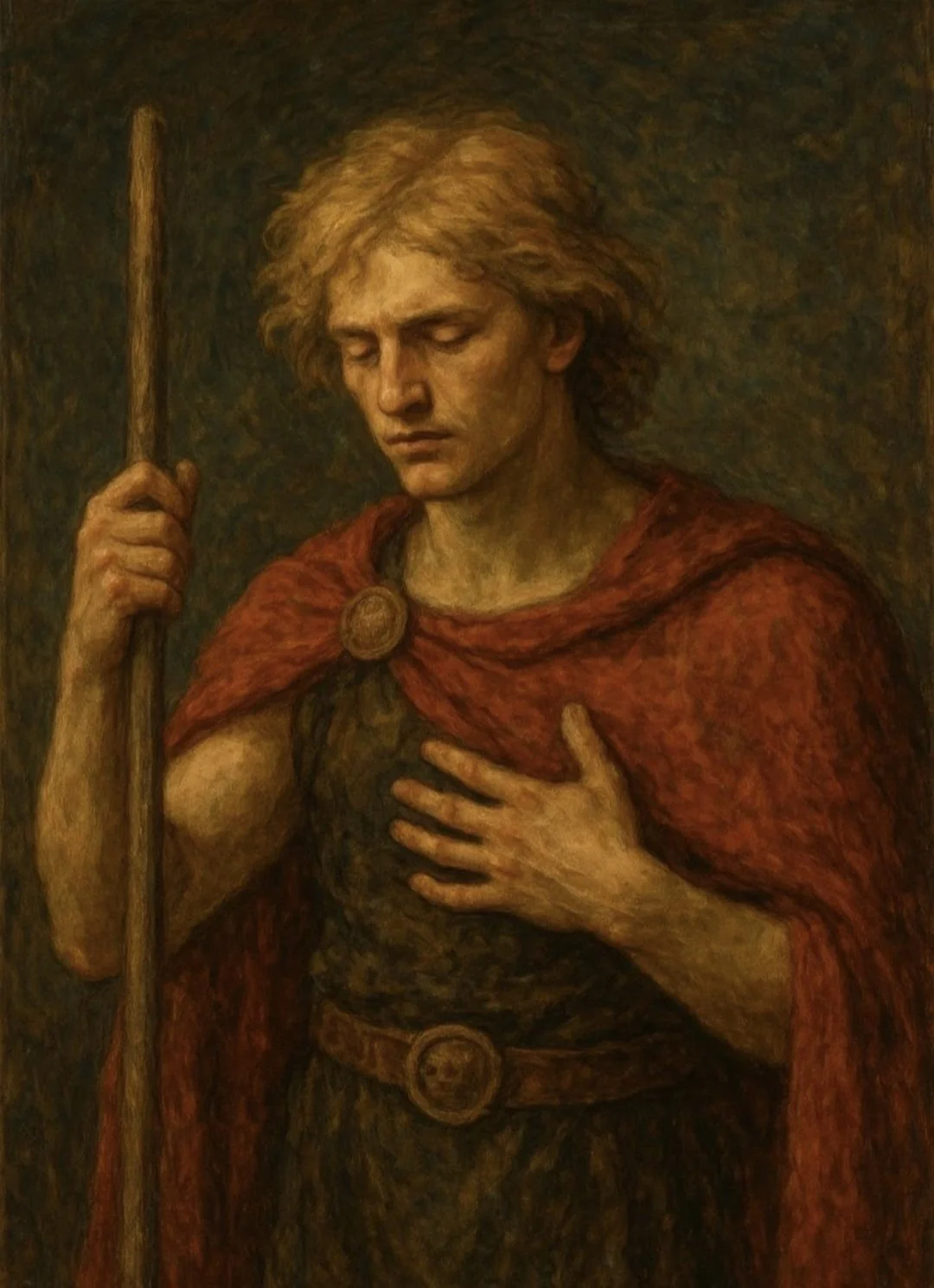
The brother cloaked in shadow, the god who moves unseen, the hand that fate wields without intent or malice.
Darkness That Sees
Hodr is the quiet shadow at the edges of the cosmos, the blind god whose absence of sight is matched only by the presence of inevitability. He is the brother of light, Baldr, and the twin of circumstance, a god who moves where others dare not tread. Born of Odin’s intellect and a maternal line lost to time, Hodr embodies the principle that not all power is luminous, not all influence deliberate, and not all consequences foreseen.
Unlike Thor, who strikes with hammer and fury, or Baldr, whose brilliance illuminates and enchants all, Hodr is the inevitability of fate made flesh. He acts without intent yet shapes the world profoundly. Where Meili tempers storms, Hodr channels the hidden currents of destiny, moving unseen, unseen yet unavoidable. His myth reminds gods and mortals alike that the universe is as much governed by shadow, silence, and inaction as it is by visible force.
Hodr’s existence is a meditation on perspective: that blindness does not equate to absence, that silence does not equate to impotence, and that consequence often travels through the hands of those who neither seek nor deserve it.
Darkness That Sees
Hodr is the quiet shadow at the edges of the cosmos, the blind god whose absence of sight is matched only by the presence of inevitability. He is the brother of light, Baldr, and the twin of circumstance, a god who moves where others dare not tread. Born of Odin’s intellect and a maternal line lost to time, Hodr embodies the principle that not all power is luminous, not all influence deliberate, and not all consequences foreseen.
Unlike Thor, who strikes with hammer and fury, or Baldr, whose brilliance illuminates and enchants all, Hodr is the inevitability of fate made flesh. He acts without intent yet shapes the world profoundly. Where Meili tempers storms, Hodr channels the hidden currents of destiny, moving unseen, unseen yet unavoidable. His myth reminds gods and mortals alike that the universe is as much governed by shadow, silence, and inaction as it is by visible force.
Hodr’s existence is a meditation on perspective: that blindness does not equate to absence, that silence does not equate to impotence, and that consequence often travels through the hands of those who neither seek nor deserve it.
The Essence of Hodr
Hodr is defined by duality. He is gentle yet tragic, passive yet pivotal, blind yet all-seeing in his way. His essence is the subtle tension between presence and absence, the quiet pressure of inevitability that runs beneath the surface of the Nine Realms.
Legends depict Hodr as kind-hearted, loyal to family and kin, and contemplative in his actions. He does not seek glory, for he is unaware of it; he does not crave vengeance, for he does not know harm. Yet through his simple existence, he embodies a force of cosmic consequence.
Hodr’s paradox lies in his innocence: his lack of knowledge, his blindness, his silence - these are not weaknesses, but conduits for fate itself. He is the quiet note in a symphony of gods, the pause in the storm, the shadow that shapes light. His story asks us to reflect on the power of unintentional acts and the depth of influence that arises from restraint, humility, and presence.
The Mythical Context
Hodr’s myth is inseparable from the tale of Baldr’s death, the single event that defines his legacy. Baldr, beloved by all, was made invulnerable to every substance in the cosmos except mistletoe. Loki, ever the trickster, exploited this single vulnerability, guiding Hodr to strike Baldr with the fatal sprig.
Hodr did not act from malice; he acted from ignorance and loyalty. He becomes the instrument through which tragedy unfolds, a stark reminder that the universe moves not only by choice but through inevitability. In this story, Hodr’s life demonstrates the cruel beauty of fate: that innocence can wield irreversible power, and that even the blind are capable of shaping destiny.
Yet Hodr’s myth extends beyond this tragic moment. He is said to have wandered the realms, moving through forests, mountains, and halls of gods with silent grace. Mortals and lesser beings may have sensed him as a fleeting shadow or a subtle disturbance in fortune, a presence that hints at consequence without announcing itself. Hodr’s story is not simply tragedy - it is a meditation on the inevitability that flows beneath all events, a silent reminder that all outcomes have agents, whether seen or unseen.
Hodr and the Gods: Interactions of Silence
The relationship between Hodr and the gods is complex, tender, and tragic. Baldr and Hodr represent the duality of light and darkness: where one radiates, the other absorbs; where one acts, the other waits. Their fraternal bond is marked by love, loyalty, and, ultimately, sorrow. Hodr’s innocence does not diminish his role in the universe; rather, it magnifies the tragedy of Baldr’s death, a moment in which love and fate collide.
Odin, ever cunning, saw in Hodr the potential for balance. While Baldr embodied perfection and visibility, Hodr embodied reflection and shadow. His existence served as a counterweight to brilliance, a necessary presence in the cosmic equilibrium. Thor, whose might often erupts like a storm, may have overlooked Hodr’s quiet strength, yet even he recognized the subtle weight of consequence that the blind god carried.
Interactions between Hodr and the gods highlight a central theme: influence does not require sight, recognition, or intent. Hodr’s silence allows him to observe, absorb, and participate in cosmic events in ways that are subtle but profound. Even Loki, whose trickery forever changes Hodr’s life, acknowledges the god’s inevitability: a force that can be used, yet never controlled.
Abilities and Nature
Though not a warrior in the traditional sense, Hodr’s abilities are profound. His blindness is not a limitation- it is a different form of perception. Some myths suggest he can sense currents of fate, detect unseen threats, and navigate the Nine Realms with absolute certainty. Hodr moves without hesitation, his awareness guided by intuition, presence, and the hidden flow of destiny.
Hodr embodies inevitability: the quiet power that moves through inaction, the strength that arises from being a conduit rather than an agent. His influence is subtle yet pervasive. When misfortune occurs, when the course of events shifts in unforeseen ways, Hodr is often the silent hand guiding outcomes, though he may never know it himself.
Legends speak of moments where his mere presence altered decisions, prevented errors, or intensified consequences. He acts not with intent, but through existence, demonstrating that true power can manifest without force, without recognition, and without malice.
The Tragedy of Baldr
The story of Baldr’s death is central to Hodr’s myth, and it exemplifies the delicate interplay of innocence, trust, and inevitability. Baldr, radiant and invulnerable, became the pride of the gods. Yet even his invulnerability had a flaw: mistletoe.
Loki’s cunning exploited this flaw. Guided by the trickster’s words, Hodr cast the sprig of mistletoe at Baldr, unaware of its potency. The blow fell, and Baldr died. The cosmos shuddered, and grief spread through Asgard like fire.
Hodr’s act was neither malicious nor heroic it was the quiet inevitability of tragedy. The gods mourned, Loki fled, and Hodr was left as the embodiment of sorrow, guilt, and the unseen hand of fate. He teaches that innocence can shape destiny and that power does not always require understanding. In the story of Baldr, Hodr becomes a mirror of cosmic inevitability: blind, silent, and tragic.
Hodr and the Mortal World
Hodr’s influence extends beyond gods and into mortal lives. Travelers, warriors, and kings occasionally sense the silent hand of consequence, the subtle shadow that shifts fortune, alters events, or directs outcomes. He does not intervene with intent, but his presence can guide, test, or redirect paths.
Hodr embodies the principle that life is shaped not only by deliberate action but also by circumstance, chance, and unseen forces. His story teaches mortals humility, patience, and reflection: that outcomes are rarely neutral, and that even the innocent can wield great power. He is the god of unintended consequences, a shadow that ensures life’s complexity is preserved, even if unknowable.
Hodr and the Cosmic Balance
Hodr is the counterweight to brilliance, action, and light. Without him, the perfection of Baldr would lack contrast, the fury of Thor would lack pause, and the schemes of Odin would lack consequence. Hodr reminds the cosmos that balance requires shadow, restraint, and inevitability.
His presence teaches that power is not always exercised through action; it can manifest through passivity, silence, and restraint. By embodying consequence, Hodr ensures that light and action have meaning, that choices carry weight, and that destiny moves through channels both seen and unseen.
Hodr and the Shadows
Hodr’s connection to darkness is both literal and symbolic. Blindness allows him to inhabit the liminal spaces of reality: the thresholds between life and death, light and shadow, knowledge and ignorance. He moves where gods hesitate, observes where others act, and acts where events dictate.
The shadows are his domain: the quiet moments before revelation, the pause before catastrophe, the unseen threads that tie cause to effect. Hodr teaches that shadows are not absence - they are context, depth, and the space in which consequence breathes. He reminds gods and mortals alike that understanding comes not only from light but from the darkness that shapes it.
Lessons of Hodr: Power in Innocence
Hodr demonstrates that strength and influence are not always visible. Blindness, silence, and restraint are forms of power as profound as sword, hammer, or cunning. He embodies the truth that consequence travels through all hands, whether aware or unwitting, and that inevitability requires no malice to act.
Through Hodr, we learn patience, humility, and acceptance. His life teaches that understanding one’s role in the cosmic weave is more important than controlling it. Even inaction carries power, even silence carries weight, and even the blind can shape the course of history.
Hodr as a Symbol of Fate
Hodr embodies the principle that destiny often operates independently of intent or awareness. In mythological symbolism, he represents the forces that govern life and death beyond comprehension or control. While other gods act and are celebrated for their deeds, Hodr reminds us that the universe is shaped equally by the quiet inevitabilities - by the moments that pass unnoticed, by the choices made in ignorance, and by the currents of circumstance that no mortal or god can fully see.
His blindness is metaphorical as well as literal: the unseen forces of consequence move through the cosmos just as invisibly. In this way, Hodr is a living allegory of fate itself: impartial, unavoidable, and profoundly influential.
Hodr and the Philosophy of Inaction
Inaction is often misunderstood as weakness, but Hodr teaches a different lesson. His life demonstrates that restraint, observation, and silence can wield power equal to, if not greater than, overt action.
Philosophically, Hodr embodies the subtle potency of passivity: the way consequences ripple from mere presence, the role of the observer in shaping outcomes, and the moral complexity of unintended results. He illustrates that sometimes the most profound interventions in life are those that occur without intention, shaping history not by force, but by existence itself.
The Poetics of Blindness
Blindness in Hodr’s myth is not a limitation; it is a lens. It allows him to perceive what others cannot: the interwoven strands of destiny, the subtle movements of fortune, and the inevitability of death and sorrow.
Hodr’s perception is quiet yet penetrating. He is aware of flows of fate that others, even the wisest of gods, cannot see. Through this, his myth evokes the poetic idea that understanding does not always come from sight or reason, but from presence, intuition, and attunement to the hidden rhythms of the world.
Hodr and the Human Condition
Hodr mirrors the experience of mortals in their own lives. Every person carries the capacity to affect outcomes unknowingly, to act as agents of consequence without full understanding. Hodr’s story reminds humanity that innocence, mistakes, and inaction are part of the complex weave of existence.
In mortality, as in the cosmos, unintended actions can have reverberating effects. Hodr is a guidepost for humility: he teaches that everyone touches the world in unseen ways, and that life’s balance relies as much on the quiet as the celebrated.
Hodr in Mythological Comparison
Hodr’s story and nature are not unique to Norse mythology; he embodies archetypal themes found across cultures - the blind, silent, or unintended agent of fate, whose influence is profound despite apparent passivity. Comparing him to similar figures in other mythologies highlights the universality of his role:
- Oedipus (Greek Mythology): Like Hodr, Oedipus acts unknowingly with catastrophic consequence. Both are blind to critical truths: Oedipus metaphorically (and later literally), Hodr literally. Their stories emphasize the tension between innocence and the inevitability of fate.
- Moirai / Fates (Greek Mythology) : The Greek Fates spin, measure, and cut the threads of life, often indifferent to human desires. Hodr’s inadvertent role in Baldr’s death mirrors their impartiality: the universe moves through him, yet he is neither malicious nor fully aware.
- Anubis (Egyptian Mythology): While primarily a guide to the dead, Anubis moves between worlds silently and without fanfare, overseeing the transition of souls. Hodr, similarly, inhabits thresholds between life, death, shadow, and consequence, embodying the liminal power of the unseen.
- Blindfolded Justice / Lady Justice (Roman / Western Symbolism): The blindfold symbolizes impartiality. Hodr exemplifies a divine version of this principle: the blind god acts as a conduit for balance, demonstrating that consequences need not be controlled or even understood to shape outcomes.
- Yama (Hindu Mythology): As god of death and dharma, Yama enforces cosmic law impartially, overseeing life’s moral and fatal consequences. Hodr likewise functions as a silent enforcer of inevitability, his actions shaping destiny in ways beyond comprehension or intent.
Through these comparisons, Hodr emerges as a recurring archetype: the blind agent of fate, consequence, and balance, whose power lies not in intent, strength, or recognition, but in existence as a conduit of inevitability. Across cultures, myths recognize the quiet yet unstoppable force of unseen hands, and Hodr embodies this archetype within the Norse cosmos.
Hodr’s Legacy in Modern Interpretation
Hodr has inspired modern reflections on ethics, leadership, and responsibility. In literature and philosophy, he is often invoked as a symbol of the unintended consequences of human action, the moral weight of innocence, and the unseen threads that connect events.
In contemporary storytelling, Hodr reminds us that tragedy is not always born of malice, that agency can be unconscious, and that the blind hands of fate shape our world just as decisively as deliberate choice.
The Death of Hodr
In Ragnarok, Hodr meets his end. Some sagas describe him slain by Vali, avenger of Baldr; others depict him falling amid the fire and flood that consume the old order. His death is both tragic and inevitable, a reflection of the forces he has always embodied.
Even in death, Hodr’s role persists. He is a reminder that fate moves through all hands, that consequence flows through both action and inaction, and that the blind, the silent, and the overlooked often leave the deepest marks on the world.
Epigraph: Shadow and Silence
Silent he moves, where light cannot dwell,
Blind yet seeing, in the weave of fate’s spell.
Brother of brilliance, kin to despair,
He carries the weight the cosmos must bear.
Closing Reflection: The Blind Hand of Fate
Hodr walks in shadow, yet his presence is undeniable. His myth teaches that inevitability and consequence are as potent as thunder or lightning. Even without sight, even without intention, his actions shape worlds, reminding gods and mortals alike that the universe is orchestrated not only by strength or will but by inevitability, circumstance, and unseen hands.
Hodr embodies the truth that absence is as meaningful as presence, that silence carries weight, and that even the blind can guide, alter, and define the course of history. His story whispers across the Nine Realms: power, consequence, and fate do not always require eyes to see, words to speak, or hands to strike.
Inspirational Closing
Hodr teaches us that power is not always loud, and influence does not always demand recognition. Even in blindness, silence, and inaction, there is agency. Our lives, like the Nine Realms, are shaped not only by the choices we intend but also by the currents we unknowingly enter. In every shadow, there is meaning; in every quiet act, there is consequence; in every hand that does not see, there is the potential to guide fate.
So, pause and reflect: Where in your own life might the unseen hand of consequence be moving, shaping outcomes in ways you do not yet understand? How might your quiet presence, your restraint, or even your mistakes ripple through the world in unexpected, powerful ways?
Walk forward with awareness, humility, and courage. Let the lessons of Hodr remind you that the unseen is never empty, the silent is never powerless, and that even the blind can leave a mark that echoes through eternity.
- Wyrd and Flame 🔥
