
Njörun: She Who Walks the Quiet Between Tides
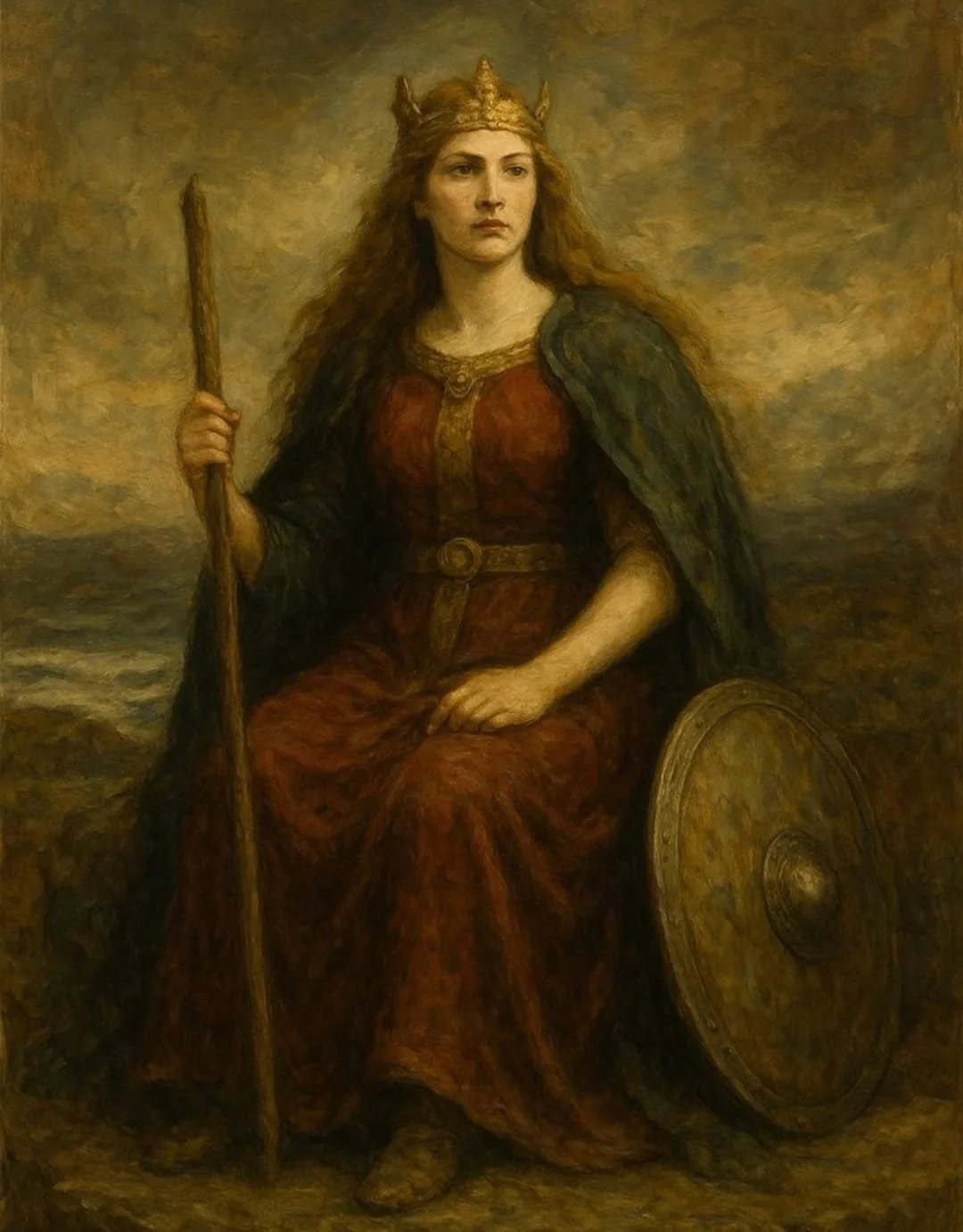
“Night is her mantle. Stillness is her crown. And where silence deepens, she stands.”
***NOTE*** Njörun is considered a real deity within the context of Norse mythology, though she is an extremely obscure figure with very little surviving narrative information. Her existence is primarily attested through brief name-drops in medieval Icelandic literary sources, such as the Prose Edda and skaldic poetry.
Introduction
In the vast expanse of Norse mythology, some gods and goddesses thunder across the pages of the sagas, their names shouted in battle and etched into legend. Then there are those who exist in whispers, in the spaces between story and silence. Njörun is one such presence. Almost lost to time, her name survives only in fleeting skaldic references, yet the power she embodies is profound. She is the quiet before the tide, the pause between heartbeats, the unseen current guiding both gods and mortals.
Njörun is not a goddess of spectacle or conquest. She dwells in liminal spaces - the thresholds where clarity arises, where decisions are contemplated, where fear softens into insight. Her dominion is subtle, her influence intangible, but it shapes the world as surely as wind shapes waves. To know her is to learn the art of attention, the power of patience, and the sacredness of stillness.
In exploring Njörun, we uncover a goddess of quiet endurance, hidden roads, and silent guidance - an almost forgotten presence whose whispers still echo in the rhythms of life
The Goddess Almost Lost to Time
Njörun is one of the most elusive names in the Norse pantheon, almost a ghost in the surviving texts. She appears only in skaldic kennings, never in the loud epics of battle or doom. Her presence is a shadow at the edge of myth, a whisper the sagas barely catch. Yet the Old Norse poets spoke of her with the same reverence they used for the great goddesses. The fact of her name is itself a testament: she existed in the mythology long before the sagas chose to forget her. Njörun is not erased; she is unspoken.
Her obscurity does not lessen her importance; in fact, it emphasizes it. Myths remember what is shouted, but they also preserve what is whispered. Njörun’s quiet presence reminds us that not all divine power is announced with drums or horned helmets. Some power lives in the spaces that words fail to describe, in pauses that the skalds could not fill. She exists in the peripheral vision of mythology, a constant hum behind the stories of heroes and kings.
This silence also makes her infinitely adaptable. Njörun is less a figure frozen in one tale than a presence felt in myriad circumstances - waiting at the edges of perception, attending to those who walk unseen paths, witnessing events without intervening with force. It is perhaps this very quality that allowed her worshippers, long forgotten, to carry her essence in their hearts even as the texts failed to record her.
Her name, her being, and her influence are threads woven into the tapestry of the cosmos, so subtle that only those attuned to quiet could sense them. Njörun is the kind of goddess whose absence from the loud chronicles of history is itself a testament to her domain: the space between, the silent current, the unnoticed power that shapes worlds without claiming glory.
Even in her near-invisibility, she embodies a kind of eternal vigilance. Where others wielded thunder or sword, she guarded the soft edges of life - the pause between heartbeats, the margin of reflection, the unseen threshold between decisions. Njörun’s significance lies in what she preserves: the quiet, the hidden, the enduring essence of the living world.
The Vanir Bloodline
Believed to be of the Vanir, Njörun belongs to the lineage of gods tied to nature’s flow - fertility, sea, wind, prophecy, and the deep harmonies that sustain existence. The Aesir moved through the world with force; the Vanir shaped it through relationship. If Freyja embodied passion and Freyr embodied prosperity, Njörun embodied the quiet that nurtures both. She is the still water that allows the sun to reflect. The dusk that softens the edges of grief. Vanir by birth, but of a temperament entirely her own.
Her connection to the Vanir suggests that she is intertwined with cycles of growth and reflection. While her siblings might command the wind or bless the fields, Njörun ensures the spaces in which life’s changes are processed and absorbed. She governs the silent intervals in which seeds germinate, tides shift, and human hearts comprehend their own depth. Her Vanir lineage gifts her a subtle authority - one that works not through demonstration of strength, but through orchestration of balance.
The Vanir are often associated with abundance and the rhythms of nature, yet Njörun’s specialty is the rhythm of stillness itself. Where Freyja’s power moves outward into desire and Freyr’s into prosperity, Njörun moves inward, shaping the unseen currents that allow both passion and wealth to manifest in harmony. She is the silent pulse underlying the world’s growth, a force so necessary it is rarely recognized, but always felt.
Her temperament, unique even among the Vanir, is reflective rather than reactive. She observes, she attends, she absorbs, and in doing so she harmonizes the extremes of divine power. While others intervene directly in mortal affairs, Njörun’s interventions are subtle, invisible, and transformative, guiding not through command but through attunement. Her influence is quiet, yet no less potent for its subtlety.
Finally, her Vanir nature reminds mortals that the cosmos contains not only drama and heroism but also reflection, patience, and attentiveness. Njörun embodies the principle that even divine beings must honor the pause, the waiting, the quiet mediation that allows life to flourish. Her heritage roots her in cycles both human and natural, connecting her directly to the rhythms that shape the seen and unseen worlds alike.
The Meaning in Her Name
Her name is a mystery. Some scholars hear it echoing the sea-god Njörðr, hinting at a feminine counterpart or cosmic twin. Others detect roots suggesting “night,” “concealment,” or “earth-bound silence.” But the sagas never clarify. Perhaps this ambiguity is purposeful. Njörun is a goddess of thresholds - those liminal spaces where meanings blend, where language falters, where truth is felt rather than spoken. Her name is less a word and more a sensation: the hush before moonrise.
Her name’s ambiguity mirrors the nature of the goddess herself. In a pantheon often defined by clear roles and grand gestures, Njörun’s essence is intentionally amorphous. It suggests that she exists not as a fixed identity, but as an experience, a sensation, a presence perceived more than described. Her name acts as a vessel, carrying multiple potential meanings without committing to any single one.
The potential link to Njörðr implies a balancing principle within the Vanir. If Njörðr governs prosperity and the bounty of the sea through action, Njörun governs the reception of that bounty through stillness. She represents the counterpart to visible forces, the subtle hand that harmonizes and integrates the gifts of her divine kin. Her name is thus not only symbolic of silence but also of equilibrium.
The linguistic traces of night, concealment, and quiet suggest that Njörun governs spaces both literal and metaphorical: the darkness before dawn, the reflective surface of water, and the internal depths of thought and emotion. Her name signals her dominion over thresholds where insight emerges quietly, unforced, and unobserved by those not attuned to the subtle rhythms of existence.
Ultimately, Njörun’s name is a testament to her function: she exists to mediate, to attend, to guide in the spaces between action and consequence, presence and perception, sound and silence. The very fact that it defies easy definition emphasizes her role in myth as the goddess who cannot be contained, only encountered.
The Realm She Walks
Njörun’s domain is not a hall of gold or a fortress of fire. Her realm is the space between sea and shadow. She moves where twilight meets water, where the tide withdraws into quiet, where the world’s noise dissolves into its essence. Some called it the Night-Tide. Others whispered that she walked on the surface of dark lakes, her reflection appearing only to those prepared to learn from it. She ruled where boundaries fade, and it was in these fading points that her power was most felt.
Her realm is as much psychological as it is physical. To enter Njörun’s space is to inhabit the liminal: the pause between waking and sleeping, the threshold between doubt and clarity, the place where decisions are made and yet not yet committed. These are spaces where insight emerges quietly, unnoticed until the consequences ripple into the world. The “Night-Tide” is a metaphor for these processes, a current that both conceals and reveals, carrying lessons in silence.
The geography of her realm is mutable. Some tales hint at forests shadowed with twilight, lakes that mirror the moon perfectly, and ocean coves that seem to exist outside of time. Travelers who feel her presence often report disorientation, a sense of being in a world both familiar and profoundly unfamiliar. This realm is one where perception is heightened, where the ordinary becomes charged with significance, and where mortal beings confront truths too subtle to be seen by the unobservant.
Njörun’s dominion is not a place of isolation but a space of revelation. She guides those who step into these thresholds, allowing them to perceive the hidden layers of existence. Mortals may never fully map her realm, but they feel its contours in moments of insight, meditation, or instinctual understanding. It is a sacred geography, internalized in the consciousness of those attuned to her rhythm.
Her power in this space is magnified by its intangibility. Unlike realms defined by walls, riches, or fortresses, Njörun’s territory exists in perception and attention. Those who recognize it are granted clarity, patience, and the ability to perceive connections hidden to the ordinary eye. In essence, her realm is the stage upon which the quiet divine performs its subtle work, shaping the world without intervention or spectacle.
Powers of the Quiet Divine
Njörun’s might was subtle, but subtlety is not weakness. She governed stillness - the force that allows transformation to root. Where other goddesses wielded magic or battle-runes, Njörun wielded the pause. She calmed storms not with command but with presence. She softened fear simply by existing. To those who sought her, she offered not answers but clarity, not miracles but alignment. Her power was the power to stop the world long enough for someone to truly see it.
Her power is relational rather than coercive. Njörun does not act on the world with force; she acts on perception, shaping awareness to bring harmony and clarity. By doing so, she touches both mortals and gods, subtly influencing choices and events without ever demanding obedience. The quiet divine is thus an active power, not passive, creating change through the cultivation of presence and attention rather than through overt action.
She also governs the transformation of fear into insight. Where chaos or uncertainty might paralyze, Njörun’s stillness provides a stabilizing presence. Mortals, sailors, wanderers, and dreamers report a calming force, a steadying influence that allows them to approach danger or complexity with measured awareness. Her dominion over stillness is a protective and transformative force, one that prepares beings to act when the time is right.
Njörun’s power manifests most vividly in liminal moments: before dawn, at crossroads, during periods of grief, or while making crucial decisions. In these moments, her presence allows a clarity that cannot be forced, only felt. She is the invisible hand that pauses the universe long enough for wisdom to emerge, making her influence pervasive yet imperceptible.
Ultimately, Njörun teaches that true divine power does not always shout or dominate; sometimes it whispers, waits, and opens the space for life to reshape itself. In doing so, she models a form of strength that is subtle, enduring, and transformative - a quiet force that enables growth, reflection, and insight.
Patron of Hidden Roads
Travelers once invoked Njörun at dusk, when the road ahead blurred into shadow and decisions grew weighty. She guided not through revelation but through intuition. The wanderer who listened carefully would notice the way a path seemed slightly clearer, a danger slightly dimmed, a thought within rising like a tide. Njörun did not show the road; she awakened the traveler’s ability to find it.
Her guidance was subtle yet transformative. It was not a map in the conventional sense, nor was it a set of instructions. Instead, it manifested as a heightened awareness: the scent of the wind, the whisper of leaves, the faint glow of the moon illuminating the safest step. Travelers learned to trust their instincts as extensions of her presence, understanding that the world could be navigated without overt signposts if one was attuned to the quiet patterns she fostered.
Njörun’s protection extended beyond physical travel. The hidden roads she governed were often internal as well - passages through fear, uncertainty, and grief. Those who turned to her found the courage to move forward even when the next step was invisible, and to trust the currents of their own insight. Her patronage suggested that the greatest journeys are often the ones taken through self-reflection and silent discernment.
She was also a goddess of timing. The paths she illuminated were only visible when one was ready, appearing in moments when patience and attention were cultivated. To rush or demand clarity prematurely risked missing the subtle guidance she offered. In this way, Njörun taught mortals that progress often requires waiting, watching, and attuning oneself to the rhythms of the world.
Ultimately, invoking Njörun meant entering into a partnership with the unseen. The road was never hers to walk for mortals; it was theirs to discover, with her presence as a silent companion, a softening force, and a guide who spoke through the quiet rhythms of the universe.
Tales the Skalds Half-Remembered
No grand saga centers on Njörun, yet fragments survive in the oral dust. Old storytellers murmured of a woman who walked into the sea at midnight and returned with her eyes filled with stars. Another tale speaks of a solitary goddess who visited the dreams of fishermen caught between life and wave, teaching them how to read the darkness itself. These are not heroic feats, but they are deeply human. The kind of stories passed at hearthside, not in mead-halls.
These tales hint at her dual nature: observer and participant, silent guide and unseen teacher. Mortals often encountered her in moments of vulnerability, when sleep or solitude rendered them receptive to insights that ordinary perception could not capture. She entered lives without fanfare, embedding lessons in dreams, quiet thoughts, or intuitive leaps. Her influence was transformative precisely because it was indirect, teaching without commanding.
Her stories also speak to her intimacy with natural cycles. The midnight sea, the shifting tide, the stars reflected in still water, all these settings are part of her narrative canvas. Njörun moves within these thresholds, connecting the mortal experience with the subtle currents of nature, ensuring that those who seek her presence do so not only in themselves but in the world around them.
Skaldic fragments hint that she may have had a subtle role in guiding artistic and spiritual inspiration. Poets, singers, and seers who slept under her attention often woke with new songs, visions, or solutions to pressing dilemmas. Her influence was neither boastful nor directive, but catalytic: she prompted revelation by making the mind quiet enough to receive it.
Through these half-remembered stories, Njörun becomes a goddess of hidden wisdom. She shows that influence need not be forceful to be profound, and that the smallest, quietest interventions can shape both fate and understanding, leaving impressions that echo across generations, even when the details of her acts fade.
Njörun and the Other Goddesses
Though absent from the main eddic narratives, Njörun’s presence is felt in the gaps. She was said to walk beside Nótt, the personification of night, as a companion rather than a rival. Freyja respected her, for Njörun’s calm steadied the fire of passion. Even Frigg, queen of the Aesir, was said to seek her counsel in moments requiring reflection rather than decree. Njörun was not central to the politics of gods, but she was central to their balance.
Njörun’s relationships with other goddesses illuminate her unique function in the pantheon. Where Freyja’s desire fuels action and Frigg’s foresight informs decisions, Njörun provides the stillness needed to process both impulse and premonition. Her role is mediatory and reflective, a quiet force ensuring that the passions and plans of her divine peers remain aligned with the deeper rhythms of the cosmos.
She is also described as a goddess who taught patience and observation to others. In myth, those who act too quickly or without reflection often suffer misfortune. Njörun’s subtle mentorship demonstrates that wisdom is not always transmitted through words or formal instruction; it can be imparted through presence, attention, and silent guidance, offering models for both gods and mortals.
Njörun’s presence beside Nótt and other goddesses underscores the importance of dualities in Norse cosmology: light and shadow, activity and pause, chaos and quiet. Through her, the pantheon acknowledges that not all power is exerted through action; some is expressed by maintaining equilibrium, preserving thresholds, and cultivating spaces for growth and understanding to emerge.
Ultimately, Njörun’s interactions reveal that divine authority need not be loud or confrontational to be crucial. Her influence sustains harmony, balances extremes, and ensures that the unseen aspects of existence - intuition, patience, quiet reflection - remain honored among both gods and mortals.
The Silence That Instructs the Gods
There is a single obscure poem that hints that Odin himself respected Njörun’s nature. The Allfather wandered seeking knowledge in the loudest places - the battlefield, the gallows, the roots of the tree. But some claimed he visited her realm when he needed truth not won by sacrifice but offered by stillness. The wisdom Njörun shared was not carved into runes; it was felt in the space between them.
This account positions Njörun as a teacher even of gods, emphasizing that mastery is not always attained through force or dominance. Odin, renowned for his relentless pursuit of knowledge, recognized that some truths could not be extracted through cunning or sacrifice; they required patience, presence, and quiet receptivity. Njörun provided the environment and the attention necessary for such insight.
Her instruction is subtle yet profound. She teaches observation over action, comprehension over domination, and reflection over reaction. In her presence, even the Allfather must learn humility, acknowledging that there are realms of understanding inaccessible without stillness. This reinforces her role as a goddess whose power operates through influence and awareness rather than conquest.
Njörun’s lessons extend to the principle of liminality: understanding that the spaces between events, thoughts, and actions are themselves meaningful. To inhabit silence is to perceive patterns and connections invisible to those who move too quickly or speak too loudly. In this way, she shapes the divine and the mortal mind alike, cultivating insight through absence as much as through presence.
Finally, her interactions with Odin remind us that wisdom is relational. Even the most powerful and ambitious beings require guidance from forces attuned to subtler truths. Njörun embodies that guidance, quietly instructing not by decree but by example, preserving the sanctity of reflection within a world that often exalts action over contemplation.
Humans Who Walked Under Her Protection
Njörun was not the goddess of kings or heroes. She belonged to the unglorified: night-watchers, midwives, quiet artisans, solitary travelers, listening spirits. She protected those whose lives threaded between worlds - those who saw too much, felt too deeply, or listened to silence as if it were a language. Her blessings were rarely spectacular. A safe journey. A softened grief. A dream that opened a path forward. These miracles were small, but they endured.
Her protection extended to those marginalized by circumstance, those living at the edges of society, and those navigating transitions in life. Njörun offered solace and guidance without fanfare, often appearing in dreams or quiet moments when individuals were most receptive. Her guardianship was personal, tailored to the inner state of each person, offering exactly what was necessary to sustain resilience and insight.
She also presided over emotional thresholds. In times of mourning, decision, or inner turmoil, her presence stabilized what might otherwise collapse under pressure. Those who sought her often discovered a newfound courage, the ability to perceive options where previously only obstacles existed, and the grace to act with care rather than impulse. Her miracles were subtle, manifesting as insight, clarity, and endurance.
Njörun’s protection was also a reminder of interdependence: even the quietest individuals are never truly alone when aligned with forces attuned to the rhythms of life. Her guardianship was less about preventing misfortune than about providing the tools to navigate it, shaping a human capacity for adaptation and reflection.
Ultimately, she serves as a model for how divine influence can manifest in ordinary life. Her blessings are not dramatic, but enduring; they foster inner development, attune mortals to subtle truths, and cultivate the quiet courage required to walk the paths between worlds.
Shrines Not Built, but Found
Unlike Freyja’s temples or Thor’s altars, Njörun’s places of worship were rarely crafted by hand. Instead, they were discovered: a smooth stone by a lake, a hollow beneath birch trees, a sheltered cove where the sea whispered without interruption. Devotees left offerings not of wealth but of intention woven grass, polished driftwood, a single tear shed in gratitude. Her worship was personal, private, intimate.
These shrines reflect the essence of Njörun herself: subtle, intimate, and attuned to the natural rhythms of the world. She is not a goddess who demands spectacle or grandeur. Instead, her sacred spaces emphasize attentiveness, reflection, and connection with the quiet forces that shape existence. To visit a Njörun shrine is to enter a moment of stillness, to become present with the world around oneself.
Her altars were often discovered by accident, as if they revealed themselves only to those whose hearts were open. A wandering artisan, a solitary fisher, or a meditative seeker might stumble upon a stone smoothed by the tide, sense the residual calm, and intuitively leave a token of reverence. These acts are less about offering and more about acknowledgment, a silent dialogue between human and goddess.
Njörun’s shrines also served as spaces for contemplation and guidance. By removing the spectacle of ritual, her devotees were invited to cultivate awareness, listening to their own inner tides and the lessons carried by wind, water, and silence. In these intimate spaces, one could attune to the subtle patterns of life, a practice far more transformative than any formal ceremony.
Ultimately, the existence of these “found” shrines underscores her domain: Njörun is present wherever stillness is honored, wherever attention is paid to subtle patterns, and wherever the human spirit seeks insight without clamoring for spectacle. Her sacred spaces, much like her essence, thrive in quiet presence.
Symbols of the Night-Tide
Njörun’s symbols were not carved into tablets, but they lived in the natural world. The still water before dawn. The crescent moon reflected on a dark surface. A stone worn smooth by years of tide. The soft hum of wind across an empty shore. These signs were not meant to declare her presence but to remind one of it. And in their simplicity, they endured long after her name faded from the poems.
These symbols communicate her dominion through subtlety and observation. They are reminders that presence need not shout to be acknowledged. Each ripple, reflection, or whisper of wind acts as a token of divine attention, inviting mortals to slow, observe, and recognize the quiet forces that structure existence. Njörun’s symbols teach attentiveness as a sacred practice.
Furthermore, these natural symbols carry a temporal quality. The crescent moon waxes and wanes, tides rise and fall, winds shift and calm, reminding those attuned to her of the inevitability of change. Her iconography, therefore, is dynamic, not static: it reflects processes, not permanence, cycles rather than monuments. This reinforces her identity as a goddess of transitions and thresholds.
These symbols also bridge the inner and outer worlds. Observing the still water, one might perceive not just the surface, but the reflections it holds - of sky, trees, and oneself. Njörun’s markers are invitations to self-reflection, encouraging mortals to perceive the interconnections between their own interiority and the rhythms of nature. Her language is visual, tactile, and experiential.
Finally, by existing in natural phenomena rather than constructed forms, Njörun’s symbols endure beyond human institutions, surviving the passage of centuries and the erasure of memory. They teach that divinity need not be monumental or codified; it persists wherever one learns to perceive, to listen, and to honor subtlety.
The Vanishing from History
Why did Njörun fade while others survived the centuries? The answer lies not in her weakness, but in the change of culture. As societies grew more war-driven, more political, more dramatic, they preserved gods who embodied tension and conflict. Njörun was neither flashy nor fearsome. Her gifts were subtle, her miracles quiet. And the quill favors thunder, not moonlit introspection. Yet the absence of her story is itself a story - one of a goddess too gentle for the harsh memory of empire.
Her disappearance from mainstream narratives reflects societal priorities rather than divine deficiency. The Norse sagas celebrated martial prowess, epic deeds, and heroic conflict, often overshadowing quieter, introspective powers. Njörun’s domain - the inner, reflective, liminal - was subtle, making her presence difficult to capture in the bold strokes of myth that survived. Her fading is a testament to the fragility of subtlety under the weight of spectacle.
Yet the fact that her name survives in fragments demonstrates resilience. Even when culture undervalued silence, Njörun persisted in memory, whispered in poetry, hidden in kennings, and preserved in small ritual gestures. Her survival is therefore a triumph of quiet endurance - a reminder that significance is not always proportional to visibility.
Her absence also highlights the way human societies interpret power. Strength is often equated with overt action, audibility, and spectacle. Njörun’s power, residing in observation, subtle guidance, and quiet transformation, operates on a different frequency, one that can be overlooked yet remains essential. In this light, her disappearance is a critique of cultural valuation, reminding modern readers to honor subtlety and presence in a noisy world.
Finally, Njörun’s vanishing invites reflection on the unseen forces shaping human experience. Even when unacknowledged, subtle guidance, quiet presence, and attentiveness persist, influencing events and shaping outcomes. Njörun reminds us that some of the most enduring powers in life are those that operate in silence, beyond the record of history.
Echoes of Njörun in Modern Life
Today, Njörun resurfaces in the places we least expect: in moments of exhaustion where silence feels like salvation; in the calm before life shifts direction; in the peace one finds when choosing to listen instead of speak. She is present in the slow healing after heartbreak, in the deep breath before decision, in the long walk taken to remember one’s own name. Njörun is not reborn; she is remembered.
Her presence is most tangible in contemporary practices that honor reflection, introspection, and mindfulness. Meditation, evening walks by water, journaling in quiet spaces - all these modern rituals echo the timeless patterns associated with Njörun.
She teaches that healing and insight are cultivated in subtle, often invisible, ways rather than through grand gestures.
Njörun also surfaces in the creative process. Artists, writers, and thinkers often experience moments of revelation in silence or solitude, when attention is undistracted and the mind is receptive. In these moments, Njörun’s influence is evident: the quiet divine guiding imagination, intuition, and insight, allowing connections to emerge that would otherwise remain hidden.
Moreover, she reminds us that modern life’s noise is not absolute; even amidst chaos, moments of quiet and attentiveness are sanctuaries. Njörun encourages humans to reclaim those intervals, to allow themselves to inhabit spaces where reflection, observation, and sensitivity to subtle forces are honored. She transforms the ordinary into sacred opportunity.
Ultimately, Njörun’s echoes in modern life reaffirm that quiet power is timeless. She is a constant reminder that presence, attentiveness, and the capacity to dwell in thresholds and stillness are forms of strength and guidance, accessible to anyone willing to recognize and honor them.
Final Reflection: The Goddess of Becoming
To understand Njörun is to understand the power of the quiet divine. She is the goddess who teaches that transformation rarely happens amid applause or battle cries. It begins in the soft dark. In contemplation. In honest stillness. She is not a deity of proclamation, but of revelation discovered gently. Njörun is the reminder that silence is not absence. It is potential. And in a world that clamors for noise, her presence is a rebellion of peace.
Her lessons extend beyond the mythical and into the practical. Every life includes thresholds, internal conflicts, and moments of uncertainty. Njörun embodies the principle that true growth and insight often occur not in action or spectacle, but in patient observation, internal alignment, and contemplative reflection. She transforms stillness into a fertile space for personal evolution.
She also teaches that one does not need recognition to be powerful. In a culture obsessed with visibility and accolades, Njörun’s influence is a model of quiet authority: effective, persistent, and invisible. Her way demonstrates that meaningful change often flows from subtle guidance, not command or conquest. She reminds mortals and gods alike that the unseen forces can shape destiny.
In her final reflection, Njörun illustrates that presence matters more than attention. To inhabit the quiet space she offers is to honor both oneself and the world, creating room for understanding, insight, and transformation. Her power is generative, shaping life not through domination, but through the nurturing of awareness and reflection.
When the night feels too deep, remember: she walks there. When the path is unclear, trust: she is the pause before the way appears. When the world demands certainty, allow yourself the grace to be quiet.
For in the quiet, Njörun waits.
And where she waits, truth begins.
Where in your own life might you pause and notice the quiet currents that guide you?
Where will you go when the hidden road reveals itself beneath your feet?
May Njörun remind you that strength is not always loud, and guidance does not always come with fanfare. In the spaces between, in the pauses of life, in the quiet that so easily goes unnoticed, there is power, clarity, and growth. Walk gently, observe deeply, and trust that even when the way is hidden, the currents of insight and resilience will carry you forward. Where the world demands certainty, she offers the grace of patience; where noise threatens to overwhelm, she offers the sanctuary of stillness.
- Wyrd & Flame 🔥🌊