
Ratatǫskr - The Messenger of Malice in Norse Mythology
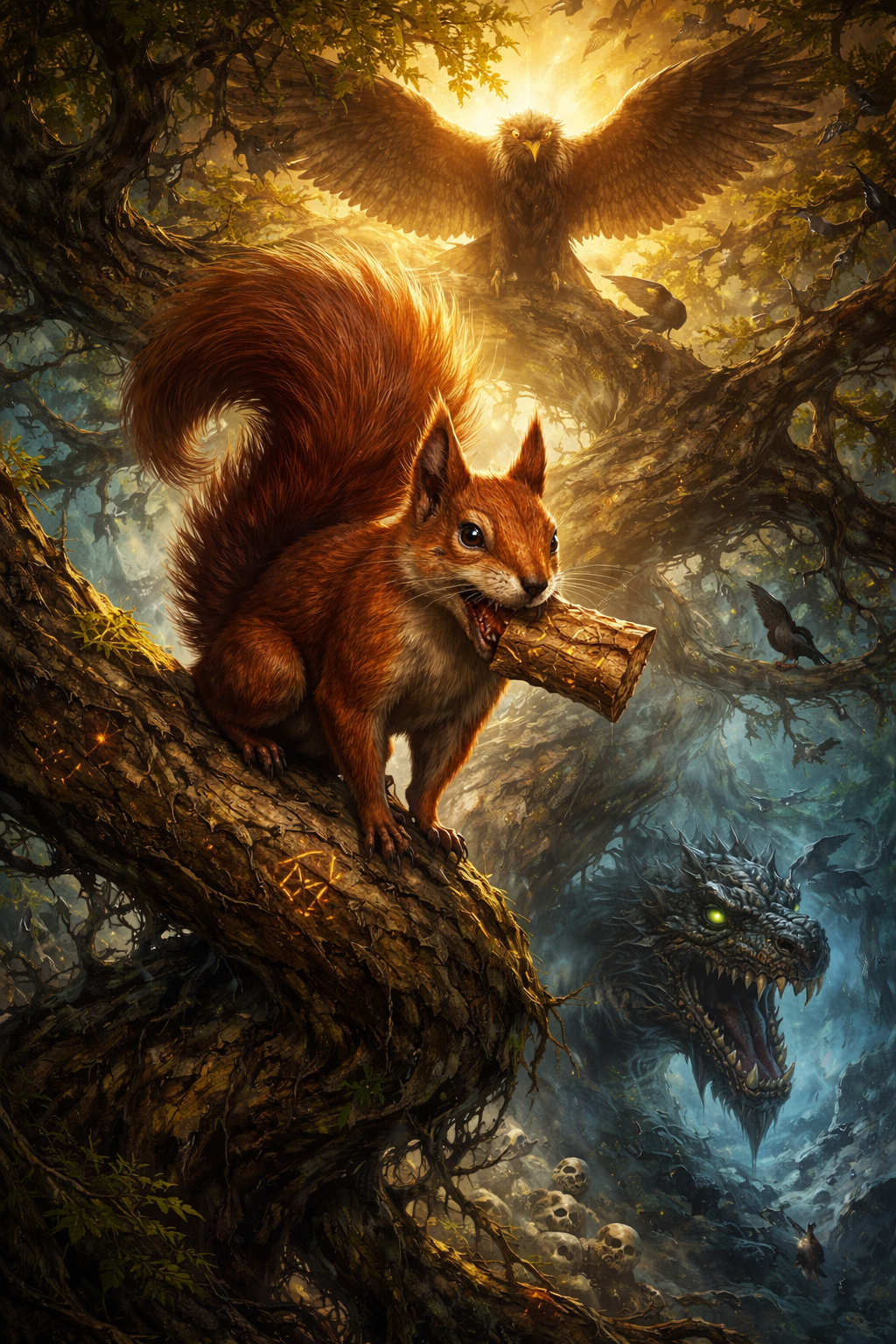
When people think of Norse mythology, they often imagine powerful gods like Odin and Thor, great battles or the final destruction of the world at Ragnarök. Small creatures are usually overlooked, treated as minor details rather than figures with meaning. Norse myth however, does not work that way. Size does not determine importance. Even the smallest being can influence the fate of the cosmos.
Ratatǫskr is one such being. He is the squirrel who runs up and down the great world tree, Yggdrasil, which holds the nine worlds together. At first glance, Ratatǫskr appears unimportant. He is not a god. He has no cult, no temples and no worshippers. He carries no weapon and commands no forces of nature. He does not rule over the dead or protect humanity. He moves quickly along the trunk of the world tree, easy to dismiss if we do not look closely.
Yet his role is far from harmless.
Ratatǫskr carries messages between the eagle that sits at the top of Yggdrasil and the dragon, Níðhöggr, who gnaws at its roots. These messages are not meant to bring understanding or peace. They are words of insult, mockery and hostility. Ratatǫskr does not ease conflict; he maintains it. He takes bitterness from one end of the cosmos and delivers it to the other, ensuring that anger continues and resentment never fades.
Ratatǫskr represents one of the most dangerous forces recognised in Norse thought: the misuse of speech. In a culture where honour shaped social order, where spoken insults could lead to feuds, exile or death, words were never considered harmless. Speech carried weight and once spoken, it could not be recalled. Reputation, law, and fate were all shaped by what was said aloud.
He is not a monster that destroys through strength, nor a force of nature that overwhelms without thought. Instead, he erodes stability slowly. While Níðhöggr damages Yggdrasil with teeth and hunger, Ratatǫskr weakens it with words. His harm is subtle, repeated and ongoing, making it all the more dangerous.
He is also a deeply unsettling figure because he moves freely between the highest and lowest parts of the cosmos. Unlike Odin, who suffers and sacrifices for knowledge, Ratatǫskr appears to pay no price for his actions. He carries words of hatred, spreads hostility and continues on his path untouched. This freedom, without consequence, highlights the risk of passing on words without responsibility.
Ratatǫskr also challenges the idea that messengers are neutral. He is not a passive carrier of information. He chooses what he repeats and how he repeats it. In doing so, he becomes an active participant in conflict rather than a simple go between. Norse myth presents him as a warning that repeating harmful words makes one part of the harm itself.
Although Ratatǫskr appears only briefly in the surviving myths, his presence is deliberate. Norse stories rarely include figures without purpose. His role reflects a world in which destruction is not caused only by great battles or sudden disasters, but also by countless small actions carried out over time. Conflict grows when it is carried, repeated, and encouraged.
Names and Identity
The name Ratatǫskr is our first clue to understanding the nature of this strange and unsettling creature. As with many figures in Norse mythology, names are not chosen at random. They describe function, behaviour, or reputation rather than appearance alone. In the case of Ratatǫskr, the meaning of the name is uncertain, but every possible interpretation points toward his role as a disruptive and troublesome messenger.
The name comes from Old Norse, recorded in medieval Icelandic manuscripts. Scholars have long debated its exact meaning, as it appears only rarely and has no clear parallel elsewhere. One common interpretation links the first element rata to words meaning to scrape, gnaw or move restlessly. This suggests constant motion, irritation and wear, which fits a creature that endlessly runs up and down the world tree, never settling in one place.
The second part of the name tǫskr is even more revealing. In Old Norse, this word can mean tooth or tusk, which would again connect Ratatǫskr to biting or gnawing. However, tǫskr was also used as an insult, meaning foolish, impudent or insolent. If this meaning is intended, then Ratatǫskr’s name may describe not only his movement but also his attitude. He is not simply a messenger; he is an offensive one, carrying words meant to provoke anger and resentment.
Taken together, the name Ratatǫskr may be understood as something like the gnawing one, the insolent runner, or the biting messenger. None of these interpretations paint a neutral or harmless picture. They suggest irritation, disruption and disrespect, all qualities that match his mythological role.
It is also important to note what Ratatǫskr is not. He is not given honorific titles, epithets of praise, or poetic kennings in the way gods and heroes are. Odin is Allfather, Wanderer and One-Eyed. Thor is Thunderer and Defender of Midgard. Ratatǫskr receives no such elevation. His name stands alone, bare and sharp, much like the words he carries.
This lack of praise is significant. It suggests that Ratatǫskr was never meant to be admired or worshipped. He exists to illustrate a function rather than to inspire devotion. In Norse myth, not every named being is worthy of honour. Some exist to show danger, imbalance, or moral warning, and Ratatǫskr belongs firmly in this category.
Ratatǫskr’s identity is also defined by his behaviour rather than his form. While he takes the shape of a squirrel, his actions place him closer to figures associated with conflict and disorder. He does not create chaos through violence, as giants do, nor through clever schemes, as Loki does. Instead, he spreads harm through speech, carrying hostility from one end of the cosmos to the other.
Ratatǫskr Before the ‘Viking Age’
Unlike major gods such as Odin or Thor, Ratatǫskr does not have a long and clearly traceable history that reaches back into the earliest Germanic periods. There are no known inscriptions, place-names, or archaeological finds that can be confidently linked to him. This absence is important, and it must be acknowledged honestly. Ratatǫskr does not appear to have been a figure of worship, nor a being invoked in ritual or prayer. Instead, he belongs to a different layer of Norse belief.
Ratatǫskr appears only in the literary sources that were written down in medieval Iceland, long after the spread of Christianity. This places him firmly within the mythic tradition as it was preserved rather than as it was practised. While this does not mean he was invented at a late date, it does mean that we cannot trace him directly to the Proto-Germanic or early Iron Age religious landscape in the way we can with figures like Odin, Tyr or Freyr.
However, this does not mean that Ratatǫskr lacks deeper roots. His role reflects older ideas that were already present in Germanic and Indo-European thought long before the period we now call the Viking Age. Rather than being an ancient god, Ratatǫskr seems to embody an old concept given a specific form within Norse cosmology.
Across early Germanic cultures, speech was understood as a force with real power. Words could create honour or destroy it. Insults, known as níð, were not merely personal attacks but social weapons that could lead to outlawry, violence or lasting feuds. Laws existed to punish harmful speech, showing that words were treated as actions rather than harmless sounds. Ratatǫskr fits naturally into this worldview. He represents the constant movement of harmful speech, passed from one place to another without restraint.
There are also parallels in wider Indo-European myth. Many traditions include small, fast-moving creatures or lesser beings who act as messengers between realms. These figures often occupy a dangerous position, not because they are powerful themselves, but because they carry influence from one world to another. They are liminal, existing between spaces, and their actions can disturb balance. Ratatǫskr shares this role, moving freely between the highest and lowest parts of the cosmos.
It is also worth noting that animals in Norse mythology often represent behaviours rather than moral alignment. Wolves embody hunger and destruction, ravens represent thought and memory, and serpents symbolise decay and renewal. The squirrel, an animal known for restless movement and constant activity, becomes an ideal symbol for the endless carrying of messages. Ratatǫskr is not chosen at random; his form reflects his function.
Before the ‘Viking Age’, the ideas that Ratatǫskr represents were already present, even if the character himself was not named. The fear of destructive speech, the awareness of how conflict spreads, and the understanding that small actions can lead to great harm were all deeply rooted in early Germanic society. Ratatǫskr can be seen as a later mythic expression of these older concerns.
Ratatǫskr in the Old Stories
Ratatǫskr appears only briefly in the surviving Norse myths, but his presence is deliberate and carefully placed. He is mentioned in the Poetic Edda, specifically in the poem Grímnismál, which is one of the most important sources for Norse cosmology. Although his role is small in terms of lines of text, it carries deep symbolic weight.
In Grímnismál, Odin speaks while disguised as Grímnir, revealing sacred knowledge about the structure of the cosmos. Among the descriptions of the halls of the gods, the creatures of the world tree, and the nature of existence, Ratatǫskr is named as the squirrel who runs up and down Yggdrasil. He carries words between the eagle that sits at the top of the tree and the dragon, Níðhöggr, who gnaws at its roots.
What matters most is not simply that Ratatǫskr carries messages, but what kind of messages they are. The poem tells us that he carries words of hostility, insults, and malice. He does not act as a neutral messenger delivering information. Instead, he actively spreads hatred, ensuring that the conflict between the eagle above and Níðhöggr below never settles. His movement keeps tension alive within the very structure of the cosmos.
This detail is crucial. Norse myths often include messengers, but they are usually tied to order or purpose. Odin sends ravens to gather knowledge. Valkyries carry the chosen dead to Valhalla. Ratatǫskr stands apart from these figures. He gathers no wisdom and delivers no justice. His task is to repeat harmful words, turning disagreement into lasting hostility.
The fact that Ratatǫskr appears in a poem concerned with sacred knowledge is also significant. Grímnismál is not a casual tale. It is a poem that reveals how the world is arranged and how it functions beneath the surface. Including Ratatǫskr in this context suggests that ongoing conflict is not an accident or a flaw, but part of the world’s design. The cosmos is not held together by peace alone, but by tension that is constantly renewed.
It is also telling that Ratatǫskr does not speak for himself. We never hear his voice directly. His presence is defined entirely by what he carries between others. This reinforces his role as a force that spreads discord rather than one that creates ideas of its own. He thrives on repetition, on carrying words that already exist and giving them new power by passing them on.
Beyond Grímnismál, Ratatǫskr does not play an active role in the narrative myths. He does not appear in heroic stories, family sagas, or tales of the god‘s adventures. This absence supports the idea that he is not meant to be a character with a personal story, but a function within the mythic system. He exists to show how conflict moves, not to take centre stage.
The Old Stories therefore present Ratatǫskr as a quiet but constant presence. He runs endlessly, carrying words that inflame rather than heal. While great beings clash at the top and bottom of the world tree, Ratatǫskr ensures that their hatred never cools. In doing so, he becomes a symbol of how small actions, repeated without thought or restraint, can sustain cosmic imbalance.
Speech, Níð, and the Danger of Words
Speech, Níð, andTo understand Ratatǫskr properly, we must understand how speech was viewed in Norse society. Words were never seen as harmless or empty. They were actions in their own right, capable of shaping reputation, law, and fate. A careless sentence could ruin a person’s standing, and a deliberate insult could start a feud that lasted generations.
One of the clearest expressions of this belief is the concept of níð. Níð was not simple rudeness or teasing. It was a serious form of insult that attacked a person’s honour, courage, or social worth. To accuse someone of cowardice, sexual shame, or moral weakness was to challenge their place in society. Such words could lead to violence, legal punishment, or exile. In some cases, níð was treated as a crime equal to physical harm.
Norse law codes and sagas show that harmful speech was taken seriously. A man who spread shameful rumours or carved insulting symbols could be declared an outlaw. His property could be seized, and anyone could kill him without consequence. This tells us that words were believed to have real power, not only over emotions, but over the structure of society itself.
Ratatǫskr embodies this danger of speech. He does not invent conflict, but he carries it. He takes hostile words from one end of the world tree and delivers them to the other, ensuring that anger is kept alive. In doing so, he shows how níð spreads. It moves quickly, passed from mouth to mouth, growing stronger with each repetition.
What makes Ratatǫskr especially dangerous is that he is not involved in the conflict he sustains. He does not suffer the consequences of the hatred he carries. He runs freely between the eagle above and the dragon below, untouched by the damage he helps to cause. This reflects a real social truth. Those who spread harmful speech are often not the ones who face the fallout. The harm falls on others, while the messenger moves on.
Norse mythology does not present speech as neutral. Odin himself is careful with words. He values wisdom, restraint, and silence when silence is needed. In Hávamál, he warns against speaking too much or trusting every voice. Loki, by contrast, uses speech recklessly, and his words in Lokasenna lead directly to destruction and exile. Ratatǫskr fits into this pattern as another warning figure, one who shows the long-term damage caused by careless or malicious talk.
The danger of words in Norse thought is not that they are loud, but that they endure. An insult once spoken cannot be taken back. It lingers in memory, shaping relationships and decisions long after the moment has passed. Ratatǫskr’s endless running reflects this. The same words are carried again and again, never allowed to fade.
Through Ratatǫskr, Norse mythology teaches that speech carries responsibility. To repeat harmful words is to become part of the harm itself. The squirrel on the world tree reminds us that destruction does not always begin with weapons or fire. Sometimes it begins with a message, passed along without care, until it weakens the very foundations of the world.
Relationships and Cosmic Function
Ratatǫskr’s role in Norse mythology is defined almost entirely by his relationships. He does not act alone, nor does he exist for his own sake. His purpose is tied to the great forces positioned at either end of the world tree, Yggdrasil, and to the tension that keeps the cosmos in motion.
At the top of Yggdrasil sits the great eagle. Although the eagle is never fully explained in the surviving sources, it is often understood as a watcher, a symbol of height, perspective, and order. From its high position, it sees across the worlds and stands close to the realms of the gods. It represents stability and oversight, a presence linked to endurance rather than decay.
At the roots of Yggdrasil dwells the dragon Níðhöggr. He gnaws constantly at the tree, seeking to weaken its foundations. Níðhöggr is associated with death, corruption, and the slow wearing away of order. His hunger is endless, and his presence ensures that destruction is always at work beneath the surface of existence.
Ratatǫskr moves endlessly between these two beings. He carries words from the eagle down to Níðhöggr and returns with words from the dragon to the eagle. These are not messages meant to resolve conflict. They are insults and hostile speech that deepen hatred and sustain opposition. Ratatǫskr does not create the conflict between the eagle and the dragon, but he ensures that it never fades.
This makes Ratatǫskr a vital part of the cosmic system. Without him, hostility might lessen over time. With him, it is constantly renewed. He is the force that keeps tension alive within the structure of the world itself. Yggdrasil does not simply stand as a symbol of unity. It is also a place of strain, held together by opposing forces that are never fully reconciled.
Ratatǫskr’s movement along the tree is also important. He travels freely between the highest and lowest points of the cosmos, crossing boundaries that few beings can. Gods, monsters, and the dead are usually tied to specific realms. Ratatǫskr is not. His freedom of movement makes him dangerous, as he spreads conflict across boundaries that would otherwise limit its reach.
Unlike Odin, who seeks knowledge and pays a price for it, Ratatǫskr seems to act without consequence. He suffers no visible punishment and gains no wisdom. He runs, speaks, and returns, driven only by the act of carrying words. This lack of cost reflects the way harmful speech often works in human society. Those who pass on hostility are rarely the ones who bear its full weight.
In this sense, Ratatǫskr is not a minor detail in the mythic world. He is a necessary part of its tension. The slow decay of Yggdrasil is not caused by Níðhöggr alone, but by the constant renewal of hatred that Ratatǫskr provides. Together, they show that destruction is not always sudden or dramatic. Often, it is maintained through repetition.
Ratatǫskr’s cosmic function, then, is to ensure that conflict remains active. He is the link between decay and order, the carrier of words that prevent resolution. Through him, Norse mythology expresses a deep understanding of how fragile balance truly is, and how easily it can be weakened by what is said and repeated.
Ratatǫskr and Ragnarök
Ratatǫskr is never described as a warrior at Ragnarök, nor is he named among the great monsters or gods who take part in the final battle. Yet his role in the lead up to the destruction of the cosmos should not be underestimated. Ragnarök is not presented in Norse mythology as a sudden event that appears without warning. It is the result of long building tensions, broken bonds, and conflicts that are allowed to grow unchecked.
Ratatǫskr represents this slow build. His endless running along Yggdrasil, carrying hostile words between the eagle above and Níðhöggr below, mirrors the way resentment and hatred accumulate over time. He does not cause Ragnarök directly, but he helps create the conditions in which it becomes inevitable. The world does not collapse in a single moment; it weakens gradually.
Níðhöggr’s constant gnawing damages the roots of the world tree, symbolising decay and death. Ratatǫskr ensures that this decay is never challenged or interrupted. By carrying insults and provoking hostility, he prevents any chance of reconciliation. Conflict remains active, and the damage continues unchecked. In this way, Ratatǫskr supports destruction not through force, but through persistence.
Norse mythology often shows that the end of the world is brought about as much by internal failure as by external attack. Broken oaths, betrayal, and loss of trust all play a part in Ragnarök. Ratatǫskr fits into this pattern as a figure who represents the spread of division. His actions echo the way rumours, accusations, and repeated insults can fracture communities long before open conflict erupts.
It is also important that Ratatǫskr survives unnoticed. While the gods prepare for battle and monsters break free, he continues his task quietly. This reflects the idea that not all forces leading to destruction are dramatic or visible. Some are constant, familiar, and easy to ignore. Ratatǫskr shows how harm can become part of the background of existence, accepted simply because it has always been there.
By the time Ragnarök arrives, the world is already weakened. Yggdrasil has endured endless strain, and the bonds that once held the cosmos together are stretched thin. Ratatǫskr has played his part by keeping hatred alive and preventing healing. His role reminds us that the end of the world is not caused by a single act of violence, but by many small actions repeated over time.
Through Ratatǫskr, Norse mythology offers a warning. Ragnarök is not only about gods and giants clashing in battle. It is also about the consequences of unresolved conflict, careless speech, and the refusal to break cycles of hostility. The squirrel on the world tree does not fight at the end of the world, but he helps ensure that the end comes.
Ratatǫskr in Modern Interpretation
In modern retellings of Norse mythology, Ratatǫskr is often treated lightly. He is frequently portrayed as a mischievous or humorous character, sometimes even as a friendly guide or playful trickster. In popular culture and modern pagan spaces, he may appear as a clever squirrel, quick and witty, more amusing than dangerous. While these interpretations make him approachable, they risk losing the seriousness of his original role.
In the surviving Norse sources, Ratatǫskr is not playful or innocent. He is not a helper, nor a figure meant to bring balance. His function is corrosive. He carries insults and hostile speech, ensuring that conflict continues. Reducing him to a harmless trickster softens a figure that was meant to illustrate the real and lasting damage caused by repeated words.
This shift in interpretation is understandable. Modern audiences often look for characters they can relate to or feel comfortable with. There is also a tendency to make all mythic figures either heroic or helpful. Ratatǫskr resists this pattern. He is not a god to admire, nor a villain to defeat. He exists as a warning, and warnings are often uncomfortable.
Some modern spiritual practitioners and writers reinterpret Ratatǫskr as a symbol of communication itself, neutral rather than harmful. In these readings, he represents the movement of information between worlds or states of being. While this view can be meaningful on a personal level, it does not fully align with the tone of the original myths. Norse sources are clear that the words he carries are not neutral. They are meant to provoke and sustain hostility.
Ratatǫskr also appears increasingly in discussions of modern communication. In an age of constant messaging, rumours, and online conflict, his role feels strikingly relevant. He reflects how quickly words can spread, how easily they can be repeated without thought, and how conflict can be amplified by those who simply pass information along. In this sense, modern readers often see Ratatǫskr as a mirror of social behaviour rather than a distant mythic creature.
Despite these modern adaptations, it is important to remember that Ratatǫskr was never a figure of comfort. He was not meant to be embraced or celebrated. His value lies in what he warns against, not in what he offers. To understand him properly is to recognise the responsibility that comes with speech and the harm that can be done by repeating words without care.
Modern interpretations can add layers of meaning, but they should not erase the core lesson found in the old stories. Ratatǫskr remains a reminder that communication is never harmless, and that the smallest voice, repeated often enough, can help undermine even the strongest foundations.
Lessons from Ratatǫskr
Ratatǫskr may be a small and easily overlooked figure, but the lesson he carries is one of the clearest and most unsettling in Norse mythology. He teaches that destruction does not always come through great acts of violence or open conflict. Often, it begins with words, carried from one place to another without care or responsibility.
One of the central lessons of Ratatǫskr is that messengers are not neutral. To repeat harmful speech is to take part in the harm itself. Ratatǫskr does not invent insults, but by carrying them, he ensures they continue to cause damage. Norse mythology makes it clear that responsibility does not end with simply passing something on. Choice lies in what is repeated and how.
Ratatǫskr also shows how small actions, when repeated over time, can have vast consequences. His running up and down Yggdrasil seems insignificant on its own, yet it helps maintain the tension that weakens the world tree. In human terms, this reflects how gossip, rumours, and repeated criticism slowly erode trust and stability. Rarely does a single word destroy a community, but many words, repeated often, can.
Another lesson lies in the absence of consequence for Ratatǫskr himself. He spreads hostility but suffers no visible punishment. This mirrors a difficult truth about human behaviour. Those who pass on harmful words are often not the ones who face the outcomes. The damage is felt by others, while the messenger moves on untouched. Norse myth recognises this imbalance and presents it as a danger rather than an excuse.
Ratatǫskr also warns against treating conflict as something distant or inevitable. He shows that conflict must be maintained to survive. Without constant reinforcement, hostility can fade. By carrying insults again and again, Ratatǫskr prevents healing. This suggests that peace requires effort, while conflict often sustains itself if left unchecked.
Perhaps the most important lesson from Ratatǫskr is the power of restraint. Norse wisdom does not praise endless speech. Odin himself values silence, careful words, and thoughtful listening. Ratatǫskr stands in direct contrast to this ideal. He speaks without wisdom and moves without reflection. Through him, the myths remind us that knowing when not to speak can be just as important as knowing what to say.
In the end, Ratatǫskr teaches that words shape wyrd. They travel further than we expect and last longer than we intend. The squirrel on the world tree reminds us that every message carried is a choice, and every repeated word helps shape the world that follows.