
Fossegrim: The Keeper Who Dwells in Falling Water
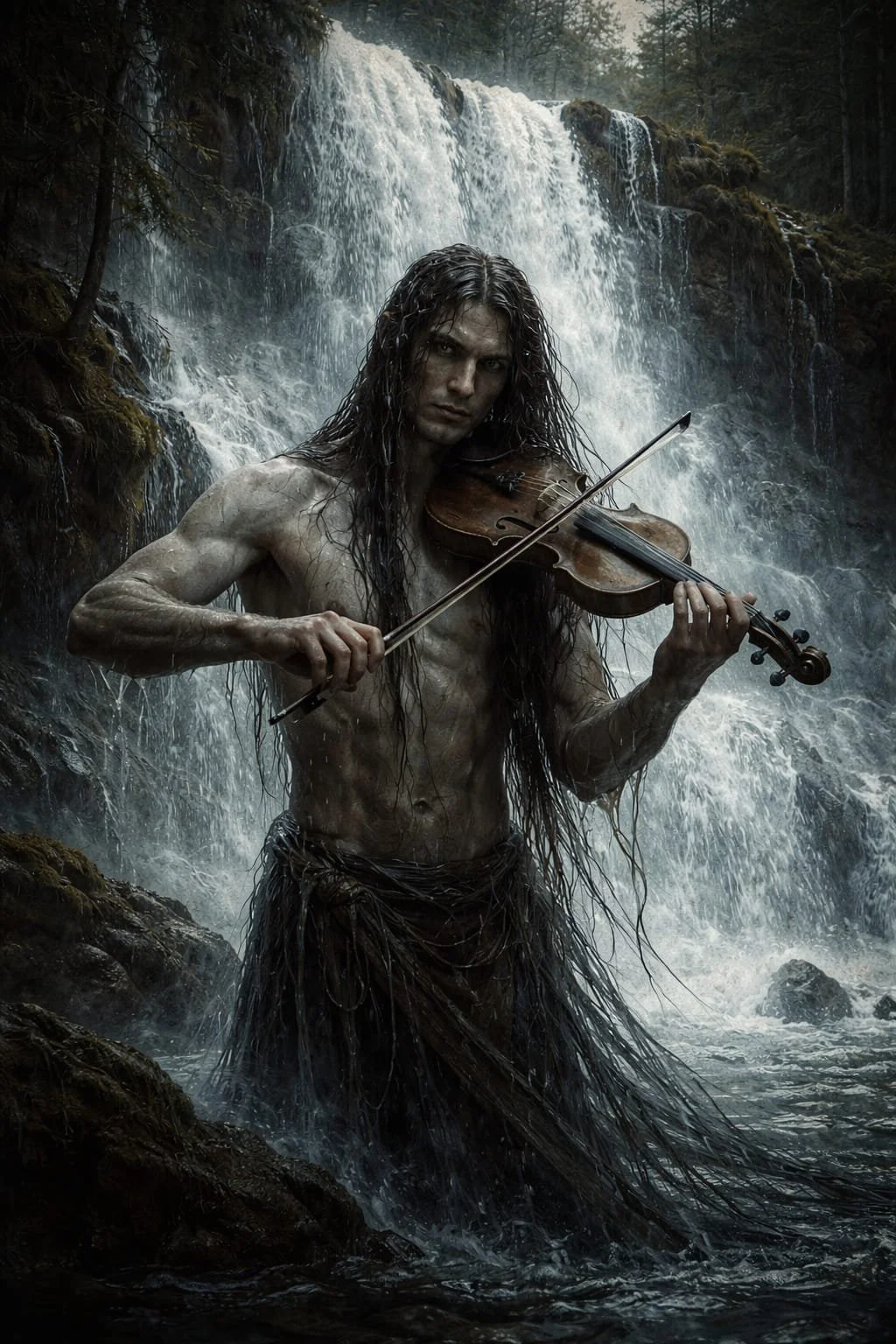
“Where water learns to break itself, music is born.” - fragment attributed to Telemark oral tradition, uncertain date
Some beings exist to pursue. Some exist to devour. Some exist to end. And some exist to remain. The Fossegrim does not chase the sun nor measure the moon. He does not hunger for the future or tear the past apart. He stands where gravity repeats itself long enough to acquire memory. Where motion disciplines itself into rhythm. Where endurance becomes intelligence. He is not loud, though his home roars. He is not violent, though his lessons wound. He is not still, though he never leaves. He is what happens when movement listens to itself.
And he waits.
***NOTE***
Before diving into this blog, it is important to clarify that the Fossegrim is a prominent figure in Scandinavian folklore: a mythical water spirit, sometimes classed among trolls or vættir, renowned for exceptional fiddle playing. He is not a real animal or historical person. The legend arises from generations of oral tradition in Norway and Sweden, where related figures are known as Strömkarlen (“the River Man”), Nøkken, or Näcken. What follows is a mythopoetic synthesis faithful to the spirit, symbolism, and internal logic of those traditions rather than a single canonical tale.
Prologue: Where Sound First Learned Meaning
Before humans learned to carve memory into stone or history into song, water already spoke. Not in words, not in symbols, but in cadence. A waterfall is gravity made audible, inevitability rendered into sound. Each drop is identical. Each moment irretrievable. This paradox is the oldest grammar of time.
In the North, sound was never decoration. Wind warned. Ice creaked with threat. Silence pressed like weight. Every sound carried consequence. To ignore it was to die. To misread it was to be lost. Listening was survival long before it was art.
The waterfall stood apart. It did not migrate like birds or answer like wolves. It endured. It repeated. It returned the same voice again and again, until the ear learned not to hear it as noise, but as presence. People learned to speak less near falling water. Words thinned. Gestures slowed. Something about the repetition demanded restraint, as though the sound itself were already saying everything necessary. Long before the Fossegrim was named, he was felt. In the way offerings appeared near spray-darkened stone. In the way paths bent rather than crossed directly through certain ravines. In the way people avoided singing over the water, choosing instead to listen.
Even now, modern ears resist this discipline. We fill silence reflexively. We layer sound over sound until none of it must be endured. The waterfall refuses this excess. It cannot be muted without effort. It cannot be ignored without consequence. It insists on being heard as itself.
Where repetition persists without decay, awareness accumulates. Where awareness forms without language, spirit awakens.
The Fossegrim is not born. He is remembered into being.
The Name and the Silence Around It
Names, in Northern traditions, are never neutral. To name a thing is to shorten the distance between yourself and it. This is why the Fossegrim’s name appears inconsistently in the record why it shifts, fractures, dissolves into regional variants and euphemisms. In some valleys he is not named at all, referred to only as han som spiller “the one who plays.” Elsewhere, his name is spoken only once, quietly, before approaching the water, and never again after leaving. Not out of fear, but out of respect for compression. Sound, like water, becomes dangerous when forced into narrow channels.
To speak his name repeatedly is to mistake familiarity for understanding. The Fossegrim does not respond to invocation. He responds to alignment. Silence, in this context, is not absence. It is accuracy.
The First Descent: On the Birth of the Fossegrim
Unlike gods who are sired, giants who emerge from chaos, or humans who are shaped from trees and breath, the Fossegrim has no genealogy that can be recited without contradiction. This is deliberate. In Norse cosmology, lineage explains power. The Fossegrim does not rule. He persists.
Some tales claim he emerged when the first glacier melted and discovered gravity. Others say he coalesced when the rivers learned their paths and ceased to wander blindly across the land. A rarer tradition claims that he was once a man, a master musician who drowned himself in a waterfall after realizing that no audience could hear what he was truly playing. The water, recognizing devotion greater than survival, kept him.
But the oldest accounts reject origin entirely.
They describe a time when sound itself thickened. When repetition wore not only stone, but awareness into shape. Where the water struck rock in the same place for generations beyond counting, something began to anticipate itself. A presence formed that did not think, but knew. Not as a mind knows, but as a body knows how to balance.
The Fossegrim did not awaken. He stabilized.
Stabilization, in this sense, is not stasis. It is continuity under pressure. The Fossegrim does not represent the beginning of something, but the point at which change becomes reliable enough to learn from.
In this sense, he is closer to a natural law than a creature. Gravity given attention. Motion that has learned its own name.
The Dwelling: Where Gravity Becomes Law
The Fossegrim does not inhabit water in its wandering. Rivers move too freely. Lakes are too still. He dwells where motion is compelled - where water must fall, not by choice, but by law. His waterfalls are rarely wide. They are narrow, disciplined, focused. Ravines that compress sound until it folds inward. Stone worn smooth not by violence, but by persistence. Moss thick enough to soften footsteps, but not the roar.
These places feel old even when newly formed. Time behaves differently near them. Minutes stretch. Thoughts slow. The world beyond the spray feels provisional, as though it exists by permission rather than certainty.
Not every waterfall houses him. Flood-born cascades are too chaotic. Seasonal torrents too unreliable. He requires devotion not from humans, but from the water itself. It must fall every day, without resentment, without rest.
Those who linger sense it. The sound organizes itself. What once felt overwhelming begins to resolve into layers. Rhythm emerges from roar. Meaning emerges from pressure. The Fossegrim does not reveal himself because revelation would break the lesson. His presence is the test: can you remain long enough for noise to become instruction?
Most cannot. They leave with ringing ears and restless thoughts, never realizing they were being examined.
The Threshold: Where the World Begins to Thin
Those who approach a true Fossegrim waterfall often report a subtle dislocation before anything overt occurs. The air cools faster than expected. Distance becomes difficult to judge. The sound seems closer than the body is prepared for. This is not enchantment. It is threshold.
In Norse cosmology, boundaries matter more than destinations. Rivers divide realms. Shores mark uncertainty. The waterfall is not merely a place it is a condition. To stand before it is to occupy a narrowing margin between intention and surrender.
Many who turn back do so here, unsettled not by fear but by the sensation that something internal is being measured without consent.
Appearance: What the Stories Permit Us to See
Descriptions of the Fossegrim contradict one another, and this is not error but integrity. Beings bound to place are seen differently by those who approach them with different hungers. Some see a pale, slender man, his skin reflecting light like wet stone. His hair hangs long and dark, slicked to his body by spray. His limbs appear fragile until they move, precise and unyielding as falling water itself.
Others see only fragments. A hand emerging from mist. A shoulder dissolving into vapor. A silhouette aligning too perfectly with the cascade to be separate from it. Often, the eye slides away before certainty can form.
Nearly all accounts mention the fiddle. It is never ornate. Never pristine. The wood remembers the tree. The strings hum faintly even when untouched, resonating with the waterfall’s pulse. His beauty, when described, is not inviting. It is concentrated, severe, almost austere.
To look at him is to feel that something necessary is being done nearby something that does not require approval or witnesses.
He does not perform. He does not beckon. He works. And those who interrupt that work rarely leave unchanged.
The Fiddle as Relic, Not Instrument
The fiddle the Fossegrim carries is not an instrument in the human sense. It is not tuned to please. It is tuned to endure. Some traditions insist it cannot be replicated, that any attempt to copy its proportions results in something lifeless. The wood is said to be taken from trees that grew leaning toward water, shaped by constant wind and spray. Its strings are sometimes described as metal, sometimes as gut, sometimes as something else entirely descriptions vary because the material matters less than the tension.
The fiddle does not sing over the waterfall. It argues with it. And when the argument resolves, the result is not harmony but inevitability.
Tales from the Spray: Recorded Encounters and Oral Warnings
1.The Fiddler of Rauland -
A well-known Telemark tale speaks of a young fiddler who sought the Fossegrim after surpassing every teacher in his valley. He brought a goat that had fed from his own hand since birth and cast it into the falls without hesitation. The next morning he was found alive, hands split and swollen, clutching his instrument. He never spoke of the lesson. When he played, listeners wept without knowing why. He refused coin and died poor, but no fiddler who heard him ever forgot the sound.
2.The One Who Gave Too Little -
Another tale tells of a man who offered only a crust of bread, reasoning that hunger itself should suffice. The Fossegrim appeared, silent, and placed the man’s fingers on the strings. The pain was unbearable, the sound discordant. When the man fled, he retained just enough skill to know he would never be great. He became a competent musician and a bitter one.
3.The Child Who Listened -
A rarer story tells of a child who did not seek teaching at all, but merely sat near the waterfall day after day, mimicking its rhythms on a stick and string. The Fossegrim never appeared. Yet the child grew into a musician whose timing was said to be impossible to imitate. Some say the Fossegrim teaches only those who do not ask.
What the Fossegrim Is - and What He Refuses to Be
The Fossegrim is often misnamed a fairy, a nix, a water sprite. These categories comfort more than they clarify. He does not trick travelers. He does not lure children. He does not revel in chaos. Nor is he benevolent.
He does not help the deserving. He does not punish the arrogant. He does not intervene in human suffering. These moral frameworks do not interest him. The Fossegrim guards mastery, not virtue. He stands at the boundary between effort and transformation. He does not ask who you are. He observes how completely you are willing to be altered.
This indifference unsettles modern readers, but it aligns perfectly with Norse cosmology. The world is not structured to reward goodness. It is structured to maintain tension. He is not cruel, because cruelty requires intention. He is not kind, because kindness requires preference.
He is precise.
The Approach: Who Comes to the Waterfall
Those who seek the Fossegrim are rarely casual. They come exhausted by competence. They have practiced long enough to know the limits of instruction and imitation.
Often they are fiddlers, but not always. Sometimes singers. Sometimes poets. Sometimes those who have lost their craft and seek its bones rather than its beauty.
They do not announce themselves. They wait. Waiting is the first test. The waterfall does not acknowledge impatience. Hours pass. Cold seeps in. Doubt rises. Many leave believing nothing happened.
Those who remain begin to change before the Fossegrim ever appears. Their breathing slows. Their thoughts thin. The sound begins to feel addressed rather than ambient.
Many seekers report a moment of resentment during this waiting. A sharp internal protest against being ignored. This, folklore suggests, is the final barrier. Those who cannot endure being unacknowledged are not prepared to learn something that does not care whether they exist.
If he appears, it is never sudden. The seeker realizes he has been present for some time already, watching, listening, measuring attention.
The lesson has already begun.
The Teaching: How the Body Learns
When teaching begins, it is immediate.
The Fossegrim takes the seeker’s hands and places them on the strings. He does not explain. He does not demonstrate. He plays through them. The waterfall roars. Fingers are forced into patterns they do not understand. Joints burn. Skin splits. Blood slicks the strings.
This pain is not incidental. It is instructional.
To play like falling water, the body must surrender authorship. Rhythm replaces intention. Precision replaces desire. The student becomes conduit rather than source.
Those who fight the pain fail. Those who endure without listening fail. Only those who allow themselves to be reorganized by sound learn.
When the Fossegrim releases them, they collapse. And when they rise, their hands are no longer theirs alone.
What the Fossegrim Never Teaches
The Fossegrim does not teach speed. He does not teach cleverness. He does not teach how to impress. Those who seek shortcuts leave early. Those who ask how long the lesson will take do not begin. The waterfall has no interest in efficiency. It measures only persistence.
Technique learned here cannot be separated from restraint. Power without compression disperses. What the Fossegrim teaches is not how to do more, but how to do only what cannot be removed.
The Bargain: What Must Be Given
The Fossegrim does not negotiate. The price is never symbolic. It must cost. Tradition speaks of white goats, of prime cuts of meat, of food given with real hunger behind it. The offering must matter not in rarity, but in deprivation.
Crucially, it is not given to him. It is thrown into the waterfall. This loss is essential. Mastery cannot be transferred or acknowledged. It must be surrendered. The offering must vanish beyond retrieval. Those who hesitate fail. Those who bargain fail. Those who give what they can spare fail.
The Fossegrim does not punish refusal.
He simply does not teach.
The Failed Gift: When the Offering Is Correct but the Giver Is Not
Some tales warn that even a perfect offering can fail. A goat raised with care. Meat taken from winter stores. Hunger made real. And still, no teaching comes. The failure, these stories say, lies not in insufficiency but in posture. An offering given as leverage is not an offering. Sacrifice made as transaction carries the wrong weight.
The Fossegrim does not accept gifts meant to secure outcomes. He accepts only those given with the knowledge that nothing may follow.
Why Blood Is Required
Modern readers often recoil here, mistaking the lesson for brutality. But Norse thought never confused harm with injustice. Pain is not moral. It is factual. Mastery rewrites the body. A craft that does not cost flesh remains superficial. To endure repetition without decayto vary without losing form requires the body to change its limits.
Blood marks the threshold where intention fails and discipline begins. It is proof that something irreversible has occurred.
The waterfall does not yield. You must become something that can exist within it. This is not cruelty. It is alignment.
Those Who Leave Unchanged
Many leave the waterfall without learning.
Some never see the Fossegrim. Some flee when the pain begins. Some break their vow mid-lesson. They are not cursed. They are unchanged. In Norse cosmology, this is not neutral. To encounter transformation and refuse it is to carry a fracture a knowledge of possibility denied.
Such people often live comfortable lives. Competent ones. But something in them remains unfinished. They heard the music.
It did not answer.
The Quiet Vigil: Refusal That Becomes Devotion
Some remain at the edge of the waterfall, knowing they cannot endure the price. They do not leave. They do not offer. They do not seek mastery. And yet, they linger. Hours become days; days become seasons. Their hands never touch the strings. Their ears learn only the surface. Folklore hints that such watchers gain something subtler: an intuition of alignment, a sense of timing that does not belong to them. They carry the music like a shadow, never claiming it. They do not play, but they remember.
In this way, devotion need not be recognized. Some are guardians not of the craft, but of its possibility. They are the silent acknowledgment that what is preserved in place matters more than what is possessed.
The Music That Remains
Those who learn from the Fossegrim do not entertain. Their music presses downward. It carries gravity. It unsettles rooms. It draws memory to the surface without asking permission. Listeners describe feeling pulled inward, as though something ancient is listening through them. The music feels older than the player, older than joy or sorrow.
It carries water. Stone. Cold. It does not move forward. It descends. And it cannot be faked.
Those Who Recognize the Sound Without Knowing Its Source
Not all who recognize the Fossegrim’s influence have stood at the waterfall. Some hear it unexpectedly...in a hall, in a recording, in a moment where sound suddenly carries weight it did not earn socially. Such listeners often describe a sensation of being addressed rather than entertained. As though the music is not for them, but through them. This recognition is fleeting, but unsettling.
Folklore suggests that once heard, this sound cannot be unheard. It becomes a private standard against which all other work is measured and often found lacking.
The Fossegrim Beyond Music
Though most often associated with the fiddle, some later traditions broaden the Fossegrim’s domain. He appears to those devoted to any craft governed by repetition and resistance: stoneworkers, rowers, blacksmiths, even poets who revise until language thins to necessity. In these accounts, the fiddle becomes symbolic rather than literal. What matters is the interface between body and constraint. Where hands meet something that will not yield easily, the Fossegrim is said to be near.
This suggests that he is not a patron of art, but of technique. Not expression, but alignment. Wherever form resists intention long enough to educate it, the same intelligence stirs.
The Fossegrim Does Not Follow
The Fossegrim cannot leave his waterfall. He does not travel to towns, to courts, to festivals. He cannot be summoned by fame or sought by ambition. To do so would undo him. Mastery is not portable. It cannot be compressed into recordings, scores, or lessons. It exists only where repetition insists and consequence endures.
Those who attempt to replicate his teaching elsewhere find only emptiness. The water he inhabits carries its own memory; the strings in their hands are ghosts. This is why he remains in place, indifferent to reputation. He measures alignment, not attention. The world may move on, and it does, but the waterfall - and he - remain.
The Fossegrim in the Web of Myth
Within Norse belief, the Fossegrim occupies a liminal tier. He is not one of the Æsir or Vanir, who govern through narrative and conflict. He is closer to the landvættir spirits bound to specific places but more focused, more exacting.
Where Odin sacrifices for wisdom, the Fossegrim demands sacrifice for mastery. Where Bragi governs poetry as divine gift, the Fossegrim governs music as bodily consequence. He does not inspire. He restructures.
Comparative Mythologies
• The Greek Muses grant inspiration without cost. The Fossegrim demands transformation.
• The Celtic Awen descends as blessing; the Fossegrim ascends as pressure.
• The Japanese kami of waterfalls share his place-bound nature, but not his indifference.
• The Hindu concept of tapas - spiritual heat generated by disciplined suffering, comes closest to his logic: power earned through endurance rather than favor. Across cultures, he belongs to a rare category: spirits of process, not outcome.
The Silent Ethics of the Waterfall
The Fossegrim offers no commandments. There are no taboos he enforces beyond attentiveness, no sins he names beyond negligence. Yet his presence implies an ethic older than law: that what is repeated deserves respect, and what demands endurance must not be approached lightly.
To practice near a waterfall is to enter into a relationship with inevitability. You cannot argue with gravity. You cannot persuade water to fall more gently. You can only learn how to stand where it falls without being destroyed. This is the ethic the Fossegrim embodies not obedience, but adaptation.
In this way, he stands opposed to modern ideas of mastery as domination. One does not conquer the waterfall. One does not extract its power. One either aligns with it, or is broken by it. The Fossegrim does not enforce this ethic. He merely demonstrates it, endlessly, with perfect patience.
Why the Fossegrim Is Still Dangerous
The danger of the Fossegrim is not that he will harm you. It is that he will clarify you.
To be shown, without judgment, the precise distance between your desire and your endurance is not a gift most people recover from easily. Some return from the waterfall knowing exactly what they are unwilling to give.
This knowledge does not fade. It settles.
When the Water Is Ignored
Folklore also records what happens when waterfalls are silenced or diverted. Mills built too close. Channels carved too aggressively. Cascades reduced to trickles in the name of efficiency. In such places, stories say the music thins. Fiddlers lose their edge. Songs become decorative rather than necessary. Craft persists, but mastery fades into competence.
This is not framed as revenge. The Fossegrim does not retaliate. He simply cannot remain where repetition is broken. When the fall is interrupted, the intelligence dissipates. What took centuries to stabilize vanishes without drama. What remains is quiet, not the fertile quiet of listening, but the hollow quiet of something unfinished.
False Waterfalls: Repetition Without Consequence
Not every cascade that roars is worthy of a Fossegrim. Some fall over sand and gravel, thin and heedless, unshaped by stone. Some are channeled to serve mills or to charm travelers, tamed until they do not resist. In such places, repetition exists but consequence does not. Musicians, laborers, and poets who train here learn something but it is always incomplete. Their fingers move correctly. Their motions are polished. Their songs carry beauty, but the weight is absent. The body has exercised, but the intelligence that forms under pressure has not been touched.
A waterfall must insist upon you as much as you insist upon it. Anything less is a lesson in the hollow echo of effort.
The Long Waiting
The defining trait of the Fossegrim is not his severity, nor his skill, nor even his age.
It is his patience. He does not roam in search of relevance. He does not diminish when forgotten. He waits through centuries of neglect, through changes in language and belief, through the collapse of cosmologies that once named him. Waterfalls outlast gods.
As long as something falls without choice, as long as sound repeats until it organizes perception, the conditions for his return remain intact. The Fossegrim does not need to be believed in. He only needs to be listened to.
The Fossegrim and the End of Time
Unlike wolves, giants, or gods, the Fossegrim does not perish at Ragnarök. When fire devours the sky and seas drown the land, water will still fall...from smoke, from ash, from whatever remains. Gravity will insist. Where it insists long enough, awareness will gather again. The Fossegrim does not require continuity of worlds. Only descent.
Final Reflection: The One Who Waits
The Fossegrim lives wherever mastery demands more than comfort allows.
He is in the art that scars your hands.
The craft that costs you certainty.
The calling that refuses to flatter you.
He does not chase you.
He waits.
And if you come, he will show you not with mercy, not with praise- but with precision - whether you are willing to be changed.
Not a trickster.
Not a demon.
Not a god.
But the intelligence that forms when repetition becomes devotion, when sound becomes law, and when mastery demands blood.
Final Reflection: The One Who Waits
The Fossegrim lives wherever mastery demands more than comfort allows.
He is in the art that scars your hands.
The craft that costs you certainty.
The calling that refuses to flatter you.
He does not chase you.
He waits.
And if you come, he will show you not with mercy, not with praise- but with precision - whether you are willing to be changed.
Not a trickster.
Not a demon.
Not a god.
But the intelligence that forms when repetition becomes devotion, when sound becomes law, and when mastery demands blood.
You as the Offering
Perhaps you have already stood before your own waterfall. Perhaps it is not water, but time, or expectation, or the relentless demand of craft. Perhaps it has been whispering at your edges for years. Have you surrendered yourself to it? Have you offered more than effort alone - the willingness to be reshaped, to bleed, to be unknown in the process?
The Fossegrim does not appear in response to curiosity, only to alignment. The question is not whether he waits. The question is whether you have truly listened.
So the question remains, unanswered and unavoidable:
What waterfall have you been standing near your entire life and have you truly listened long enough to learn what it is asking of you?
Wyrd & Flame 🔥🌊🎻
