
The Jötnar: Those Who Remember the World Before Shape
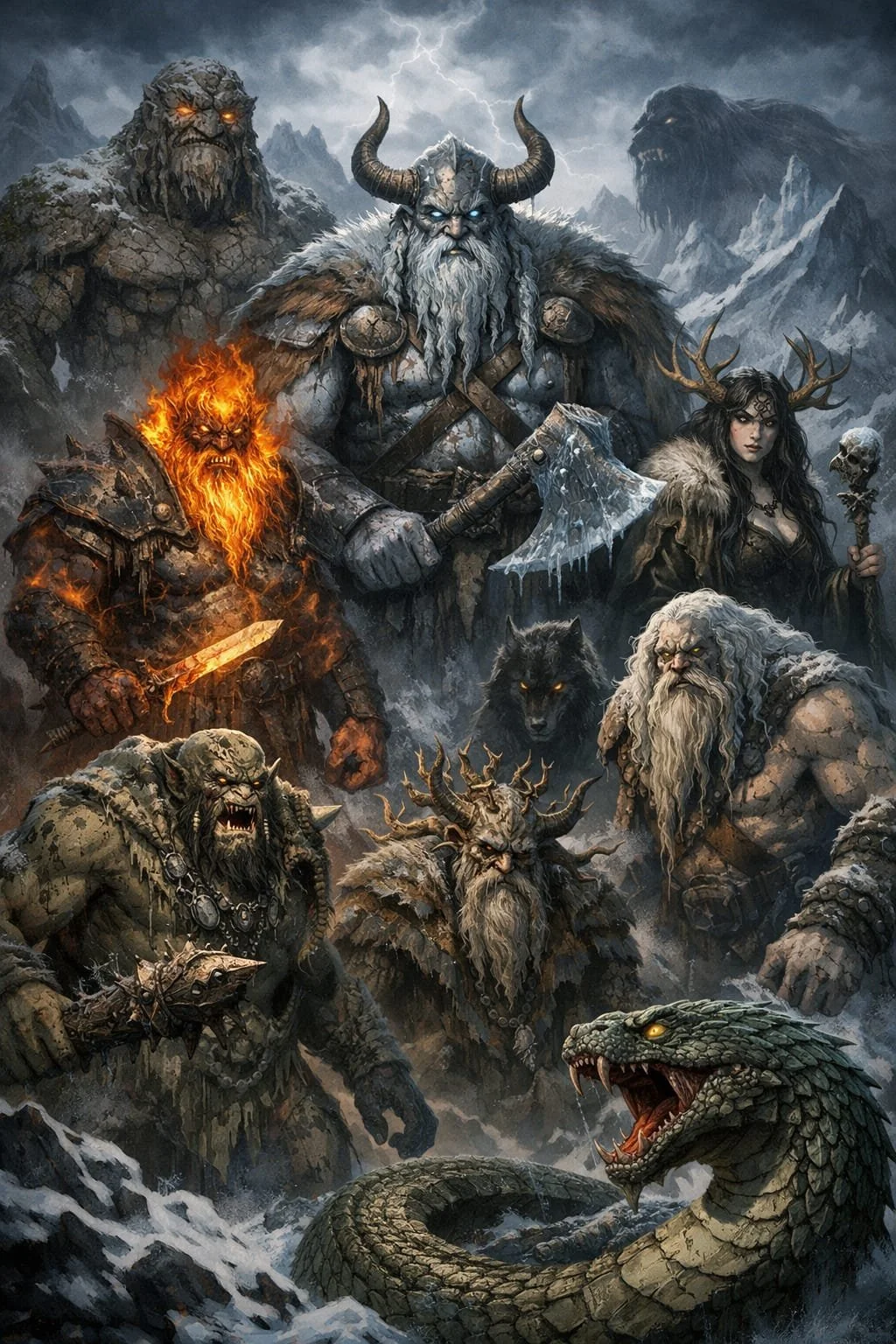
Not enemies of the gods. Not mistakes of creation. But the pressure that keeps the world from forgetting what it costs to exist.
The Weight Beneath All Stories
Some forces arrive announcing themselves. They thunder, blaze, conquer, or demand devotion. Others never announce anything at all. They simply remain, unmoved by whether they are noticed. The Jötnar belong to the latter category not because they lack power, but because power is not their purpose.
They do not seek dominion. Dominion implies a desire to shape the world into something else. The Jötnar exist to ensure the world remembers what it already is.
Before gods learned their names, before speech hardened into law and law into inevitability, existence had no narrative. There was no “ought,” no destiny, no moral arc bending anywhere. There was only pressure - raw, material, indifferent pressure. Ice advancing without malice. Fire expanding without intent. Mass pressing against mass because that is what mass does.
This pressure was not symbolic. It was literal. The cosmos did not begin as an idea. It began as a strain.
The universe’s first condition was not harmony but tension held without resolution. Not balance, because balance implies intention. What existed was imbalance that had not yet collapsed. A universe holding its breath without knowing why.
The Jötnar emerge from this condition. They are not creations in the way gods are creations. They are continuations. They are what happens when matter crosses a threshold and does not apologize for it. When accumulation becomes awareness. When weight realizes it exists.
This is why the Jötnar are so often misunderstood. They are framed as enemies because they do not cooperate with narrative convenience. They resist simplification. They refuse to be explained into usefulness. They do not justify themselves in terms gods or humans find comfortable.
To call them chaotic is to misunderstand chaos. Chaos is not randomness; it is uncontained force. The Jötnar are not uncontained. They are what containment costs.
They do not disrupt order from outside. They remind order of what it rests upon. Every law, every realm, every shining hall of the gods is built on something older, heavier, and far less concerned with meaning. The Jötnar ensure that this foundation is never forgotten.
This is why they are not worshipped. Worship implies hierarchy, and hierarchy requires aspiration. The Jötnar do not aspire. They precede.
This is why they are not prayed to. Prayer seeks mercy, negotiation, or exception. The Jötnar offer none of these. Pressure does not bargain. Stone does not soften because it is addressed politely.
What they offer instead is persistence.
To encounter a Jötunn in myth is not to face a villain or an obstacle. It is to confront a truth that does not adapt itself to comprehension. They do not explain. Explanation is a luxury of those who need to be understood. They endure.
And endurance - long before kingship, before divinity, before fate itself is the oldest authority in Norse cosmology.
When the World Was Still Unsettled
Before there were realms, there were no directions to move through. No sky to look up into, no ground to push against, no horizon to suggest distance or arrival. There was no map, because nothing had yet agreed to stay where it was.
Ginnungagap is often described as a void, but this is a failure of later language. It was not emptiness. It was unresolved existence space that had not yet decided what it would allow to happen within it. It was not absence, but suspension.
From one side crept ice: Niflheim’s slow, patient cold. Not violent, not aggressive simply advancing, because cold spreads when nothing stops it. From the other side surged fire: Muspelheim’s expanding heat, restless and consuming, not because it hated, but because heat moves outward by nature.
These forces were not symbolic opposites. They were physical realities meeting without mediation.
They did not seek balance. Balance implies design. What occurred in Ginnungagap was pressure without purpose. Fire did not negotiate with ice. Ice did not retreat. Each pressed forward, indifferent to outcome.
And in that indifference, something inevitable occurred.
Where meltwater formed, where vapor thickened, where accumulation crossed a threshold, awareness flickered not as thought, not as intention, but as density becoming self-aware. This was Ymir.
Ymir did not awaken to a calling. He did not rise with a destiny waiting to be fulfilled. He simply was, because the universe had reached a point where something could not not exist.
This moment establishes the first law of Norse cosmology: Existence does not ask permission to begin.
Meaning, identity, purpose these are later impositions. They arrive after the fact, often retrofitted onto something that never requested them.
Ymir is not the “first being” in a moral or narrative sense. He is the first consequence.
And from him come the Jötnar not as rulers of what followed, but as reminders of the conditions under which reality first cohered. They remember a time before realms, before moral framing, before gods learned to call their order “natural.”
The Jötnar are born not from intention, but from inevitability. This is why they do not speak the same language as gods. The gods operate within systems. Giants predate systems entirely.
They remember when the universe did not care whether it made sense only whether it could continue.
Ymir: The First Weight
Ymir is often spoken of as a giant, but this is a retroactive classification. At the moment of his existence, there were no categories into which he could be placed. No distinction between body and environment, no separation between being and substance. Ymir was not in the universe he was the universe’s first coherence.
He did not stand upon ground. Ground did not yet exist. He did not breathe air. Air had not learned how to circulate. He did not think in the way later beings think. Thought, as a structured phenomenon, requires boundaries. Ymir was boundaryless.
What he possessed instead was mass not merely physical size, but ontological weight. He was accumulation that had crossed the threshold into persistence. A being not because he was chosen, but because nothing prevented him from continuing.
This is why Ymir is never depicted as ruling. Rule implies hierarchy, and hierarchy implies comparison. There was nothing yet to compare him to. He had no subjects, no throne, no will to dominate. He existed the way a mountain exists: because collapse had not yet happened.
When the gods later confront Ymir, it is not a rebellion against tyranny. It is an act of restructuring.
The gods do not defeat Ymir in battle. They dismantle him.
This distinction is essential. There is no moral victory, no triumph of good over evil, no justice enacted. There is only utility applied to excess. Ymir is not judged. He is repurposed.
His flesh becomes land not because land is noble, but because mass must go somewhere.
His blood becomes oceans not as punishment, but because fluid remembers movement.
His bones rise into mountains because bone resists erosion longer than flesh.
His skull becomes the sky because even thought requires containment.
Creation, in Norse cosmology, is not an act of generosity. It is an act of salvage.
The world is not born whole. It is extracted from something too vast to remain intact.
This is why the Jötnar do not view the gods’ act as heroic. Nor do they view it as unjust. Justice requires shared moral ground. There was none. There was only necessity imposed by those who arrived later.
Ymir does not die in the way mortals die. Death implies absence. Ymir becomes everywhere. His substance is stabilized into function. His presence becomes normalized into landscape.
The Jötnar remember this. Every cliff face is an exposed rib. Every horizon is the curve of a skull. Every storm carries trace memory of blood once in motion.
They do not seek revenge, because revenge would imply loss. Nothing of Ymir is gone.
Instead, they live as walking reminders that order is constructed from something broken and reused and that what is repurposed does not forget its original form.
The gods call this world ordered. The Jötnar call it inherited. And inheritance is never neutral.
Of Lineage and Landscape: Giants as Geography Made Flesh
The Jötnar are often described as inhabitants of the world, but this framing is already too late in the story. To inhabit something assumes separation an inside and an outside, a body distinct from its surroundings. Many giants do not occupy the land. They are what remains of the moment before such distinctions hardened.
In the oldest layers of Norse thought, a giant is not a creature placed within geography. A giant is geography slowed into awareness.
Mountains are not homes for Jötnar; they are their posture. Valleys are not accidents of erosion; they are the memory of where something immense once rested. Rivers do not merely pass through giant lands they carry giant moods, their tempers softened by time into currents and floods.
This is why giants are so often described as vast beyond proportion. Their scale is not exaggeration. It is a failure of later minds to comprehend beings that were never meant to be discrete.
When a Jötunn speaks, it is not only a voice speaking. Stone has learned language. When a giant moves, something of the land shifts with them. Their slowness is not ignorance it is depth. A thing shaped by glaciers does not hurry. It knows that time eventually brings everything close enough to matter.
Hrungnir’s heart is stone because stone remembers longest. Flesh decays. Metal corrodes. Stone persists, bearing witness long after narrative has eroded. A heart of stone is not cruelty; it is durability.
Hymir’s cauldron is vast enough to hold the sea because Hymir belongs to a time before scale was domesticated. Before the world agreed to be manageable. His tools are not oversized they are correctly sized for an undiminished reality.
The gods, by contrast, are travelers. They move between realms. They visit, negotiate, conquer, and return. Giants remain. Even when a giant walks, they do not truly leave their place. The place moves with them, reluctant but compliant.
This difference defines the cosmic tension between gods and giants. The gods shape. Giants are shaped, and thus cannot forget what shaping costs.
To encounter a Jötunn is not always to meet a face. Sometimes it is to recognize a cliff that feels older than meaning. A storm that does not care who it inconveniences. A frozen expanse that refuses to be made friendly.
Giants are not hostile to life. They are indifferent to comfort. And comfort is a much younger invention than survival.
Contests of Endurance: Why the Gods Always Fail
When gods meet giants, the encounter is rarely a duel of blades or magic as later stories suggest. The contests are tests of endurance, measures of scale, capacity, and temporal patience. Strength is not the point. Skill is not the point. What is measured is how much can you hold, how long can you last, how fully can you exist under the weight of reality.
Thor’s visit to Útgarða-Loki exemplifies this principle. He is asked to drink from a horn that seems ordinary. He tries and fails repeatedly. Only afterward does he learn that the horn’s contents are connected to the sea itself. It was never meant to be emptied by mere gods. The failure is not humiliation it is revelation.
Thor attempts to lift a cat, and the impossible weight reminds him that the boundaries of the world are not negotiable. He wrestles with an old woman and discovers that she is time itself, bending but unbroken. These are not tricks. They are demonstrations of proportion.
Force alone, no matter how godly, is meaningless when applied without scale. The giants do not cheat. The universe itself is the instrument of their demonstration. When gods lose, it is not shame they endure...it is clarity.
Endurance is the giants’ language. Every riddle, every physical contest, every slow act of defiance is a question:
How much can you hold before you break?
How long can you persist without explanation or reward?
How do you bear what cannot be understood or owned?
The gods often mistake these failures for defeat, but in truth they are lessons. Illusion is the first casualty of encountering the Jötnar. That which seems absolute the gods themselves, their plans, their power is revealed to be relative when measured against primordial persistence.
Even in victory, a god carries the shadow of weight. Thor may triumph, but the debris of the lesson remains: the world cannot be conquered; it can only be endured. And the Jötnar, as custodians of memory and mass, never forget to remind you of that fact.
The Giants of Thought: Memory as Threat
Not all Jötnar carry stone, storm, or sea. Some carry memory not the sentimental memory of humans, but the primordial, structural memory of the cosmos itself. These giants are intellect made enduring, awareness stretched across time, and the past made as heavy as the mountains.
Vafþrúðnir, for example, does not threaten Odin with sword or lightning. He threatens him with irrelevance. Their contest is not a duel of knowledge as we understand it. It is a measurement of temporal reach. Every riddle, every answer, every hesitation is a way of positioning the present against what has already been. The gods, who build authority on recent acts, are exposed as latecomers.
Utgarda-Loki extends this principle to its extreme. His hall is a mirror of perception, a test in which Thor and Loki are confronted not with destruction but with reframing. The horn they cannot drain is the sea. The cat Thor cannot lift is the horizon itself.
Each “failure” is a lesson: your understanding is too narrow; your strength is misaligned. The giants are not malicious they are measurers, holding the present against scales that predate divinity itself.
These giants remind the cosmos that intelligence alone is hollow if untempered by humility. Knowledge divorced from endurance is folly. Even gods, as mighty as they are, must answer to the weight of memory, to what has already occurred and continues to exist beyond immediate perception.
Some giants of thought do not speak at all. Their presence - silent, patient, immutable - is enough to remind gods and mortals alike that time, scale, and consequence cannot be negotiated. To confront such a Jötunn is to recognize that your story is a thread in a tapestry that existed before your thread was spun.
Memory, when carried at this scale, becomes power. But it is not wielded as a weapon. It is demanding, patient, unavoidable. And that is the true threat of the giants of thought: they do not need to act. They merely remember.
Giants in Story: Faces of Weight
The Jötnar are not simply beings; they are stories made flesh, histories compressed into form, forces that carry the weight of the world in their bones. To meet one is to confront an aspect of reality too vast, too ancient, or too inevitable for gods to contain. Some test strength, some patience, some memory, and some perception - but all insist upon one lesson: existence carries cost, and cost must be borne.
Hrungnir: Stone Made Heart
Hrungnir’s heart was stone, and in stone there is memory too heavy to ignore. When he confronted Thor, it was not malice that shaped the encounter but inevitability. Thor struck, Hrungnir resisted, and fragments of that struggle lingered in the world itself - embedded in rock, lodged in flesh, remembered in tale. Hrungnir teaches that force alone is not enough, that scale leaves marks whether one wins or loses.
Hymir: The Measure of Oceans
Hymir’s cauldron is vast enough to hold the sea, because Hymir himself belongs to a time before scale was tamed. When Thor fished for Jörmungandr under Hymir’s watchful gaze, he discovered that endurance is measured not by strength, but by attention, patience, and awareness of limits. Hymir is a reminder that the cosmos is larger than ambition, and that persistence, not pride, determines survival.
Vafþrúðnir: Memory as Threat
Vafþrúðnir speaks in riddles because memory itself is his weapon. When Odin challenges him, it is not combat that unfolds but a dialogue of epochs. Every answer stretches across time, placing the gods’ authority against the weight of all that has occurred. Knowledge without humility is fragile; intelligence without endurance is folly. Vafþrúðnir ensures that even gods must reckon with what predates their rule.
Utgarda-Loki: The Hall of Reframing
Utgarda-Loki’s hall is a place where perception itself bends. The horn Thor cannot drain, the cat he cannot lift, the old woman he cannot move - these are lessons disguised as trials. Nothing there is trickery; it is reframing made tangible, showing that what seems victory or failure depends entirely on perspective. In his domain, the giants do not crush - they reveal the limits of comprehension.
Angrboda: Mother of Consequence
Angrboda births inevitabilities - Fenrir, Jörmungandr, Hel - not monsters, but embodiments of accumulated tension. Her role is subtle yet radical: she carries the seeds of transformation, fracture, and release. Where goddesses stabilize, she fractures, showing that the cosmos must occasionally press against its own limits. Angrboda reminds us that life is shaped as much by fracture as by form.
Surtr: Fire as Inevitability
Surtr waits, patient as magma beneath the crust, until the moment of release comes. Fire is his nature, and at Ragnarök, his flames do not consume out of malice they fulfill the inevitability of accumulated pressure. In Surtr, the Jötnar show that endings are not failures they are necessary releases, the natural consequence of endurance stretched to its breaking point.
Minor Giants
Thrym, who stole Mjölnir, shows cunning within cosmic scale; Bestla, Odin’s mother, embodies the passage of endurance and wisdom through lineage. Every Jötunn, whether named or forgotten, carries the same lesson: existence is not gentle, but it can be endured.
Together, these giants are a spectrum of inevitability, from stone to thought, from endurance to perception, from memory to fire. They are the faces of weight, each a reminder that the universe does not bend to the gods, and the gods do not bend reality itself. To meet a giant is to see what lies beyond comprehension, and to learn, silently and insistently, that the world carries cost and that cost shapes everything.
Giantesses: The Mothers the Gods Do Not Name Loudly
Many of the gods are born of giantesses, yet this fact is mentioned only in passing in most myths, as if it were embarrassing to the divine narrative. The gods’ mothers are often footnotes, their presence muted. But the truth is far more radical: without giantesses, there would be no gods at all. They are not exceptions they are the foundation.
Bestla, Odin’s mother, is the most famous of these maternal figures, yet she is rarely celebrated in the way goddesses are. Her role is not merely genealogical; she is ontological. Through her, the lines of thought, foresight, and power flow. Odin is not independent of her essence; he is a product of the pressures she embodies.
Angrboda is another example. She is remembered as the mother of monsters - Fenrir, Jörmungandr, Hel - but the labeling of her children as “monsters” is a misreading. They are not evil; they are inevitabilities made flesh. They exist because the universe, like the giants themselves, accumulates pressure and releases it in forms that are sometimes dangerous, sometimes transformative, but always meaningful. Through them, giantesses teach the limits of structure, the consequences of entropy, and the necessity of tension in the shaping of life.
Where goddesses often stabilize, giantesses fracture. They do not seek to destroy, and they do not nurture in predictable ways. Instead, they are the agents through which the world tests itself. Birth, prophecy, and dissolution pass through their hands as instruments of transformation.
These mothers are not villains. They are not to be conquered, nor are they to be feared in the simple moral sense. They are vectors of change living reminders that creation is never safe, never fully controllable, and never morally simple. They carry the weight of memory and inevitability, and through them, the divine learns both humility and consequence.
To name them loudly, in the way we name gods, is to misunderstand them. They are not to be celebrated or petitioned. They are to be recognized, understood as the carriers of life’s uncompromising truths.
Birth, Death, and the Giant Cycle
The Jötnar do not exist in the same temporal framework as gods or mortals. They are not truly immortal, yet their lifespans are measured in pressures, not years. They are born when the universe accumulates weight that cannot be ignored, and they die only when that weight is transformed, redistributed, or absorbed.
Birth among giants is rarely ceremonial or deliberate. It is inevitability taking form. Fenrir, Jörmungandr, and Hel are born because circumstances demand it the mass of consequence must be embodied, the tensions of the cosmos must manifest, and the latent forces of time must find shape. These births are not tragedies, nor celebrations. They are events of structure.
Death, similarly, is not disappearance. A giant does not simply vanish. Their passing is geological, elemental, narrative. Mountains erode; rivers change course; storms settle. In death, a Jötunn becomes the land, the water, the memory embedded in the world. The cycle of birth and death among giants is continuity made tangible, a loop in which nothing is ever truly lost but transformed.
The cycle is also a caution. Where gods act quickly, giants act slowly. Where gods impose order, giants accumulate consequence. A Jötunn may appear in the present as a storm, a glacier, or a mountain, but they carry within them the memory of pressures and forms that existed long before gods set their thrones. Every encounter is a reminder that time is not linear, and weight is never forgiven.
This is why the Jötnar endure while gods rise and fall. Theirs is not life measured by power, but by persistence across epochs. They do not fight for dominion they exist because the universe requires custodians of inevitability.
To understand a giant is to understand that life, death, and existence itself are not just matters of narrative or morality they are expressions of force and consequence. And in this, the Jötnar are teachers without words, guides without intent.
Thor’s Encounters: The Trials of Strength
Thor does not conquer the giants. He wrestles with inevitability. He lifts the cat he cannot lift, drinks from the horn he cannot empty, and confronts the obstacles that measure force against the weight of the world. In Utgarda-Loki’s hall, every failure is not humiliation it is lesson, inscribed in muscle and breath, in motion and restraint. Thor’s encounters reveal that endurance is not about victory, but alignment with the pressures that exceed comprehension.
Even in triumph, Thor carries the residue of these lessons: splintered bones, delayed journeys, and the quiet knowledge that strength alone cannot bend scale.
Odin and the Giants of Knowledge
Odin seeks not battle but understanding. In Vafþrúðnir’s hall, each riddle is a thread through time, a measure of what has already occurred and what inevitably will. Odin answers with wisdom built from recent deeds, but the giant’s knowledge stretches across epochs. Every misstep places him closer to irrelevance. Mimir’s waters, deep and unmoving, reflect the same principle: wisdom requires endurance, not speed; comprehension demands patience, not domination. The giants of thought remind the All-Father that even gods must yield to the immensity of memory and the authority of accumulated consequence.
The Tricksters: Loki’s Interactions
Loki moves differently. He does not wrestle or reason in the same way the gods do. He tests, deceives, negotiates, bending perception and exploiting inevitability. Giants do not fear him, but they measure him, observing how cunning navigates scale.
When Loki shapeshifts or bargains, he encounters limits he cannot ignore. Even trickery has cost. Every miscalculation results in a story written in consequence, a reminder that the world responds not to cleverness alone but to the weight of persistence, awareness, and inevitability.
Children of the Giants: Fenrir, Jörmungandr, and Hel
Angrboda’s children are called monsters, yet they are manifestations of cosmic inevitability. Fenrir grows bound yet unstoppable, Jörmungandr coils around the world, Hel rules the shadowed realms.
They exist because pressure accumulates, because consequence must have form, and because the world requires reminders that tension cannot be ignored. To encounter them is to witness the lineage of inevitability, the inheritance of endurance across generations of giants.
Encounters Beyond the Gods
The giants endure beyond myth. They are storms that shape coastlines, glaciers that carve valleys, grief that arrives without warning. Humans still meet them, though they may not recognize them.
Here, giants are forces of endurance made tangible in the natural and emotional world. They remind us that survival, adaptation, and humility are lessons older than any god, and older than any story. To live in the presence of such forces is to carry weight, to bend without breaking, and to honor the memory embedded in the world itself.
Mythological Parallels: Giants Across Cultures
The Jötnar are not unique to Norse cosmology. They are one expression of a universal mythic pattern: the recognition that existence rests upon forces older, heavier, and more indifferent than those who claim authority over it. Across cultures, we see beings who perform the same function custodians of scale, memory, and consequence though they take different shapes and roles.
Greek Titans: Like the Jötnar, the Titans predate the Olympian gods. They are immense, slow to yield, and embodiments of primal forces Oceanus is the flowing sea, Hyperion the movement of the heavens. The Olympians’ rise is not a moral victory over the Titans, but a shift in narrative framing: younger powers imposing story and law over older realities.
Mesopotamian Tiamat: The Babylonian chaos-dragon mirrors Ymir and the giants in her role as primordial substance. Tiamat is dismembered to create the cosmos, just as Ymir’s body becomes mountains, oceans, and sky. Creation is not an act of benevolence it is restructuring necessity, with the remnants of the past encoded into the new world.
Hindu Asuras: Often translated as demons, the Asuras are not inherently evil. They are forces that oppose or resist the imposition of order, reminders that the cosmos cannot be entirely governed by divinity. Like the Jötnar, they are measures of scale and endurance, necessary for balance in the long run.
Biblical Nephilim: These giants appear as reminders that human frameworks of morality and authority are not absolute. They are remnants of a world too heavy, too wild, or too primordial for conventional structures to contain. They endure, not out of rebellion, but because the universe itself has weight that cannot be erased.
Across all these mythologies, the pattern repeats: the forces that predate law, kings, and morality are never truly conquered. They are reframed, repurposed, or remembered through narrative. Their endurance ensures that later orders - gods, heroes, civilizations - must operate with awareness of what came before.
In this light, the Jötnar are not merely “giants” or “monsters.” They are the universal expression of weight, memory, and inevitability, encoded in flesh, thought, and landscape. They teach a lesson that is older than morality itself: existence has cost, and that cost cannot be ignored.
Jötunheimr: The Realm That Refuses Comfort
Jötunheimr is not evil. It is not designed to punish. It is honest a place in which survival is earned, not promised, and the cost of existence is never hidden behind illusion or ceremony. The realm does not negotiate. It does not soften. It reflects the laws of reality before gods or humans named them, before morality could claim jurisdiction.
The land is uncompromising. Mountains rise abruptly, not to impress but because mass must be sustained. Rivers cut paths that are practical, not safe. Forests are dense, not for mystery, but because survival in abundance requires adaptation. Weather does not forgive mistakes; it simply occurs. Every path, every clearing, every storm is a measure.
Gods enter Jötunheimr when they require tools, wisdom, or truths unavailable elsewhere. Odin ventures there to seek knowledge, Thor to retrieve artifacts, Loki to accompany and endure. Each journey is a trial by existence. The realm does not attack proactively it simply exists, and the traveler must bend or break.
Odin pays a price for his curiosity: he loses an eye to gain wisdom. Thor is humbled by challenges he cannot overcome. Loki witnesses patterns of inevitability that cannot be evaded. Jötunheimr does not grant mercy; it grants clarity. Every trial shapes the gods, bending them to the limits imposed not by malice, but by reality itself.
This is why mortals who encounter tales of Jötunheimr sense fear or awe. The realm is a reflection of what the world demands: endurance, attention, and respect for scale. Those who enter unprepared are not destroyed for sin or pride they fail because they cannot bear the weight of truth in its raw form.
The giants of Jötunheimr are its custodians. They do not create danger. They measure it. They are patience given form, memory given mass. To live alongside them is not to dominate, but to align oneself with endurance, to accept that comfort is earned, not given, and that existence itself carries inherent cost.
Time, Prophecy, and the Ones Who Already Know
The Jötnar do not predict the future in the way mortals or even gods understand prediction. They do not divine probabilities or cast lots to see what might happen. Their foresight is not calculation it is memory seen from another angle. To them, what will occur has, in some sense, already existed, recorded in the patterns of matter, the flow of rivers, the erosion of stone, the cycles of life and decay.
Prophecy among giants is recollection. Surtr does not burn the world out of hatred or malice; fire is his essence, and its release is inevitable. The cycles of Ragnarök are familiar to the Jötnar because they are echoes of patterns already embedded in the cosmos. Where gods experience dread, the giants experience recognition. The end is not shocking it is expected, a form of release after immense pressure.
This gives the Jötnar a different relationship to time. Past, present, and future are layers of weight rather than points on a line. The events of yesterday inform the storms of today, which inform the collapse of tomorrow. To encounter a giant who remembers is to encounter time as a landscape, not a sequence.
This also explains their interactions with gods. When Odin debates Vafþrúðnir, it is not a contest of cleverness alone. It is a measurement of temporal perspective. Odin’s wisdom is constructed from his present and recent past; the giant’s knowledge stretches across epochs. To lose is not shame it is the recognition that your authority is temporary, and that even divine power must yield to the endurance of memory.
The Jötnar, in this way, teach an uncomfortable truth: the cosmos does not wait for comprehension, and power alone cannot guarantee awareness of what has already been set in motion. Their prophecies are not gifts. They are reminders that the world is older, larger, and heavier than any act of gods or men.
Ragnarök: When Pressure Is Allowed to Resolve
Ragnarök is not chaos triumphing over order. It is tension finally releasing, the inevitable consequence of forces that have been accumulating since the first moments of existence. The world does not end in moral failure or divine error it collapses into possibility because the pressure it has carried for eons has reached its limit.
The gods experience Ragnarök as tragedy, as betrayal, as catastrophe. To them, it is an ending imposed on plans, schemes, and carefully constructed structures. But the Jötnar experience it differently. They do not despair. They do not celebrate. They witness. They have seen endings before. They understand that collapse is not annihilation, but transformation.
Surtr’s fire does not burn in hatred; it burns in accordance with his nature. The seas surge, the skies fall, the wolves devour, and the cosmos reshapes itself. Every motion is natural, a consequence of weight, memory, and inevitability.
This is why giants do not intervene to prevent Ragnarök. Intervention would be meaningless. They have already carried the weight of the outcome for millennia. Fire, flood, and floodwaters are not new they are continuations of patterns they remember and embody.
Ragnarök is a lesson in endurance: the world cannot maintain infinite tension. Systems built on pressure eventually exhaust themselves. Motion reaches its limits. What survives does so not because it is strong, righteous, or clever but because it can continue carrying weight.
The Jötnar endure, as they always have. They do not require victory. They do not demand remembrance. They persist through endings, embodying the truth that survival is measured not by glory, but by the capacity to endure, to remember, and to bear what must be borne.
Why Humans Still Meet Giants
The Jötnar have not vanished. They have not retreated into myth. They persist, though often in forms that disguise their ancient scale. They are no longer always the towering figures of legend; they are climate, grief, and change that arrives without permission. The storms that reshape coastlines, the glaciers that carve valleys, the floods that erase towns these are their gestures, their presence made tangible in the human world.
Humans encounter giants not to defeat them, but to measure themselves against reality. They do not negotiate, bargain, or bargain with these forces. Survival is the only response. To live alongside a giant is to learn posture how to carry weight, how to endure pressure, how to navigate inevitability without surrendering to despair.
Giants are patience incarnate. They remind humans that force is limited, and control is always provisional. They are the long view, the slow memory, the unyielding law that precedes moral codes. To misunderstand them is to mistake endurance for weakness.
This is why legends survive: humans record encounters not to claim mastery, but to transmit lessons in persistence. The giant does not vanish when a human passes by. The giant persists in storm, stone, and circumstance, shaping minds and landscapes alike.
To meet a giant today is to confront a weight that cannot be lifted, a scale that cannot be measured, and a memory that refuses to forget. To endure in their presence is to participate in the oldest cosmic lesson: that the world carries cost, and that learning to bear it is itself a form of wisdom.
Final Reflection: The Pressure That Remains
The gods rise.
The gods fall.
Names change, empires crumble, and civilizations forget themselves.
But the Jötnar persist.
They are not monsters. They are not villains, nor are they simple antagonists in stories meant to thrill or terrify. They are memory given weight, history made substance, endurance made visible. They do not seek attention, approval, or worship. They simply exist, and through their existence, they ensure that the world never forgets the cost of being.
They remind us that pressure is not an enemy - it is the material from which life, thought, and story are forged. Mountains bear weight because they must. Rivers flow because matter remembers motion. Storms strike not out of malice, but because tension finds release. The Jötnar are the custodians of these truths.
To live with awareness of giants is to live without illusion. It is to understand that existence is not free, that every form, every structure, every comfort has been carved from accumulation, struggle, and endurance.
They endure. And through them, we learn: you were shaped under pressure. And pressure, properly carried, is how worlds continue.
Every choice you make, every act of patience, every measured step under strain is a conversation with the giants. Every hardship you bear, every weight you carry, inscribes you into the ongoing story of existence. The world remembers, and through endurance, you shape it in turn.
So ask yourself: what weight do you carry and how will it shape the world around you?
Wyrd & Flame 🔥🪨❄️
May what you cannot control teach you how to endure.
