
Norse Holy Feasts of 2026 - Sacred Dates, Meaning, and Modern Practice
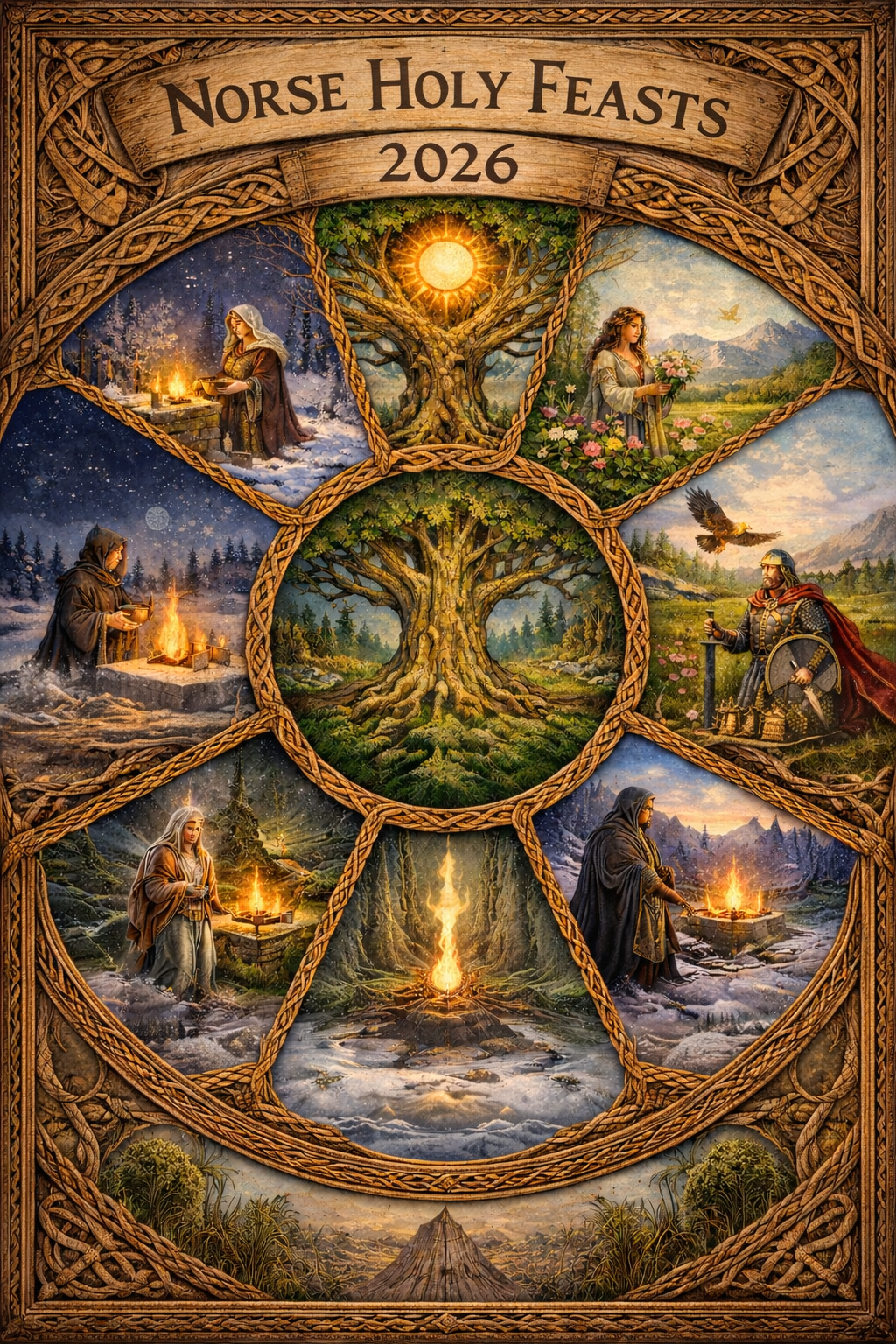
In the Norse world, time was not measured by fixed dates on a calendar. It was shaped by the land, the seasons, and the movement of the moon. Holy feasts were not universal holidays observed on the same day everywhere, but living traditions that followed natural cycles. Winter, light, darkness, growth and survival mattered far more than numbered days.
The Norse used a luni-solar system, where months began with the new moon and seasons were understood as phases rather than precise moments. Feasts were often held after key seasonal turning points, guided by lunar timing rather than fixed solar dates. This meant that observances could shift from year to year and from region to region. There was no single “correct” calendar, only systems that reflected local conditions and cultural understanding.
The dates given here for 2026 reflect this lunar reckoning. They are not presented as universal or absolute, but as one coherent way of observing the Norse sacred year. Other traditions and calculations exist, and they too reflect valid approaches. What matters is clarity, consistency and respect for the worldview behind the calendar, not rigid uniformity.
In the Norse understanding, sacred time was woven into life itself. Feasts marked moments of transition, gratitude, preparation and reflection. They honoured the gods, the ancestors, the land, and the unseen forces of fate. These observances were not about control, but about alignment - knowing when to act, when to prepare, and when to endure.
What Are Norse Holy Feasts?
Norse holy feasts were communal religious observances known as blót. The word blót does not simply mean sacrifice, but offering, devotion and shared responsibility between people, gods, ancestors and the land. These feasts were not private acts of belief. They were public, social events woven into the structure of everyday life. To take part in a blót was to take part in the spiritual wellbeing of the community as a whole.
Unlike modern religious holidays, Norse holy feasts were not fixed to specific calendar dates. There was no central authority dictating when or how they should be observed. Instead, feasts were shaped by seasonal change, agricultural cycles, weather patterns and lunar movement. This meant that the same feast might occur at slightly different times from year to year, or be observed differently from one region to another. Sacred time was flexible, living and responsive.
At their core, these feasts marked transitions. The beginning of winter, the depth of winter, the return of activity, the height of summer and the close of the harvest were all moments that demanded recognition. Survival in the North depended on understanding these shifts and responding to them wisely. Holy feasts provided moments to pause, reflect, prepare and give thanks. They were practical as well as spiritual.
Blót usually involved offerings of food, drink or animals, followed by communal feasting. The offering was not about appeasing distant gods, but about maintaining right relationship. The gods, ancestors and land spirits were understood as active participants in the world. By honouring them at key moments in the year, people sought balance, protection and continuity rather than miracles or domination.
These feasts also served an important social function. They reinforced bonds between families, settled disputes, renewed alliances and strengthened communal identity. To feast together was to affirm belonging. To refuse participation could be seen as a withdrawal from the shared life of the community. Sacred observance and social responsibility were inseparable.
How the Norse Measured Time
The Norse used a luni-solar system, meaning that months were counted by the moon while the year was anchored to the seasonal cycle of the sun. Each month began with the new moon, not the full moon, and this lunar rhythm structured daily life. Farming, travel, legal assemblies and religious observances were all influenced by these cycles. Time was something that unfolded and was recognised, not something abstracted and controlled.
Seasons were understood as periods, not moments. Winter did not begin on a single day, nor did summer arrive at an exact hour. Instead, seasonal shifts were recognised through environmental signs such as temperature, snow cover, animal behaviour and agricultural readiness. The winter solstice marked a turning of the sun, but it did not automatically signal the time for feast or celebration. In many traditions, the feast followed later, when the season itself was fully present.
This approach explains why Norse holy feasts were often observed after seasonal turning points rather than on them. The feast responded to lived reality rather than astronomical precision. Midwinter was not the shortest day alone, but the deep heart of winter, when hardship was real and endurance mattered most. Observing a feast after the first new moon following such a turning made practical and spiritual sense.
Regional variation was also normal. Scandinavia was not culturally uniform, and neither was its timekeeping. Local climate, geography and tradition shaped how people reckoned the year. What mattered was coherence within a community, not conformity across a wide region. A feast was “right” when it aligned with the land and the people living upon it.
Because time was measured in this way, Norse calendars were inherently flexible. Dates shifted from year to year, and no single version can be declared universally correct. This flexibility is not a flaw or a loss of precision. It reflects a worldview that valued responsiveness, awareness and alignment with natural forces over rigid structure.
When we attempt to place Norse holy feasts onto a modern calendar, we are always translating rather than reproducing. Modern dates serve as reference points, not replacements for the original system. Understanding how the Norse measured time allows us to approach these feasts with greater respect and realism, recognising that sacred time was once something lived, felt and negotiated with the world itself.
The Norse Holy Feasts of 2026
The following feast cycle reflects a Scandinavian lunar method of calculation, where observances are placed after the first new moon following seasonal turning points, rather than fixed solar dates. Historically, Norse feasts were fluid, local and responsive to land, climate and community. What follows is one way of walking the sacred year with awareness and continuity.
Jól / Midwinter - February 1st to 3rd (3 days)
Jól marks the deep heart of winter, when darkness, cold and endurance are fully present. In this reckoning, Jól is not tied directly to the winter solstice, but observed after the first new moon following midwinter. It is a feast of survival, continuity and renewal, honouring the gods, ancestors and the strength required to endure the hardest season of the year. Jól is not a single act, but a sacred period containing several important rites.
The first toast was dedicated to Odin for victory and power, the second to Njörðr and Freyr for prosperity and peace, and further toasts honoured ancestors, kings or local leaders. These toasts were made from specially blessed ale, emphasizing the sacred nature of communal drinking as a religious act.
Hauknótt - 1st February:
Hauknótt is observed as the opening night of Jól. It marks the threshold into the midwinter feast, a moment of transition where the old year’s weight is acknowledged and the sacred time of Jól begins. This night is often approached with reflection, preparation and ritual focus.
Sonargöltr - 2nd February:
Sonargöltr is the ritual of the sacred boar, traditionally associated with oath making and commitment. During Jól, vows were sworn over the boar, binding words to action for the coming year. This rite reflects responsibility, honour and the understanding that words spoken carry weight within wyrd.
Jólablót - 3rd February:
Jólablót is the central sacrificial rite of the Jól period. Offerings are made to the gods and ancestors, and the community gathers in shared observance. This marks the culmination of the midwinter feast, focusing on continuity, protection and the turning toward what will come.
Dísablót - 3rd March (3 days):
Dísablót honours the dísir, powerful female ancestral and protective spirits connected to family lines and fate. This feast is associated with fertility, protection and the unseen forces that shape life. It stands at the threshold between endurance and the first stirrings of renewal.
The dísir are often understood as female ancestral spirits, though they are not limited to direct ancestors alone. They exist somewhere between the human and the divine, representing the accumulated strength, memory and influence of those who came before. In this way, Dísablót is deeply rooted in lineage. It honours the women of the past whose lives, labour and endurance ensured survival and continuity.
Dísablót is strongly associated with protection and fertility, not only in the sense of childbirth or crops, but in the wider meaning of sustaining life. The dísir were believed to watch over families, influence luck, and shape how fate unfolded across generations. Honouring them was a way of maintaining balance, ensuring favour and avoiding disruption within the weave of wyrd.
Sigrblót - 2nd April (3 days)
Sigrblót marks the beginning of the active season and is associated with victory, strength and forward movement. Traditionally linked to the start of summer in the Norse reckoning, this feast focuses on preparedness, courage and the energy needed to step back into the world after winter’s restraint.
The primary figures honoured during Sigrblót are the gods associated with victory, protection and success in action. Most prominently, this includes Odin, who is closely linked to victory, strategy, leadership and the fate of warriors. Odin’s role is not simply as a god of battle, but as a god of knowledge, foresight and sacrifice. Honouring him at Sigrblót reflects the desire for wise action, not reckless strength.
Týr is also strongly associated with Sigrblót. As a god of law, justice and rightful action, Týr represents victory gained through honour and correct conduct rather than brute force. His presence reflects the understanding that true success depends on keeping oaths, acting justly and maintaining social order, especially as the active season begins.
In some traditions, Thor may also be honoured during Sigrblót, particularly for protection during travel, work and conflict. As the defender of both gods and humans, Thor embodies strength used in service of stability and survival. His inclusion reflects the practical realities of Norse life, where physical protection was as important as strategic victory.
Summer Solstice - 20 June:
The summer solstice marks the height of light and growth. While not as clearly defined as other blóts in surviving sources, this turning point was likely recognised as a moment of balance, fertility and protection. It stands as a pause within the year, acknowledging abundance and the power of the sun at its peak.
Unlike feasts such as Jól or Sigrblót, the summer solstice is not strongly tied to a single named blót in the surviving sources. Instead, it is best understood as a seasonal turning point that may have been marked in different ways across regions. What was honoured here was not only the gods, but the forces sustaining life itself.
Gods associated with fertility, prosperity and protection were likely honoured at this time. Freyr, connected to growth, peace and good seasons, fits naturally within the themes of midsummer. Thor, as a protector of the land and the one who guards against chaos and destruction, may also be honoured, especially in relation to storms, crops and the safety of the community during the active months.
Haustblót (Harvest / Autumn Blót) - 26 September:
This feast gives thanks for the harvest and acknowledges the closing of the productive season. It is a time of gratitude, reflection and preparation for the coming winter. Offerings are made in recognition of what has been received, and attention turns toward storage, foresight and balance.
Haustblót honours the gods, land and unseen forces that sustained life through the active months. Central to this blót is gratitude rather than petition. The harvest has already been gathered; the work has been done. What remains is recognition of what was received and acknowledgment of what will be needed to endure the coming winter.
Gods associated with fertility, prosperity and peace are most strongly linked to Haustblót. Freyr stands at the forefront, as a god deeply tied to good seasons, abundance, fertility of land and stability within society. Honouring Freyr at this time reflects thanks for successful crops, livestock health and the ability to sustain the household through winter.
Njörðr may also be honoured, particularly in communities connected to the sea, trade or travel. As a god of wealth, favourable conditions and prosperity, Njörðr represents the flow of resources that ensure survival beyond the fields alone.
Alongside the gods, the land itself is honoured during Haustblót. The earth has been worked, fed with labour and care, and now rests. Offerings at this time acknowledge the land as a living presence rather than a passive resource. This reinforces the reciprocal relationship between people and place that sits at the heart of Norse belief.
Ancestors may also be acknowledged during Haustblót, especially those who once farmed the same land or built the foundations that made survival possible. Their knowledge, choices and endurance are seen as part of the reason the harvest succeeded at all.
Vetrnætr (Winter Nights) - 26 October (3 days):
Winter Nights marks the beginning of winter in the Norse year. This is a significant transitional feast, acknowledging the shift into darkness, cold and inward focus. It is often associated with ancestors, land spirits and the acceptance of what cannot be avoided in the coming season.
Winter Nights primarily honours ancestral and land connected beings, rather than focusing solely on the gods. This reflects the seriousness of the season ahead. Winter was dangerous, unpredictable and unforgiving, and survival depended on forces closer to home than distant divine ideals.
At the heart of Vetrnætr are the ancestors. Both known and unknown ancestors are honoured, especially those who endured past winters and whose lives shaped the present household and land. Their strength, wisdom and survival are recognised as living influences within wyrd. Honouring them at the start of winter was a way of asking for guidance, protection and continuity through the hardest months.
Land spirits and local wights are also central to Winter Nights. As the land enters dormancy, it becomes powerful and demanding. Offerings at this time acknowledge the spirits tied to fields, forests, waters and boundaries, seeking balance and goodwill rather than control. Maintaining right relationship with the land was essential for survival and future fertility.
Álfablót - 24 November:
Álfablót is a private, household-based observance honouring the álfar, ancestral and land connected beings. Unlike public blóts, this feast was traditionally quiet and inward, often closed to outsiders. It reflects intimacy, ancestral connection and respect for unseen presences tied to place and family. In Norse belief, they exist somewhere between gods, ancestors and land spirits - In modern terms they are known as Elves.
Álfablót honours these ancestral presences as guardians of continuity and prosperity. Offerings were made to maintain right relationship, ensuring protection, luck and stability through the winter months. This observance usually took place in late autumn or early winter, when the land turned inward and ancestral influence was felt more strongly.
Unlike blóts dedicated to major gods, Álfablót was quiet and restrained. There were no large gatherings or open feasting. Instead, the focus was on respect, secrecy and attentiveness. In some accounts, strangers were actively turned away during Álfablót, reinforcing the idea that this was not a communal celebration but a familial rite.
Winter Solstice - December (12 days):
The winter solstice marks the turning of the light, the moment when the sun begins its slow return. In this framework, it is observed as an extended sacred period rather than a single feast day. While not identical to Jól, it holds deep symbolic meaning as a cosmic shift, a reminder that even in the deepest darkness, change is already underway.
Gods connected to light, renewal and continuity may be honoured at this time, depending on local tradition. Baldr, associated with light, purity and rebirth, is often symbolically linked to the solstice, particularly in later interpretation. However, this connection is not firmly attested in early sources and should be understood as interpretive rather than historical.
Sunna (Sól), the personification of the sun, may also be acknowledged, not as an object of worship in the later sense, but as a sacred force whose movement governed life itself. Honouring the sun’s return was an act of recognition rather than petition.
Many modern Norse pagans choose to celebrate Yule around the winter solstice, aligning their observance with the return of the light and later Germanic or contemporary traditions. While this differs from lunar based Scandinavian reckoning, it reflects a widely practised modern approach to midwinter devotion.
Taken together, these feasts form a living cycle, not a rigid schedule. Each observance marks a moment of alignment between people, land, season and fate. This calendar for 2026 offers one way to walk the Norse year with intention, awareness and respect for the rhythms that shaped Northern belief.
Across the year, we see different forces honoured at different times. Ancestors, land spirits and fate stand closest during the darker months. Gods of growth, protection and victory emerge as the world becomes active again. Some observances are public and communal, others private and inward. Together, they form a balanced rhythm, reminding us that life requires both action and stillness, celebration and restraint.