
Hermóðr: The One Who Crosses and Returns
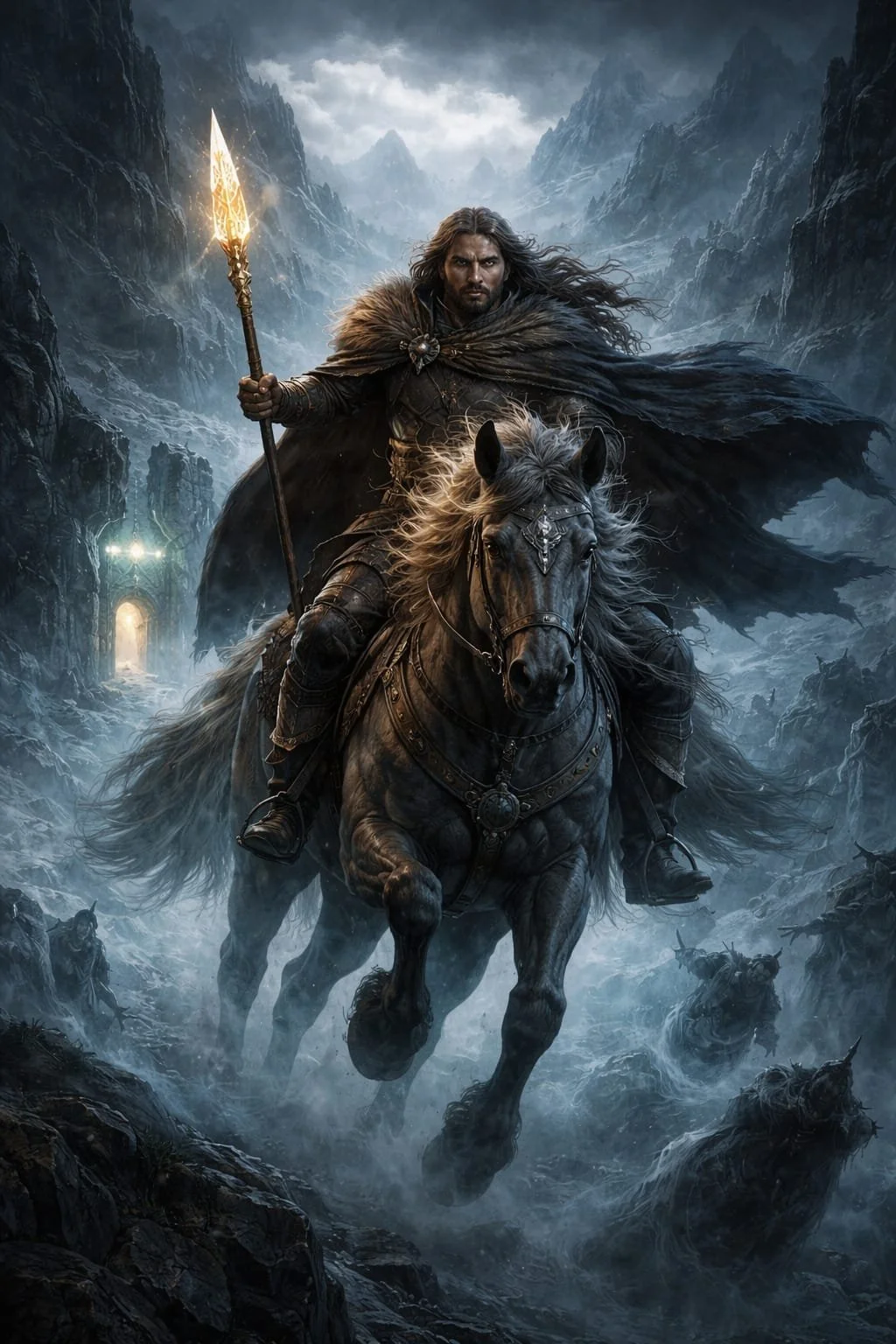
"Not all courage is loud. Some of it rides into silence and does not know if it will come back." - From the Lay of the Long Road, c. 11th century
Even as the hoofbeats that carried him have faded into myth, their echo endures. Between life and death, hope and acceptance, motion and exhaustion, Hermóðr rides.
Here is a god unlike the thunder of battle or the clarity of judgment: enduring, burdened, uncelebrated. His power is neither command nor conquest; it is passage. Hermóðr does not rule, decree, or conquer. He goes where others cannot, preserving continuity where rupture threatens.
He is not remembered for victory.
He is remembered for crossing.
Hermóðr is best known for his ride to Hel following Baldr’s death, acting as emissary between the living gods and the realm of the dead.
Note on Sources and Approach
Hermóðr is a figure from Norse cosmology whose surviving accounts are limited but significant, most notably preserved in Snorri Sturluson’s Prose Edda. He is not a god of death, nor a ruler of the underworld, nor a conqueror of fate. He occupies a liminal role, defined less by dominion than by movement. What follows is a mythopoetic synthesis faithful to the symbolic logic, cosmological structure, and moral gravity of Norse tradition, rather than a single exhaustive canonical account.
On the Name Hermóðr
In Norse cosmology, a name is never incidental; it is a condensation of function, fate, and essence. Hermóðr carries the weight of speed, resolve, and perilous courage - not the recklessness of haste, but determination shaped by obligation. He moves not for glory or reward, but because some boundaries demand crossing. In crossing, he preserves the fragile threads between realms.
Where Forseti steadies imbalance, Hermóðr prevents severance. One preserves harmony through stillness; the other preserves continuity through motion and risk. Both act where fracture threatens order. Before he rides, Hermóðr already embodies the crossing. His name is a promise that no realm remains isolated so long as someone is willing to traverse the distance between them.
Prologue: The One Who Went
Before grief had words, before the gods could agree on blame, before rage hardened into certainty, Baldr lay dead. The halls of Asgard did not erupt - they stalled. Sound thinned. Motion ceased. The cosmos itself seemed to hesitate, unsure how to proceed when light had fallen.
No weapon could be raised against death.
No law could recall what had passed beyond breath.
In that suspension, Hermóðr stepped forward. Not appointed. Not commanded. Not crowned by prophecy. He went because someone had to.
This is the axis upon which his myth turns. While others deliberated, mourned, or raged, Hermóðr accepted a road offering no assurance of success. His courage was not defiance of fate, but the willingness to confront it directly, to ask whether return was possible.
Introduction: The Weight of Motion
Hermóðr is the god of necessary movement in a cosmos that exacts a price for travel. Son of Odin by some accounts, kin to gods of thunder and wisdom, he inherits none of their spectacle. His inheritance is heavier: the obligation to act when stillness could fracture worlds.
In the Nine Realms, where boundaries define existence and crossing them exacts a price, Hermóðr bears that cost. Unlike Thor, whose strength shatters obstacles, or Forseti, whose presence restores equilibrium, Hermóðr’s power lies in endurance - physical, emotional, and spiritual.
He teaches that not all courage seeks triumph. Some courage seeks connection. Some journeys are undertaken not to change the outcome, but to ensure that loss does not become isolation, that death does not become silence, and that grief does not sever the living from meaning.
Hermóðr embodies the principle that continuity itself is sacred. Motion, guided by love and responsibility, can hold the worlds together even when restoration is denied. His ride to Hel is not a myth of victory - it is a testament to resolve, reminding gods and mortals alike that the road must sometimes be walked simply because it exists.
The Silence Between Worlds
Hermóðr moves where silence is not absence, but threshold. Between Asgard and Hel, between breath and stillness, between the warmth of memory and the cold of finality, there exists a quiet that presses inward.
It is not emptiness; it is resistance. Every step through it must be earned. This silence is heavier than grief. Grief cries out, demands witness, seeks response. The silence Hermóðr enters offers nothing: no reassurance, no omen, no promise that words will matter.
Yet Hermóðr does not mistake silence for refusal. He understands that thresholds do not announce themselves. They must be crossed deliberately, without certainty, without applause. Where Forseti listens to the silence between words to uncover intent, Hermóðr listens to the silence between worlds to determine whether passage is still possible.
In this liminal quiet, identity thins. Titles lose weight; even divine authority dulls. What remains is resolve stripped of ornament. To continue is to accept vulnerability as the price of connection. Hermóðr advances not because the silence yields, but because it must be honored.
The silence does not answer him. It allows him through.
The Roads of Descent
There is no single road to Hel. Many exist, and none are kind. None are paved for triumph, nor marked for return. Each bends downward, away from warmth and familiarity, toward a realm that welcomes no interruption. These roads are guarded not by walls or weapons, but by endurance. The cost is paid not in blood, but in persistence.
Hermóðr rides Sleipnir across these paths, and even the eight-legged steed feels the strain. The land resists forward motion. Valleys lengthen. Rivers remember every crossing and test each new one. The farther he descends, the thinner certainty becomes, until progress itself feels like defiance, not against authority, but against finality.
Unlike Glitnir, which invites disputants into reflection, the roads of descent offer no mirrors. There is no opportunity to argue, to persuade, or to refine one’s case. The road does not care why you travel. It only measures whether you can continue.
Here, Hermóðr’s authority is irrelevant. He is not received as a god, nor challenged as an intruder. He is simply a traveler moving against the current of ending. His strength lies in acceptance of this truth: passage is not negotiated at the gate, but proven along the way.
Each mile strips away expectation. Hope quiets, tempered but not extinguished. By the time Hel’s realm rises, Hermóðr rides no longer with desperate urgency, but with the steadiness of someone who understands: arrival itself is an act of courage. The roads teach without cruelty; descent is not punishment. It is preparation
Light and Shadow of Passage
Passage is rarely straightforward. Hermóðr moves through a realm where every step carries both risk and revelation. The path to Hel is neither purely dark nor purely illuminated; it is a landscape of perception, endurance, and consequence.
The light is rare, subtle, and mercilessly honest. It illuminates truths Hermóðr must confront: grief, mortality, and divine limits. Shadow conceals dangers, missteps, and the quiet temptation of retreat. He cannot rely on clarity alone. He must interpret both what is seen and what is withheld, moving steadily despite uncertainty. Mercy and rigor coexist here. Every misstep instructs; every hesitation is measured. The landscape teaches and tests, forcing recognition of mortal limits, obligation, and consequence. Courage is measured not by combat, but by persistence under unrelenting conditions.
True passage, Hermóðr demonstrates, is not the absence of fear, nor the promise of success. It is deliberate motion, sustained through insight, patience, and acceptance of risk. Each mile teaches that continuity is a sacred achievement, that the journey itself carries a power unmatched by force or spectacle. The crossing is never final, never simple, yet it endures - a testament to those willing to move when stillness would be easier. Hermóðr rides through both light and shadow, understanding that in their interplay lies the measure of all journeys worth taking.
Lineage of Obligation
Hermóðr inherits not spectacle, nor the fiery authority of the Æsir, but the weight of responsibility - the burden of movement when inertia could fracture worlds. Son of Odin and a mother of less celebrated lineage, he carries a dual inheritance: courage tempered by wisdom, action guided by purpose. From this flows a single truth: some journeys must be undertaken, some truths delivered, some crossings cannot be refused.
Where Baldr embodies radiance and Thor embodies force, Hermóðr embodies duty in motion. Divine expectation fused with human awareness of cost. His roads are not for glory; they sustain order. Without him, the separation of life and death would remain absolute; without his willingness, grief would harden into despair, and connection fray.
The myths leave ambiguity about his parentage, his rank, and even his ultimate purpose. Yet all accounts converge on one principle: Hermóðr’s courage is functional, his endurance sacred, and his crossing indispensable. In his lineage, obligation and motion are inseparable - a legacy binding him to the worlds both living and departed. He rides not for triumph, but because the cosmos requires a messenger willing to move where others cannot. His inheritance is responsibility; his expression is motion; his authority is necessity itself.
The Voice of the Messenger
Hermóðr speaks rarely, but when he does, his words bear the weight of the journey. He does not shout, command, or argue to win. His voice is measured, deliberate, infused with the knowledge of distance traveled, obstacles overcome, and consequences faced. Attention comes not from volume, but presence.
When he approaches Hel or speaks to the gods of Asgard, each word is carefully chosen, each pause intentional. His speech illuminates without blinding, reveals without coercion. He does not demand Baldr’s return; he presents the possibilities, the conditions, and the truths the living must confront. His authority does not lie in fiat, but in the quiet force of someone who has journeyed where few dare to tread and returned bearing insight.
Hermóðr’s tongue is sharper than any sword in precision, softer than any lull in compassion. It untangles grief, clarifies intention, frames reality without embellishment. To hear him is to feel the gravity of crossing: actions have consequences, some outcomes are contingent, and courage is measured in the willingness to move, not in triumph.
Even the gods respect his counsel. Odin listens, weighed by knowledge and prudence. Loki, mischievous and capricious, finds no leverage against truth born of passage. Mortals, too, encounter echoes of Hermóðr’s voice in acts of necessary courage - the words spoken when someone chooses to act in the absence of certainty, guided by duty rather than desire. In every utterance, Hermóðr teaches that the power of motion - ethical, deliberate, and sacrificial, is more enduring than the clamor of triumph.
Hermóðr in the Mortal Realm
Hermóðr’s influence extends beyond the edges of the Nine Realms. Whenever a person chooses to act where others hesitate crossing dangerous boundaries, speaking painful truths, or moving into the unknown - Hermóðr’s presence is felt.
He is the god of necessary courage, accompanying human action when fear tempts inaction. In settlements, households, and gatherings, his ethos manifests quietly. The leader who negotiates between hostile factions, the traveler who carries aid into perilous lands - all enact Hermóðr’s principles. Even without temples or rites, his spirit endures whenever someone steps forward despite uncertainty or danger.
Hermóðr teaches that the value of courage is not in glory, but in continuity. Motion maintains connection; speech maintains life; action preserves hope. The mortal world, fragile and finite, depends upon such crossings. Every decision to go where others would stay reinforces the unseen network binding the human and divine. Through mortals, Hermóðr ensures grief is not isolation, loss is not silence, and death is not finality. His quiet presence reminds us that courage is participatory: enacted, witnessed, and perpetuated by those willing to move when standing still would be easier.
Comparative Mythologies
Hermóðr’s archetype is not unique to Norse cosmology. Across cultures, figures arise to embody the courage of necessary motion, the endurance of thresholds, and the resolve to traverse realms others cannot:
Orpheus (Greek Mythology): Descends into the underworld for love, navigating perilous passage where others dare not tread, bound by conditions beyond his control.
Inanna / Ishtar (Mesopotamian Mythology): Crosses into the underworld to confront death, returning transformed and carrying knowledge of balance between life and the underworld.
Anubis (Egyptian Mythology): Guides the dead through boundaries between life and death, ensuring continuity without dominion.
Hermes Psychopompos (Greek Mythology): Escorts souls across liminal thresholds, emphasizing the necessity of movement and guidance through transition.
These figures demonstrate a universal truth: the act of crossing, bearing burden, and returning is sacred. It preserves connection, conveys truth, and upholds threads of order that might otherwise unravel. Hermóðr is the Norse embodiment of this archetype - a god who carries what cannot be carried by others, ensuring death, loss, and grief remain part of the living story rather than absolute ends.
Why the Crossing Must Be Made
In the Norse cosmos, separation is perilous. Death, grief, and silence can fracture worlds as surely as any war or storm. Without Hermóðr, Baldr’s death might have remained an irreparable rupture - a silence hardened into despair.
Some thresholds, once left untraveled, become impassable; some truths, once unspoken, corrode bonds between realms. Hermóðr’s crossing is not ornamental - it is necessary, maintaining continuity where inertia would divide.
By moving into Hel, he carries not just grief, but also potential understanding, connection, and the knowledge that endings must sometimes be witnessed to retain meaning. Hermóðr reminds us that courage is not about confrontation nor victory. It is about acknowledgment, persistence, and bearing what others cannot. He presses against inevitability, not to overturn it, but to preserve the integrity of life, death, and the delicate bonds between them. Without the messenger, worlds would remain fractured. With him, even loss becomes a path toward understanding - a road that honors what is gone without allowing it to sever the living from purpose or memory.
Sleipnir, Descent, and Wyrd
Sleipnir carries Hermóðr as the wolves carry the sun and moon: relentlessly, inevitably, with purpose shaping the rhythm of existence. Where Skóll and Hati pursue celestial bodies to preserve cosmic order, Hermóðr rides to preserve continuity between realms - a subtler, less visible labor, but no less vital.
The descent to Hel is a journey through wound and waiting, through silence that tests endurance and solitude that measures resolve. Motion here is moral as well as physical; every hoofbeat, every measured pause, carries consequences for gods and mortals alike. Hermóðr presses against grief, fear, and disbelief, ensuring that the dead are honored, the living informed, and that no rupture becomes absolute.
Wyrd threads the journey, binding past, present, and potential future. Each choice he makes, each mile advanced, touches lives far beyond the road itself. Without this motion, separation would harden into isolation; with it, loss becomes conduit, grief becomes remembered, and connection endures. Hermóðr does not strike like Thor, nor command like Odin. He rides. And in riding, he preserves the fabric of existence, unseen yet indispensable a quiet force threading life, death, and fate through necessary motion.
A Parable of the Road
A messenger is called to deliver news of death to a distant village. He hesitates, knowing the words will wound, knowing the path is long and the terrain unforgiving. Others stay behind, preferring comfort over necessity. Yet he mounts and begins the journey, understanding that motion is the only way to honor what must be conveyed.
Days pass. The road stretches beyond endurance, shadows lengthen, and every step tests resolve. The messenger does not falter for pride, nor seek reward. Each mile is measured by the burden he bears, by the obligation to carry truth without distortion, by the courage required simply to arrive.
When he reaches the village, he speaks. His words are unadorned, deliberate, precise. No comfort is promised, no blame imposed. Yet in hearing, the villagers grasp not only the loss, but also the thread connecting them to what remains. The messenger’s presence shapes understanding more than his words alone.
He departs, leaving no accolades, no lasting mark on the road itself. And yet the act of his passage endures. The village remembers, the loss is acknowledged, and connection is preserved. The messenger’s courage, ordinary and monumental at once, becomes the bridge between what has ended and what must continue.
This is Hermóðr’s domain not victory, not triumph, but the sacred motion of necessary crossing, where the act of going transforms absence into continuity, silence into witness, and despair into a path forward.
Stories of Hermóðr
The myths recount moments when Hermóðr’s crossings shaped fate without altering inevitability.
Once, after Baldr’s death, the Æsir despaired. Fracture hovered over Asgard. No counsel could restore certainty, no weapon could return what was lost. Hermóðr mounted Sleipnir, riding nine nights through shadowed valleys and across rivers that remembered every passing soul. By the time he reached Hel, he had already enacted his power: endurance itself had become a statement a bridge connecting despair to possibility. Though Baldr could not immediately return, Hermóðr brought knowledge, conditions, and the framework for eventual restoration, preserving hope where silence threatened to harden.
Elsewhere, among the gods, mischief and misunderstanding festered. Loki’s schemes teetered on disruption, threatening discord even in the face of grief. Hermóðr’s ride - unheralded, unarmed, uncelebrated - reminded gods and mortals alike that action guided by courage and duty carries more weight than deception or inaction. His presence alone reshaped perception: motion, when undertaken for necessary ends, reverberates across realms.
These stories endure not as accounts of glory, but as templates of essential courage. Courage, the myths suggest, is not always triumphant; sometimes it is simply enacted. Hermóðr’s victories are subtle yet lasting - the preservation of connection, the acknowledgment of loss, the endurance of motion where stillness would fracture the world. In every tale, his crossing transforms absence into continuity, despair into witness, and inevitability into purpose.
Encounters on the Threshold
Hermóðr does not act in isolation. Every crossing intersects with the lives of those he touches -gods and mortals alike - and each encounter is a delicate negotiation of attention, respect, and consequence.
When he arrives in Hel, he meets its mistress not with defiance, but with acknowledgment. Hesitation, grief, and fear are met with clarity, not coercion. Every question he poses, every phrase he frames, is calibrated to reveal truth and preserve connection. Even Loki, mischievous and evasive, finds no purchase against the clarity born of passage. Odin, ever wise and measured, listens with deference to the messenger who has gone where few would tread.
Among mortals, Hermóðr’s presence manifests whenever courage must be enacted against fear. The messenger does not command action; he enables recognition of what is necessary. Every interaction reinforces a principle: continuity is preserved not through force, but through deliberate, informed motion. In these encounters, Hermóðr demonstrates that courage is relational. It requires presence, awareness, and accountability. He does not resolve every conflict, nor prevent every loss. Yet through his crossings, others are guided to act, to bear witness, and to participate in the sacred continuity that motion alone can sustain.
Trials of Passage
Hermóðr’s journey is not without peril, though his battles are seldom fought with weapons. Here, the trials are of endurance, will, and moral clarity. The road to Hel tests mind, body, and spirit, confronting the messenger with fatigue, doubt, and the stark reality of mortality.
At times, the path resists. Rivers swell, winds howl, and the ground itself threatens to undo progress. Mortals and gods alike would falter if faced with such relentless necessity. Hermóðr endures, not through brute strength, but through steadfast purpose and careful attention to each step. His is a battle of continuation, where hesitation is the enemy and resolve the only weapon.
On rare occasions, he encounters beings unwilling to honor the passage. Shades, spirits, and forces of obstruction challenge him not with malice alone, but with the weight of inevitability, the pull of despair, and the demand of natural law. His responses are subtle yet unyielding: demonstration of consequence, navigation of danger, and the quiet insistence of moral motion.
These trials resemble storms without destruction, tests that leave no scars but demand total presence. Victory is measured not in defeat of adversaries, but in the preservation of connection, the assurance that the living and dead remain linked, and that loss is acknowledged without severing hope. Hermóðr fights the battles that truly matter: the ones of endurance, witness, and necessary motion.
Skills of Hermóðr
Hermóðr’s mastery is subtle but profound, honed through countless journeys across realms and thresholds.
Endurance: His greatest weapon is the ability to continue when body, mind, and spirit all urge stillness. The roads to Hel are unrelenting; every step tests strength, yet Hermóðr moves steadily, transforming persistence into power.
Perception: He reads the unseen currents of grief, fear, and expectation. Mortals and gods alike cannot hide intentions or vulnerabilities from him; he discerns what must be carried, what can be left, and what requires careful negotiation.
Articulation: Though rare, his speech honors both living and dead. Each word shapes understanding, frames reality, and conveys what cannot be borne silently.
Timing: Motion alone is insufficient; Hermóðr chooses the moment to depart, the path to follow, and the cadence of his speech with deliberate care. Patience and urgency coexist in his decisions, each calibrated to preserve continuity and mitigate harm.
Through these skills, Hermóðr orchestrates outcomes that maintain cosmic and mortal order. He reminds us that courage is not only action, but insight; that motion is not merely movement, but an instrument of preservation. His mastery is quiet, persistent, and indispensable the proof that endurance and discernment can hold worlds together when spectacle or force could not.
Death and the Return
Hermóðr is not a god of endings, yet he confronts mortality in a singular way: by ensuring that passage, memory, and consequence endure. Death, once it occurs, threatens to sever the living from the lost, grief from acknowledgment, and hope from continuity. Hermóðr rides to confront this fracture, to witness what others cannot, and to preserve the threads that bind realms together.
When a mortal dies, when a god mourns, when loss threatens to become isolation, Hermóðr carries the message and witnesses the transition. His journey transforms absence into acknowledgment, despair into comprehension. The road he travels becomes a conduit through which continuity persists, and through which separation does not solidify into irreparable isolation.
Even after the crossing, his influence remains. The memory of his journey, the recognition of his endurance, echoes across realms. Loss becomes understood, grief becomes shared, and the living retain a measure of connection to what has passed. Hermóðr ensures that death does not destroy order, but tests it, and that the act of witnessing becomes a sacred extension of life.
Vows of the Messenger
Hermóðr’s journeys are bound by unspoken covenants - pledges of duty, fidelity, and courage that connect action to consequence. Every crossing is a vow: to endure, to witness, and to preserve the continuity of life and death. These are not formalized in temples or carved in stone, but enacted in motion, witnessed by gods, mortals, and the unseen eyes of fate itself.
When he departs for Hel, the commitment is implicit - he will ride the perilous road, deliver truth without distortion, and return if possible. This vow carries weight beyond recognition; it binds Hermóðr to the work of maintaining connection and honoring what must be acknowledged. Mortals, too, mirror this principle whenever they act courageously, fulfill promises in the face of fear, or speak truths that are difficult but necessary.
Even the gods respect these pledges. Hermóðr’s motion, witnessed by Odin, Hel, and the assembled Æsir, creates anchors of accountability. Tricksters may attempt to subvert intention, but the crossing undertaken under such a vow cannot be undone. A promise carried across the threshold whether of movement, message, or witnessing ensures that consequence and integrity remain aligned.
Final Reflection - “The Messenger in Us”
To live in the spirit of Hermóðr is to confront the necessity of action when inaction would fracture connection. Every threshold, every moment of uncertainty, every instance where fear tempts hesitation, becomes a test of courage and responsibility. The messenger asks not, “Can I succeed?” but, “Will I move when movement is required?”
Hermóðr reminds us that courage is not always triumphant. It is deliberate, sacrificial, and relational. To honor him is to act where silence might otherwise dominate, to witness what others avoid, and to carry the weight of consequence without expectation of reward. Passage itself becomes sacred; endurance itself is heroic.
Even unseen, Hermóðr functions as the pulse beneath action the quiet insistence that continuity can be maintained, that grief can be acknowledged, that loss can be integrated rather than allowed to sever. To embody his spirit is to move with awareness, to speak with integrity, and to accept the cost of crossing, knowing that motion, responsibility, and courage are inseparable.
Question to the Reader
Hermóðr does not ask, “Will you succeed?” He asks, “Will you move when the path demands it?”
When the road is uncertain, do you linger in comfort or step forward despite fear?
When grief, loss, or duty calls, do you speak the words that must be spoken, even if they wound or tremble? Are you willing to bear the burden of responsibility, knowing that some journeys carry no applause, no guarantee, no certainty of return?
Every action, every choice, every step carries consequence. In life, as on the threshold between realms, the motion you take can preserve connection, continuity, and understanding. Hermóðr asks that you reflect: will you wait, or will you ride into the necessary road, guided by courage, insight, and obligation? will you wait, or will you ride into the necessary road, guided by courage, insight, and responsibility?
Hermóðr: Not Conqueror. Not Silent Observer. Not Fearless in Triumph
He is the eternal messenger, threading the living and dead together, ensuring separation never hardens into isolation. He carries burdens others cannot, preserves continuity others neglect, moves where stillness would fracture worlds. He seeks no glory, dominance, or spectacle. His authority is necessity enacted through courage; his victories are preservation, not conquest. Absence becomes acknowledgment, despair becomes witness, inevitability becomes continuity.
May your journeys be undertaken with awareness, your actions guided by duty, and your courage steady when the path is perilous. Let Hermóðr remind you that even when roads are dark, thresholds unwelcoming, and outcomes uncertain, motion, witness, and responsibility hold the world together.
Wyrd & Flame 🔥 🌌 🐎
