
Landvættir: The Nature Spirits of Norse Belief
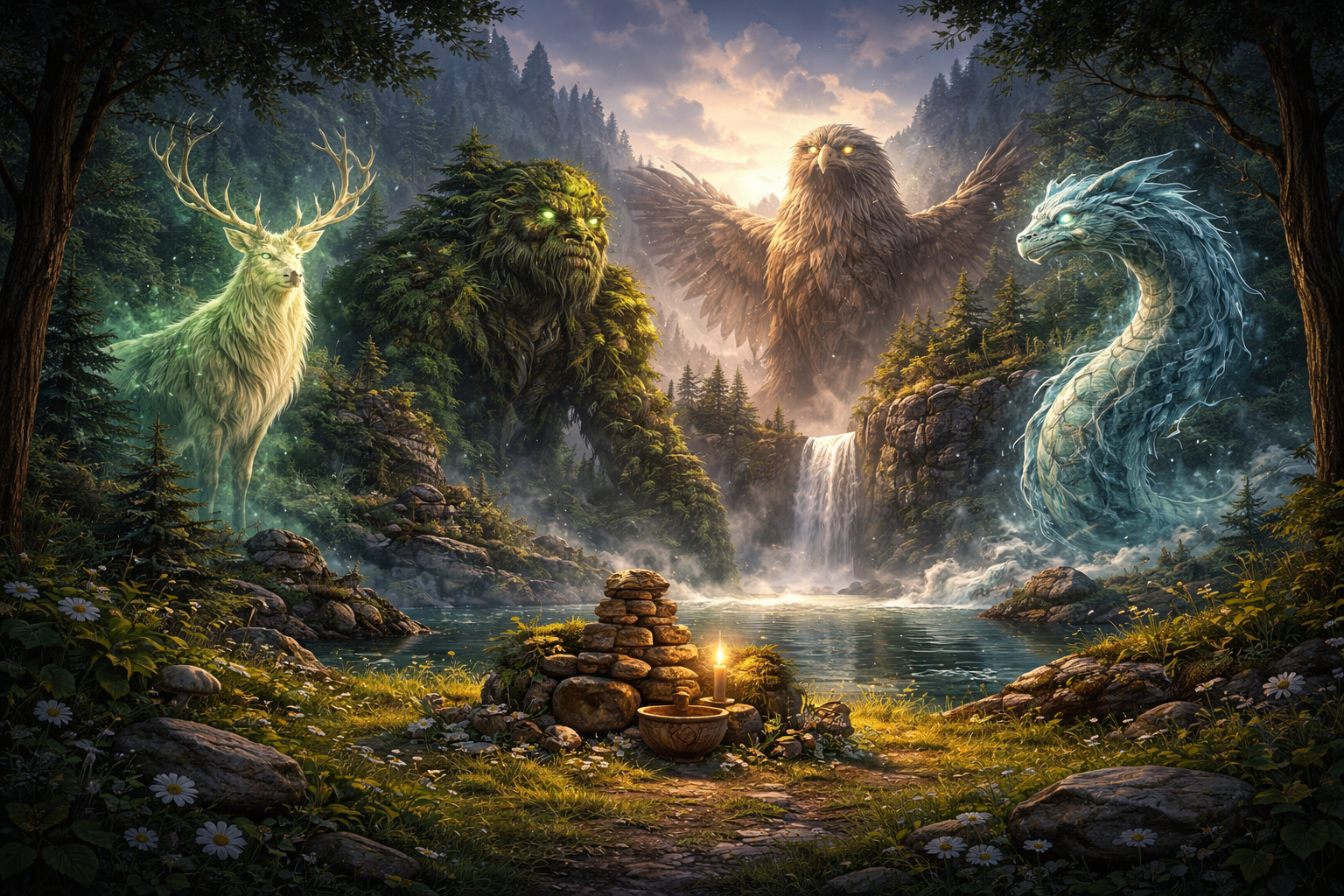
Wherever we walk, something watches. Not with eyes like ours, not with a human mind, but with a presence older than memory and rooted deep within soil and stone. Long before the first Norse settler pushed a boat onto Icelandic shores, before farms, halls or churches stood, the land was believed to be alive with unseen guardians. These beings were the landvættir - spirits of rock and field, mountain and water, quiet dwellers in the places we call home.
The old stories rarely shout their names. They appear like a whisper on the edge of a saga, a warning to remove the dragon-heads from ships before landfall, a blessing given when a farmer treats the earth well. They are not god-like figures demanding worship, nor monsters waiting to strike, but something in-between: spirits of place, woven into the landscape like roots beneath grass. They are protectors, listeners, watchers who reward respect and withdraw when offended. And in their silence, they carry the weight of ancient relationship between humans and the land that sustains them.
To the Norse, land was never just ground underfoot - it was alive. Hills might have moods, rivers might remember, and fields could turn against a careless hand. A person did not own land, they lived with it. The landvættir were proof of that relationship, invisible neighbours whose goodwill could mean fertile crops, good fortune, or a safe journey home. Their displeasure, however, could bring storms, lost animals, or a house where nothing seems to settle right.
Today, many modern pagans and heathens still feel that quiet presence on wind-swept moors, in ancient woods, or even in the small green spaces beside our homes. Offerings left on stones, a whispered greeting at a riverbank - gestures echoing the old ways. The land spirits may not speak in words, but the sense of being seen, of being received, is something many recognise.
In this blog, we will step into that hidden world - exploring who the landvættir are, where they appear in sagas and law codes, how people once honoured them and how many still do today. We will look at the four great guardians of Iceland, the spirits of hill and water, and the etiquette of walking on land that remembers. By learning about them, we move closer to the mindset of our ancestors - one that understood that the world is not dead matter, but living presence.
The land has a voice. The question is whether we still know how to listen.
What Are Landvættir?
Landvættir are, at their heart, spirits of the land itself. They are not gods, nor ancestors, nor human souls - they are something more elemental. They belong to the soil, the rock, the river, the tree roots and windswept hills. Each one is tied to a specific place, and that place shapes their nature. A landvættir of a quiet bog is not the same as one who dwells beneath a cliff battered by ocean storms. They reflect the mood and memory of the land they guard.
Rather than being a single type of being, landvættir form a wide family of nature spirits. Some are gentle and curious, watching quietly as life grows and seasons turn. Others are stern, unpredictable, or easily offended when disturbed. They are not human-like in thought, but ancient in presence - closer to the pulse of the earth than to the minds of gods. When we speak of landvættir, we speak of the character of a place given form.
Landvættir rarely appear directly in the myths the way gods do. They do not boast, wage war, or weave dramatic tales. Instead, they linger in the spaces between stories, in quiet warnings and long-held customs. A farm that prospers year after year might be said to have friendly spirits. A rocky ridge where travellers are always uneasy might be home to restless ones. To the Norse, fortune was not random. The land remembered how it was treated, and its spirits responded.
They are guardians, but also neighbours. In sagas, they protect regions from invaders or storms, guide those who show respect, and withdraw their favour when offended. When angered, they might cause bad weather, accidents, or a general sense of unease. When honoured, they bring peace, good harvests, and the feeling that one belongs upon the land.
In short, landvættir are the living presence of nature. To know them is to see the world not as a backdrop, but as a companion. They remind us that we walk on living ground, and that every field and river has a spirit within it - watching, remembering, waiting to be acknowledged.
Origins and Historical Sources
Although the landvættir rarely take centre stage in surviving Norse myths, they quietly shape the background of daily life across Iceland and Scandinavia. Their presence can be felt more in customs, laws, and whispered beliefs than in heroic stories. To understand who they were to our ancestors, we turn to the sagas, law codes, and scattered references that survive in medieval writing.
In the Landnámabók (The Book of Settlements), which documents the early colonisation of Iceland, landvættir appear not as abstract spirits but as active protectors of territory. The text tells how a sorcerer attempted to enter Iceland in the shape of a whale, scouting for places to attack. Wherever he swam, the land spirits rose against him - great beasts that guarded the island’s shores. Their presence was enough to drive him away. This story reveals two things: first, that the land was not to be conquered lightly, and second, that its spirits could defend it without a single human sword raised.
The law codes of Iceland also reflect a deep respect for these beings. One of the most striking examples is the ban on carving dragon-heads on ships when approaching land. Warriors could sail with fierce prows at sea, but as they neared the coast they were required to remove them. The reason was simple - to avoid frightening or angering the landvættir, who might otherwise drive settlers away or curse their efforts. A simple act of lowering a figurehead became a gesture of respect to the unseen powers that dwelled ashore.
In the sagas, landvættir appear as both helpers and warners. A farmer might dream of a figure asking for a stone wall to be moved, or a strange event might signal a place where offerings should be left. Sometimes they are described almost like animals, sometimes like shining figures, sometimes only by the effects they cause. Their forms are rarely fixed, perhaps because they are less bodies than presence. They are the spirits of place - impossible to fully define, yet strongly felt.
Even after the conversion to Christianity, belief in landvættir persisted quietly in Icelandic tradition. Folklore speaks of spirits living in hills and stones, of hidden folk guarding certain fields or streams. Many Icelanders today still avoid disturbing specific rocks believed to house spirits, and builders sometimes consult seers before moving earth. Though centuries have passed, the land is still treated with a kind of reverence - as if the old spirits might still be listening beneath the moss.
Landvættir exist in the spaces where history meets belief, where law meets superstition, where myth touches soil. The sources that mention them may be few, but the marks they left on culture, behaviour, and imagination are unmistakable.
Types of Land Spirits
When we speak of landvættir, we are not referring to a single, uniform type of spirit. They vary as widely as the landscapes they inhabit. A spirit born in the stillness of a marsh will not behave like one rooted in a mountain of basalt and storm. Every place shapes its guardian, and the old Norse understood this instinctively. They recognised that the land has a thousand faces, and each face may carry a spirit of its own.
Below are some of the main types of landvættir as they appear in lore, folklore, and modern practice:
Mountain, Rock, and Field Spirits -
These are perhaps the most commonly referenced. They dwell in high ridges, boulder-strewn hills, grassy meadows and windswept plains. Their presence can feel steady and ancient, like the land itself thinking slowly beneath you. Some are protective and nurturing, others stern and territorial. Farmers often sought their favour through simple offerings, believing that crops grew better when the spirits were pleased.
Forest and Grove Spirits -
In wooded places, landvættir may take forms tied to trees, roots, and leaves. Some stories speak of figures moving between trunks like shifting shadows. Others describe an atmosphere - the sense of being watched when you enter certain woods. Cutting trees without thought or leaving waste in forests was believed to anger these beings. Many heathens still greet the woods before stepping inside.
Water Spirits (Lakes, Rivers, Springs, Shorelines) -
Where water flows, spirits follow. These can be gentle or deeply unpredictable. Rivers in particular demand respect, and some folklore warns against bathing or fishing without acknowledging the presence that dwells there. Springs have long been places of offering across Northern Europe, and shoreline landvættir were seen as the first to greet travellers arriving by sea.
Household and Local Spirits -
Though not always separated from landvættir, some spirits attach themselves to human-built spaces - barns, hearths, or the boundary between home and field. They may be more interactive, helping or hindering depending on treatment. Offerings of milk, bread, or ale were common. A well-tended home was believed to be a happy one.
Wild and Unsettled Landvættir -
Some places hold spirits that feel untamed - dangerous cliffs, deep bogs, or places where people instinctively speak softly. These beings are not malicious but powerful, like natural forces with teeth. They remind us that not every part of the land is meant to be conquered. Some ground is best walked with caution, or not walked at all.
These categories blur and overlap. Landvættir rarely fit neatly inside a box because they are shaped not by names but by land, weather, history, and memory. A single mountain might hold a spirit older than any story. A river spirit might shift with the flood, gentle in summer and fierce in spring thaw. The type matters less than the relationship. What defines a landvættir is not its appearance, but its connection to place.
Every field, stone, and stream may hold a watcher. And just as no two landscapes are the same, no two landväettir are either.
Landvættir and Iceland - Four Guardians of the Land
Among all lands touched by Norse belief, Iceland holds a special relationship with its landvættir. They are not merely background spirits there - they are woven into identity, history, and even national imagery. The Landnámabók tells how early settlers were warned that the island was fiercely protected. Anyone approaching its shores risked facing powers that would not tolerate disrespect or invasion.
From this lore come the Four Great Landvættir of Iceland, guardians of the island’s four quarters. They are not small household spirits, but vast beings tied to the shape of the land itself. Each stands watch over a direction, forming a protective circle around the island:
The Dragon of the East -
Coiled and watchful, the dragon represents ferocity and defence. In the tale of the scouting sorcerer-whale, this spirit rises from the shore in a shape so terrifying that the intruder flees. It speaks of fiery will, of volcanic might sleeping beneath the earth, of a land not easily trespassed.
The Griffin (or Eagle) of the North -
Feathers, wind, wide wings across cold skies - this landvættir belongs to storm and height. It is sharp-eyed, restless, the spirit of mountains and biting air. Some versions call it a griffin, others a great bird. Either way, it soars where few can follow, guarding the wild northern terrain.
The Bull of the West -
Heavy with strength, patient and enduring, the bull stands for grounded power. He is the spirit of fertile fields, grazing land, and quiet endurance. A bull does not rush - he pushes forward with steady force when needed. This guardian holds the western coast like a wall of muscle.
The Giant of the South -
Massive as cliffs, rooted in stone, the giant embodies mountains and ancient weight. Slow but unstoppable, like glaciers carving deep valleys. Where the east has the dragon’s fire and the north has storm-wings, the south stands with raw, immovable presence. A reminder that the land itself can rise against those who threaten it.
These four figures became so central to Icelandic identity that they appear on the country’s coat of arms today - not as relics of superstition, but as honoured symbols of the land’s protective spirits. It is one of the clearest examples of landvættir belief carried into the modern world, not only surviving but standing as a national emblem.
Their presence teaches a crucial truth about Norse worldview: land was never passive. It guarded itself. It accepted settlers only when approached with humility. Even now, Icelandic culture holds strong taboos around moving ancestral stones, disturbing certain hills, or building without regard for hidden folk and land spirits. Construction projects have been rerouted because of them. Roads curved to spare boulders believed to be home to spirits.
In Iceland, the land is alive, and its guardians still stand watch.
How Landvættir Interact with Humans
The relationship between people and landvættir has always been one of respect, exchange, and awareness. Unlike the gods, who may be called upon for victory or wisdom, landvættir are far more local and immediate. They are neighbours rather than distant powers. Their presence is felt not through grand miracles, but through subtle shifts – a harvest that thrives, animals that calm, a journey that passes safely when the weather might have turned.
In the sagas and later folklore, landvættir respond to the way humans treat their land. A farmer who cared for his fields, spoke politely to the ground, and left offerings might find his cattle healthy and his crops abundant. One who cut trees carelessly or polluted streams could expect misfortune or illness. In this way, the spirits act as guardians of balance. They encourage good land-stewardship and punish thoughtless behaviour. The land remembers how it is treated.
Many tales describe landvættir warning or aiding people. A traveller might dream of a figure who tells them to avoid a certain path, and by doing so they survive a storm. A family might hear strange noises near a stone mound and later discover it is a place that must not be disturbed. Sometimes spirits grant protection – a house that never burns during lightning storms, or sheep that always find their way back even in snow. Other times they withdraw, leaving a home feeling hollow and unsettled, as though something has turned its back.
Their communication is rarely direct. Landvættir speak in signs more than words. A sudden feeling of unease at a riverbank, a tool going missing until a mistake is corrected, a patch of land where grass refuses to grow – these can be messages if one listens. In a world where survival depended on reading nature, such signs were taken seriously.
Importantly, landvættir are not bound to humans. They were here long before us and will remain long after. They are patient but not passive. They do not demand worship, but they respond to relationship. They do not insist on offerings, but they notice gratitude. In this sense, they mirror the land itself – generous when respected, harsh when abused.
In modern heathen practice, many still believe that landvættir can guide, protect, or warn just as they did in the old stories. A person moving to a new home might introduce themselves to the spirits of that land. A wanderer might leave a coin or a piece of bread at a waterfall. These gestures are not transactions – they are acknowledgements. A way of saying, “I see you. I am here gently.”
Where the gods represent cosmic forces, the landvættir represent the living presence underfoot. They are the breath of the field, the pulse of the hill, the quiet intelligence of place. To know them is to learn to walk with awareness.
Offerings and Etiquette
Honouring landvættir has less to do with ritual pomp and more to do with conduct. These spirits are not swayed by grand sacrifices or elaborate ceremonies, but by how one treats the land itself. Offerings are gestures of gratitude rather than payments. Etiquette is a way of living respectfully, not a list of duties. To approach the landvættir is to approach the land as something alive.
Traditionally, offerings were simple and natural. A splash of ale poured onto the ground after a good harvest. Bread or milk left by a stone or boundary marker. A few flowers placed at the foot of a tree. Some would bury a small coin at the edge of a field before planting, a quiet gift for the spirits who watched over sprouting seeds. These acts were done with intention, not extravagance. A small offering given sincerely was worth more than a costly one given without thought.
Etiquette mattered as much as offerings. Loud, careless behaviour was frowned upon in sacred or wild places. One approached with awareness – speaking softly, avoiding unnecessary harm, asking permission before cutting wood or moving a stone. It was common to greet the land when entering a forest or fishing from a river. A simple nod, a calm word, a moment of stillness could signal respect. The old belief was that you do not walk into someone else’s home without acknowledging them.
There were also taboos. In some regions, iron was believed to drive spirits away, and people avoided bringing it into certain groves or stone formations. In Iceland, as mentioned earlier, ships were required to remove dragon prows before approaching land to avoid frightening the spirits. Building on untouched ground was often preceded by an offering or a request for permission, sometimes through quiet meditation or a dream-seeking ritual.
The core principle was balance. If you take from the land, give back. If you disturb, restore. If you ask, be willing to listen. If you benefit, show gratitude.
Modern practice follows the same heart, though adapted to contemporary life. Some leave offerings of clean water, grains, or fruit at natural sites. Others plant native flowers, clean litter from woods, or tend a garden space as a living altar. Even mindful walking, without rushing or dominating, can be an act of respect. Many heathens speak aloud when entering nature – a greeting carried on the wind.
Landvættir do not require grand devotion. They require relationship. A cup of mead poured into the soil means little if one treats the earth roughly the next day. Respect is the offering. Care is the gift. The physical tokens are simply reminders of the connection between land and people.
To honour the landvættir is to recognise that we do not stand above the world, but within it.
Respecting the Land - Taboos and Good Manners
Respect is the thread that holds the relationship with landvættir together. The old stories suggest that spirits respond more to behaviour than to offerings, and that good fortune rests on how humans move through the landscape. To treat the land with care is to treat its spirits with honour. To disregard it is to invite silence, withdrawal, or misfortune.
In many traditions, certain acts were considered disrespectful or risky. Some of these taboos survive in Icelandic custom even today:
Do not disturb sacred stones or cairns. Many were believed to house spirits or the hidden folk, and moving them without need could stir resentment.
Avoid shouting or acting aggressively in quiet natural places. Noise was considered disruption, a sign of arrogance rather than presence.
Cutting trees without permission was frowned upon, especially old ones. Trees were homes, boundaries, or watchers.
Polluting rivers, lakes or springs was deeply offensive. Water is life, and spirits dwell where it flows clear.
Never take more than you need. Greed breaks bond; gratitude strengthens it.
Good manners, however, ran just as deep:
Greet the land when you arrive. A simple hello, a touch to the earth, a moment of listening.
Walk gently. Tread as a guest, not a conqueror.
Leave spaces better than you found them. Removing rubbish or tending a neglected corner is an offering in itself.
Give thanks when you harvest, gather herbs, or hunt. A word, a breath, a pour of drink.
Acknowledge boundaries. Some places do not wish to be entered. If you feel unwelcome, step back.
These practices reflect a worldview where land was not owned, only shared. A field might be legally claimed by a farmer, but spiritually it belonged first to its spirits. Humans were stewards, not masters. This mindset kept balance between people and place.
Modern heathens often speak of “right relationship.” It is less about rigid rules and more about awareness. To ask, “How does this place feel today?” To listen for quiet shifts. To act from respect rather than entitlement. The land has a presence, and each spirit responds in its own way.
Sometimes the clearest offering we can give is care. Picking up fallen litter, planting native plants, or protecting habitats honours the landvættir more deeply than coins or honey ever could. In a world where nature is often exploited, tending the earth becomes a sacred act.
When we treat the land as alive, something profound happens - the world no longer feels empty. Hills breathe. Streams murmur. Paths seem to open rather than resist. We move not through dead matter, but through a living home.
Respect is not a ritual. It is a way of walking.
Landvættir in Modern Norse Paganism
Although centuries have passed since the sagas were first told, belief in landvættir has never disappeared entirely. Today, many modern pagans and heathens still work with these spirits, sometimes consciously through ritual and offerings, other times instinctively through a deep sense of connection to place. While our world has changed beyond anything our ancestors imagined, the land remains, and the spirits that dwell within it have not gone silent.
For many practitioners, building a relationship with landvættir begins simply by acknowledging them. A greeting when entering a forest. A quiet moment before placing a foot in a stream. A candle lit at the edge of a garden. It is less about asking for favour and more about showing presence and respect. Over time, some people speak of a feeling that the land “opens” to them - paths feel gentler, certain places feel welcoming, animals are calm, and intuition sharpens.
Modern heathen practices vary widely, shaped by landscape, culture, and personal experience. In Iceland, it is not uncommon for roads to be rerouted around known spirit sites. Builders may pause work on land believed to house vættir or huldufólk, sometimes negotiating terms through a medium or reading of dreams. Even those who are not pagan often speak of these traditions with respect, as part of the living fabric of the land.
Outside of Scandinavia, practitioners adapt their approach. Landvættir are not imported spirits from the north - they belong to local soil. A forest in Britain has its own presence, different from one in America or Norway. Land is particular, and so are the spirits tied to it. Many modern pagans prefer to meet the landvættir where they are, not where the lore says they should be. Instead of imagining an Icelandic mountain spirit in a suburban park, one listens to the park itself and the life it holds.
Some heathens experience landvættir as subtle sensations: a sudden hush in the wind, a sense of approval after offering water, a dream of roots and stone. Others describe clear encounters - lights in the trees, shadow-shapes at dusk, or objects moving unexpectedly when work is done without respect. While such experiences vary and cannot be measured, they are often described with the same quiet certainty: something was there. Something noticed. Something responded.
For many, honouring landvættir has become a way to root their practice in the present world, not only in ancient myth. It brings spirituality down to earth - literally. Instead of reaching only toward gods in the sky, one also kneels to touch soil, listens to water, speaks to stone. It encourages mindfulness, ecological care, and a sense of belonging. One does not have to live in a wild place to meet the spirits of land. Even a single tree can house a presence. Even a balcony plant can be tended as a living altar.
In modern heathenry, the land is not mythic distant history. It is here, breathing beneath our feet. The landvættir are not forgotten - they simply wait for those who remember how to look.
Symbolism of Landvættir
Beyond their presence as spirits of stone, soil, wind and water, landvættir carry a symbolic weight that reflects how the Norse people understood their world. They are not merely guardians or supernatural neighbours – they are embodiments of relationship, balance, and belonging. To speak of landvættir is to speak of how humans live with the earth rather than simply upon it.
At their core, these spirits symbolise connection to place. Every region, every field, every ridge has its own character, shaped by weather, history, and memory. The landvættir represent that character in spiritual form. They remind us that land is more than geography – it is identity. A person born near mountains often speaks differently from one raised by the sea. The land shapes us as much as we shape it.
They also symbolise reciprocity. The land gives – food, shelter, water, beauty – and in return, humans are expected to give respect. This balance reflects a worldview where taking without thanks is a breach of harmony. Landvættir reward care and presence, and withdraw when ignored or harmed. In this, they represent the idea that a healthy relationship requires exchange, not consumption.
Landvættir can be seen as symbols of liminality – standing between seen and unseen, culture and wildness. They occupy boundaries: the edge of the forest, the mouth of a cave, the place where tide meets shore. Boundaries are powerful in myth because they are places of change. To meet landvættir is often to stand at a threshold, where the everyday world grows thin and something older breathes through.
They also embody ancestral memory. While they are not ancestors themselves, they are woven into the same land that held generations of people. To honour them is to honour continuity. The farm your great-grandparents tended may still hold spirits aware of every harvest, every winter survived. In this sense, working with landvættir is an act of remembering roots – both literal and cultural.
On a deeper level, landvættir represent the living spirit of nature. In an age of concrete cities and restless speed, they bring us back to soil and rain. They urge us to slow down, to listen, to touch bark with bare hands. As the world grows loud, they whisper of quiet things – the weight of moss, the patience of stone, the rhythm of seasons. They teach that sacredness is not distant but underfoot.
Finally, they symbolise agency in landscape. The world of Norse myth is not a backdrop but a participant. Mountains act. Rivers choose. Storms respond. Landvættir embody this belief that nature has will and voice. Not always gentle, not always harsh, but alive. And when humans recognise that aliveness, the world becomes a place of relationship rather than resource.
Through these layers of meaning, the landvættir remind us that spirituality is not only skyward. It is rooted. Grounded. Present in every stone and leaf. They teach that belonging begins with acknowledgement, and that the earth responds when we treat it as a living being rather than a possession.
The land is not silent. It speaks in the language of wind and growth. The question is whether we slow ourselves enough to hear.
Working with Landvættir in Your Practice
Connecting with landvættir is not about summoning or commanding. It is about building a relationship that grows slowly, like moss across stone. These spirits respond to presence, patience, and care. Rather than seeking dramatic signs or visions, the work often starts quietly – by spending time on the land and letting the relationship unfold at its own pace.
For those wanting to begin, a simple first step is introduction. Find a place that feels alive to you - a grove, a riverbank, a hilltop, even a garden. Stand or sit there in stillness. Breathe. Notice the sounds, the movement of wind, the texture of earth beneath your feet. Speak softly, aloud or in your mind:
“I am here. I greet the spirits of this place with respect.”
You may feel nothing at first, or you may feel a shift – a subtle lightness, a settling, a sense of being acknowledged. Either response is fine. Relationship is slow, earned through consistency.
Leaving simple offerings is a traditional next step. Natural items are best - water, grains, fruit, bread, mead, milk. Avoid plastics, coins that may tarnish local soil, or anything that could harm wildlife. A drop of drink poured onto the ground can be more meaningful than a feast left to rot. Offer what you can with sincerity, not extravagance.
Spending time in the same place strengthens the bond. Walk with awareness. Listen more than you speak. Touch stone with your palm, thank a stream for its coolness, clear a fallen branch from a path. Caring for a space is an offering in itself. Some practitioners make a small shrine outdoors (a stone, a bowl, a carved piece of wood) as a point of connection.
Signs of approval are often subtle: a sense of welcome, smooth walks, wildlife appearing nearer, dreams of roots or running water. A space may feel brighter or more comfortable. You might notice that offerings disappear faster than nature alone would explain, or that inspiration comes easily when you visit.
Signs of discomfort or displeasure can be just as subtle: unease, tools going missing, sudden obstacles to plans involving the land, or a heaviness in the air. If this happens, pause. Ask permission again. Make amends. Clean the area, give a small offering, or simply acknowledge your mistake. Respect mends more than ritual ever could.
Outside wild nature, working with landvættir can happen at home. A house has a spirit of place too - the ground beneath it remembers. Tending a garden, planting native flowers, even keeping a single potted plant with intention can create a small space where land spirits are honoured.
Above all, this is a practice of relationship rather than control. You do not command landvættir - you befriend them. Like any relationship, it grows through trust, patience, and mutual care. The more time you spend with the land, the clearer its voice becomes.
In a world that often forgets the living presence beneath concrete and noise, working with landvættir brings us back to earth. It teaches us to move through the world gently, to listen, to give thanks, and to belong. When we honour the land, the land honours us in return.
Comparisons with Other Land-Spirit Traditions
Although landvættir come from Norse tradition, the idea behind them is far from unique. Across cultures and eras, people have sensed a presence within the land - something more than soil and stone, something that listens, responds, and remembers. By comparing the landvættir with other land-spirit beliefs, we can see how widespread this way of thinking truly is, and how deeply rooted it is in human experience.
In Celtic tradition, there are the áes sídhe and local spirits tied to hills, rivers, and ancient places. Sacred wells received offerings, and certain mounds were never disturbed for fear of angering the hidden folk. Much like landvættir, these beings protect their territory and favour respect over intrusion. Many Celtic sites still carry a hush of presence - a recognition that the land is alive.
In Slavic belief, domovoi and leshy inhabit home and forest. The domovoi is a household spirit that protects or disrupts depending on how the home is cared for. The leshy, guardian of the wild woods, can lead wanderers astray if disrespected. Like landvættir, these spirits respond to human behaviour rather than devotion alone.
In Japanese Shinto, the concept of kami closely mirrors landvættir. Kami reside in rivers, mountains, trees, and even stones. Shrines and torii gates mark places where the sacred is felt strongly. Offerings of rice, sake, or flowers echo the old Norse customs of milk or ale. Respect, purity, and gratitude form the core of relationship - much like in landvættir practice.
The Greek nymphs also share similarities. They dwell in springs, groves, and caves, often tied to specific places. Some bless travellers; others punish those who exploit or pollute. Even though their mythology is more detailed, the underlying idea is familiar - nature has guardians.
Indigenous cultures worldwide carry deep relationships with land-spirits. Many First Nations and Aboriginal traditions speak of ancestors and beings who live in landforms, animals, and waterways. These spirits hold story, memory, and identity. To harm the land is to harm the spirit - a truth mirrored in Norse lore.
What all these beliefs share is the understanding that land is alive and relationship matters. While names, stories, and customs differ, the heartbeat beneath them is the same. People everywhere once lived close enough to soil and sky to feel its presence. The languages may change, but the wisdom remains.
Landvættir belong specifically to Norse cosmology. Yet when viewed beside other global traditions, they remind us of something human and universal - that nature is not a backdrop but a conversation. A partnership. A living world of spirits, memory, and breath.
It is not myth alone that ties us to the land. It is experience. It is awe. It is the feeling that you are being watched - gently - when you stand alone on a hilltop at dusk.
Living With the Spirits of the Land
The Norse did not imagine themselves as owners of the earth, but as neighbours sharing space with spirits older than memory. To honour the land was to honour the spirits within it. To neglect or exploit it was to break relationship.
Although we live in a different world now, surrounded by roads, screens, and restless noise, the land has not fallen silent. Forests still whisper. Stones still hold warmth. Streams still carry stories. When we slow down, when we listen, we can feel the same pulse that the old sagas hint at - the sense that something is here with us, quiet and patient.
Working with landvættir in modern times does not require ancient farms or wild mountains. A garden can be a sanctuary. A local park can be a place of connection. A single tree can hold presence. Every land has spirits, whether in Icelandic lava fields or a corner of soil behind a home. Respect is still the key - greeting the land when you arrive, tending it rather than taking, offering thanks with your hands as much as with gifts.
This way of seeing the world changes how we walk. We become guests rather than conquerors. We ask permission rather than assume. We move gently, aware that every place has its own breath. In return, the land often feels more alive, more welcoming, more companion than backdrop. Relationship grows, slow and rooted, like a sapling taking hold in earth.
The landvættir are not relics of myth, but part of a living worldview. They remind us to be mindful, grateful, present. To stand in the world not above it, but within it. When we treat the land with respect, its spirits respond, and the boundary between human and earth becomes thin as morning mist.
To walk with the landvættir is to remember that we are not alone here. We never have been.