
Lagertha: The Shieldmaiden Who Danced With Fate
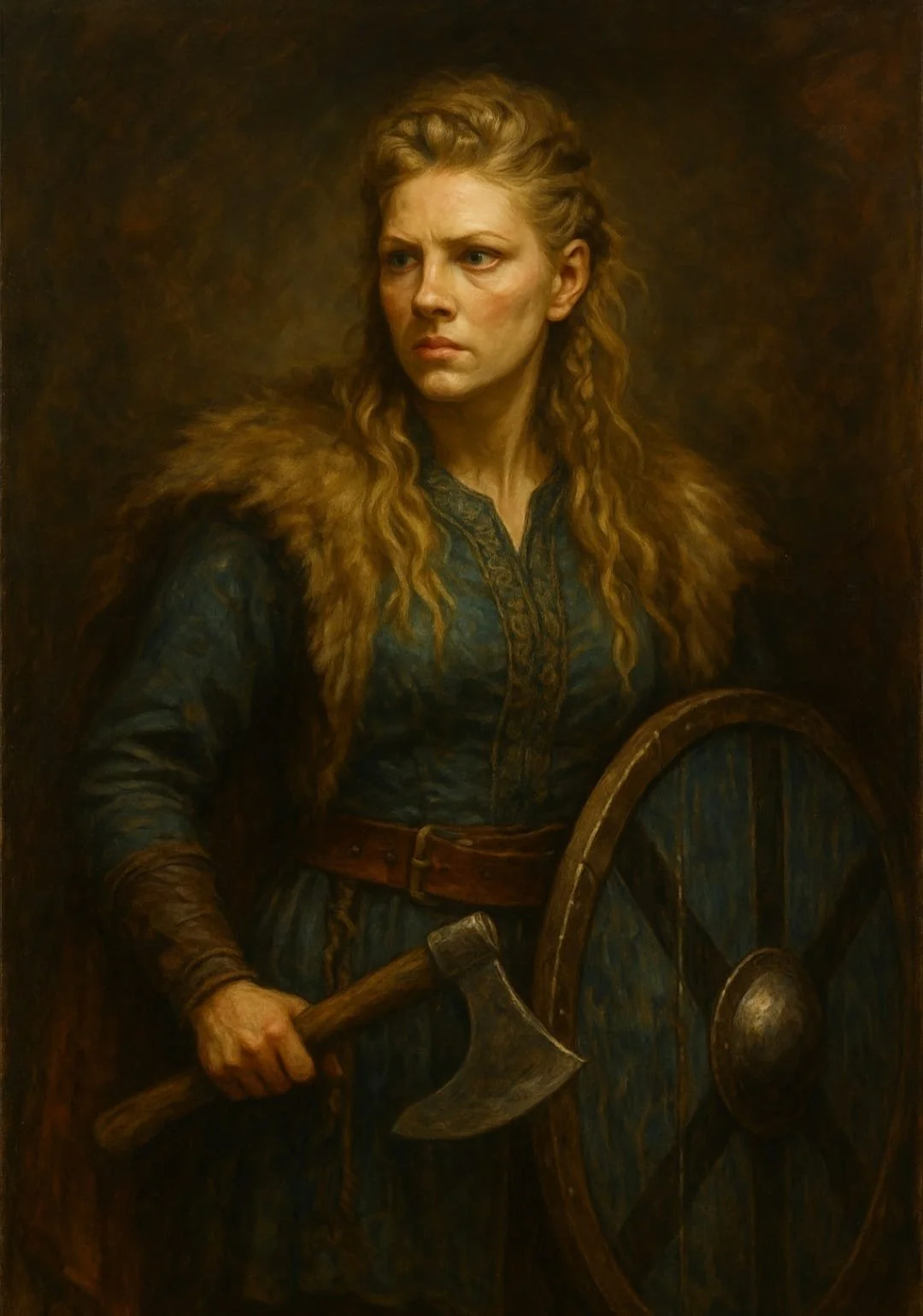
"She held not only axes, but hearts. Not crowns, but storms. And wherever her shadow fell, the earth itself seemed to bow."
** Note - The character Lagertha is not a real historical figure, but a created legend from mixtures of old sagas.
Prologue: The Skald’s Whisper
Skalds sing of her still, blending song and story into one. Listen, then, to Lagertha - daughter of the North, warrior of the waves, queen of Kattegat. Her legend is not measured in years, but in courage. Not in kings, but in the tremor of the earth beneath her enemie’s feet. This is her saga... the tale of the shieldmaiden who met fate with laughter and steel.
Footnote: Like many Viking legends, Lagertha’s story is a tapestry of history and saga. Her deeds are celebrated in chronicles, yet they were embroidered by poets eager to match courage with myth.
Her story is not merely a story of blood and battle, but of resilience, intellect, and the shaping of a world where women could lead as fiercely as men.
The Daughter of the North Wind
Lagertha was born on a night when the aurora danced across the skies like fire on ice. Her mother whispered, “This girl will not be tamed by hall or hearth.” And indeed, Lagertha’s infancy was marked not by lullabies, but by the echo of the wild: wind tearing through the fjords, waves crashing against stone, the cries of wolves in the distance.
Her father, a farmer of repute yet not of legend, saw the spark in her eyes and knew the North had claimed a daughter who would walk between life and myth. “Let her learn the land and the blade,” he said, “for both will be hers before she is grown.”
And so, from her first steps, Lagertha moved with the rhythm of survival - swift, sure, and fearless.
Legends say she could climb cliffs as easily as others walked fields, her small hands gripping stone and ice with the grip of a future warrior. By the age of seven, she had tamed the wild horses of her village, and by ten, she had crafted her first leather armor - not for play, but because she felt the first stirrings of destiny in her bones.
The Maiden and the Wolves
As a girl, she was drawn to the forests and fjords. She hunted alone, not for food alone, but to learn the ways of the world: the silence of the snow, the strike of the falcon, the patience of the wolf.
Her hands became familiar with steel as soon as they were familiar with soil. She carved practice axes from branches, fashioned leather shields, and trained until her arms ached and her laughter rang across the hills.
“A shieldmaid does not wait for danger,” her mother told her. “She meets it halfway, and sometimes, passes it by without a word.”
Lagertha took this to heart. She became both student and master of the hunt - and later, of war.
Stories tell of a lone wolf she befriended, a creature of the forests that came to follow her through every skirmish and hunt. It became her silent companion, symbolizing her bond with the wild and the fierce independence that would mark her life. Villagers whispered that even animals recognized the fire in her soul.
The Meeting with Ragnar
It was said that Lagertha first met Ragnar when he arrived in her village, fleeing enemies and seeking warriors for his raids. The hall was full of men, yet her presence alone commanded attention. She stepped forward, axes in hand, eyes like a storm breaking.
They fought, not in hatred, but in the unspoken language of equals. Her strikes were precise, her feet light, her courage undimmed. Ragnar, ever a seeker of strength, smiled. “Here is a shield that refuses to break,” he said. And so, the son of prophecy and the daughter of the wind became allies - and, in time, companions.
Their bond was more than passion; it was partnership. They exchanged strategies, fought side by side in raids, and shared tales late into the night. Lagertha taught Ragnar patience and cunning, just as he inspired her with visions of distant lands. Together, they became not merely a couple, but a force the North would never forget.
The Shieldmaiden of Kattegat
Lagertha rode with Ragnar across fjords and fields. She fought side by side with him, repelling invaders and inspiring warriors. The skalds sang:
"The shieldmaid dances in blood and snow, The axe sings with her laughter, the spear bows low."
Her fame spread. Kings whispered her name with both fear and respect. She was not a queen yet, but every hill, every harbor, knew the shadow of her sails and the glint of her steel.
Yet even amid battle, Lagertha’s gaze was keen. She understood strategy, leadership, and the fragile balance of loyalty. She ruled not through fear alone, but through respect... a rarity in an age of swords.
Warriors swore that when Lagertha rode into battle, the wind itself seemed to change direction, shielding her from arrows and guiding her strikes. Songs tell of her single-handedly turning the tide at a crucial battle in Kattegat, where Ragnar’s army, on the verge of defeat, rallied around her as if drawn by a magnet of courage.
The Widow and the Queen
Years passed. Ragnar’s fate was cruel - betrayal and death at the hands of King Ælla. Lagertha mourned, not as a passive widow, but as a warrior and mother. She returned to her people, to Kattegat, and ruled with wisdom born of fire and blood.
She married again, a jarl’s son, and bore children, yet her heart remained unbroken in battle. Her legend was no longer only in raids, but in governance - a queen who wielded laws like axes, shaping her people with justice and strength.
“The North is not for the weak,” she would tell young warriors, “but neither is it for the cruel. There is honor in both shield and word.”
Lagertha’s governance introduced councils of warriors and elders, creating a balance between strength and fairness. She was known to hear grievances herself, walking among her people in leather armor, not royal robes, earning loyalty through courage and presence rather than fear or title alone.
The Test of Rivalry
Even kings feared her. Ragnar’s sons, Ivar among them, once challenged her right to rule. Yet Lagertha met their schemes with cunning and patience. She did not strike blindly; she observed, waited, and then struck - swift, decisive, and unassailable.
Her enemies often underestimated her because she was a woman. They learned, sometimes too late, that the shieldmaid’s mind was as sharp as her axe.
“I do not fear death,” she told them once. “I fear only dishonor, and even that I carry lightly.”
Skalds tell of a council meeting where Lagertha faced three rival jarls who conspired against her. They plotted, thinking her age and gender a weakness. Lagertha, unarmed, simply proposed a contest of strategy and foresight. By sunset, she had outmaneuvered them so completely that they swore fealty on the spot. Intelligence, not brute strength, became her deadliest weapon.
The Saga of the Sons
Lagertha raised her children not as delicate heirs, but as warriors of the North. They learned her lessons: courage, strategy, and the subtlety of mercy.
And yet, even as she nurtured, she prepared them for the world’s cruelty. Her sons would grow into men who understood the weight of a mother’s legacy - that blood alone does not define greatness; courage, wisdom, and honor do.
She trained them with axe and shield before they could walk fully, teaching them to read the tides and the winds as one reads a map. Stories say she told them of the wolf in the forest: “A wolf hunts for survival, but also for wisdom. So must you.” Her children grew with both ferocity and intelligence - not as pawns, but as heirs to her spirit.
The Return to Battle
Even in later years, Lagertha could not resist the call of the fjords. She took up her axes once more, not for conquest, but for defense. Kattegat remained her kingdom, but the seas were hers, too.
Skalds tell of her final campaigns - lightning raids, daring defenses, and battles that turned tides not by numbers, but by her sheer presence. To face Lagertha was to face the North itself: relentless, unyielding, and beautiful in its fury.
One tale recounts how a fleet of rival Jarls approached Kattegat under the cover of night, expecting a weak ruler. Lagertha, atop the cliffs, signaled her warriors with a torch and a horn. By dawn, the invaders found themselves surrounded by fire-lit ships and warriors in full battle cry - the shieldmaiden had orchestrated a perfect trap, turning ambush into annihilation.
The Shieldmaid’s End
Lagertha’s end came not in whispers, but in calm. She passed surrounded by her people, her children, and the land she had shaped. Yet the skalds insist that her spirit did not rest.
Some say she rides still upon the fjords, wind in her hair, axes gleaming in the moonlight, guiding warriors who would fight with honor. Others whisper she walks among her children, unseen yet felt, her laughter a promise of strength and courage.
“Death is no enemy,” the skalds sing, “for a shieldmaid lives wherever courage remains.”
Her tomb, atop a hill overlooking Kattegat, was said to be so grand that the villagers left axes, shields, and tokens of victory alongside her. Even in death, she commanded respect - a silent queen whose legacy was carved in stone and memory alike.
The Legacy of Lagertha
Her name became more than legend; it became ideal. Lagertha taught the North that a warrior need not be cruel, that leadership is not only conquest, and that courage is the truest inheritance.
She was shield and sword, queen and mother, tempest and calm. And in her halls, even centuries later, the echoes of her axes and laughter can still be heard.
"Lagertha - the Shieldmaiden Who Danced With Fate."
Historians and poets alike later attributed a wave of women warriors to her influence, noting that her example inspired generations to wield sword and counsel with equal strength. She became not only a symbol of power, but of balance, a queen who ruled with fairness as fiercely as with steel.
The Aurora of War
Lagertha’s battles were often painted in colors of legend - the aurora borealis casting light on frozen fields as axes clashed. She became a living metaphor for the North itself: beautiful, terrifying, and unstoppable.
In one famed raid, she led a contingent of women warriors across icy fjords, outflanking an army twice their size. Skalds recount that the enemy thought they faced spirits, such was the suddenness and ferocity of her attack. She became known not just as a shieldmaiden, but as the Ghost of the North.
The Jarl’s Council
Lagertha did not rule alone. She formed councils of trusted warriors, advisors, and elders - valuing wisdom as much as strength. Her decisions were deliberate, often baffling her enemies who expected rash fury.
She once resolved a dispute between two warring clans by challenging both leaders to a single combat observed by all. The combat was fierce, but she decreed the victor would share lands equally. Her judgment was respected because it was fair, decisive, and showcased her mastery of both mind and battlefield.
The Marriage of Duty
Though she married twice, Lagertha’s heart never lay entirely in domesticity. Her unions were alliances as much as personal relationships... tools to strengthen her position and protect her people.
Her second husband, a nobleman of the north, once attempted to dominate her rule. She quietly outmaneuvered him politically, retaining full control of Kattegat. She demonstrated that marriage was not submission, but strategy, and that a woman could wield influence as silently and deadly as a blade.
The Shadow of Ragnar
Even after his death, Ragnar’s presence lingered. His legacy was both inspiration and burden. Lagertha carried it not by imitation, but by transforming his ambition into her own vision.
She sometimes visited the cliffs where they had first met, staring into the horizon, remembering Ragnar’s laughter and lessons. “He was a fire,” she whispered to the wind, “but I am the storm.” She made her own legend, independent yet intertwined with his.
The Mother of Warriors
Her children and protégés became an extension of her will. Every raid, every battle, every negotiation carried her imprint.
One of her sons, inspired by her teachings, later led an expedition that expanded Kattegat’s influence. Lagertha’s guidance ensured they were not just conquerors, but rulers who understood law, mercy, and diplomacy. Her legacy lived in blood and wisdom alike.
The Final Voyage
Some skalds suggest that even in her last years, Lagertha took a final voyage across the fjords - not for conquest, but for reflection. She watched the waves, remembering every battle, every laugh, every loss.
Her ship, the Windbreaker, was said to sail faster than the northern gales. She returned home with no glory-seekers in her wake, only silence, ensuring her people remembered her strength as natural and inevitable, like the tides themselves.
The Hall of Stories
Her halls became a repository of wisdom. Warriors, children, and skalds came to hear her recount battles, strategies, and lessons in leadership.
She emphasized that memory itself was a weapon: “A warrior who forgets is already dead,” she said. Each story became a teaching, each victory a lesson, and each failure a cautionary tale.
The Last Winter
Lagertha’s death was peaceful, in contrast to her violent life. She stood atop the cliffs near Kattegat, looking over the fjords one last time. Snow fell like blessings from the gods.
It is said she whispered to her children: “Carry the North in your hearts, not as chains, but as wings.” Then she passed, leaving behind a silence that spoke louder than any battle cry.
The Song of the Shieldmaiden
No saga truly ends. The skalds still sing of Lagertha, not as a perfect woman, but as a perfect storm.
Her name inspires courage and balance: strength tempered by justice, ferocity guided by wisdom, and power wielded with care. Young women of Kattegat were named after her; men sought to emulate her honor. Her echo shaped generations.
The Dance Beyond the Fjords
Lagertha’s legend sails beyond death, as eternal as the northern winds. Some nights, the aurora reflects her axes, some say her laughter rides the fjord mists.
In every north wind, in every wave that crashes against the cliffs, in every young warrior gripping an axe for the first time... Lagertha lives. She is wind, storm, and memory, dancing forever with fate.
Historical Note:
While her exact historicity is debated, accounts like Saxo Grammaticus’s Gesta Danorum and later Norse sagas depict Lagertha as a formidable shieldmaiden, warrior, and leader. Her story remains a symbol of courage, wisdom, and the power of women in Viking society.
Reflection
Lagertha’s saga is more than the tale of a shieldmaiden’s rise.It is a mirror polished by battle, sacrifice, and triumph - reflecting what it means to shape one’s life with courage rather than fear. Her story reminds us that fate (wyrd) is not a chain but a thread, and every choice we make becomes a stitch in the tapestry that will outlive us.
She teaches us that strength is not the denial of vulnerability, but the mastery of it.
That leadership is not dominance, but responsibility. That legacy is not born of titles or kingdoms, but of the lives we shape through our actions.
Her saga whispers:
Walk boldly. Live fiercely. Leave behind echoes that cannot be silenced.
Invocation
By the flame that lights the long night,
By the wyrd that binds all paths and choices,
By the steel that sings in the hand of the brave - May Lagertha’s spirit walk beside those who seek clarity, courage, and honor.
May the storm be your teacher. May the wind be your ally. May your wyrd guide you not with fear, but with fire.
And may the ancestors warriors and wanderers alike - watch over your journey as you carve your own story into the world’s unending saga.
Walk with purpose.
Stand with honor.
Let the fire within you burn steady through every frost.
Until the next chapter unfolds…
What part of your own wyrd are you ready to claim next?
Wyrd & Flame 🔥
