
Skóll and Hati: The Wolves Who Chase the Light
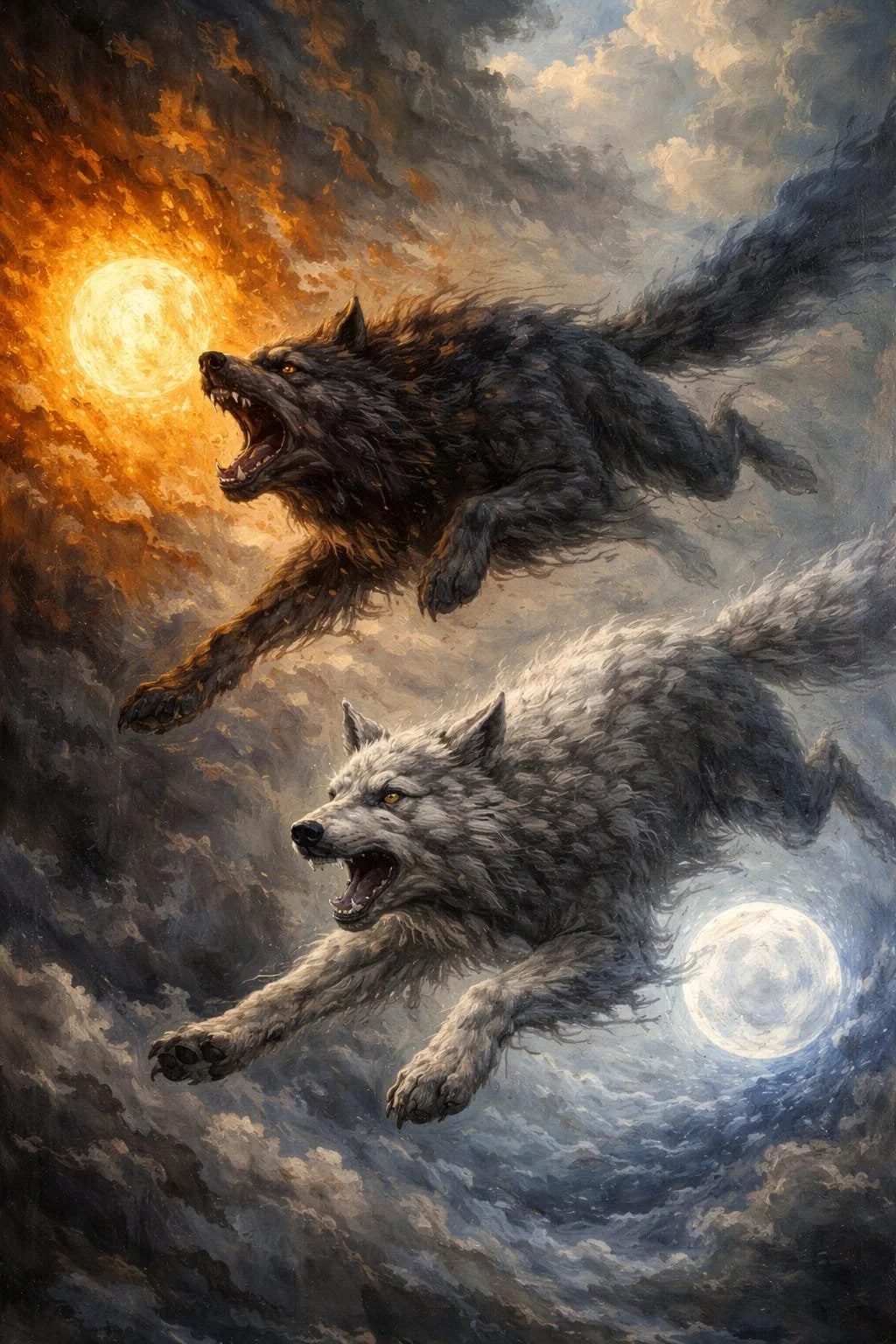
Some things are not meant to be caught. Some things exist so that the world does not stop.” - from the Ash-Sayings, fragment attributed to the Westfjords, c. 10th century
And though the voices that carried these words have faded into earth and bone, the chase they describe still circles above us, hour by hour, breath by breath.
Prologue: Born to Run
Before the sun learned to rise on schedule, before the moon learned the art of vanishing without dying, the cosmos already knew movement. Not gentle movement, not the drifting of clouds or the turning of leaves, but the kind of motion that prevents collapse. In that first age - when order was still an experiment - there were wolves already running.
Skóll and Hati did not emerge into a finished universe. They were not late additions, not corrections to a stable system. They are older than routine, older than predictability. They belong to a time when even the heavens could not be trusted to behave. Their running is not rebellion against order; it is the mechanism by which order survives.
In Norse cosmology, stillness is never neutral. Ice that does not crack becomes prison. Fire that does not move becomes consumption. The world is held together not by peace, but by tension, by forces that pull and are pulled in return. Skóll and Hati exist precisely within this tension, teeth bared not in malice, but in necessity.
The myths do not give us lullabies about their birth. There are no warm dens, no maternal tenderness lingering in the telling. Wolves are not softened in Norse thought. They are respected, feared, acknowledged, but never sentimentalized. This absence is itself a clue: Skóll and Hati are not meant to comfort. They are meant to function.
Where a wolf appears in these stories, a boundary is under strain. Civilization presses against wilderness. Order leans too heavily toward permanence. The wolves arrive not to destroy the boundary, but to remind it that it exists. Skóll and Hati are not chaos incarnate; they are resistance to stagnation.
They are born not as destroyers, but as forces of insistence. They insist that the sun cannot linger. They insist that the moon cannot remain whole. They insist that time must feel like something chasing you, or else it ceases to be time at all.
And so, from their first breath, they run. Not toward an ending, but away from stillness. Not because they desire the light, but because the light must never forget how to flee.
Before the sun learned to rise on schedule, before the moon learned how to disappear without dying, there were wolves already moving.
“There is a wolf called Sköll; he chases the sun, and Hati Hróðvitnisson chases the moon.”
(Gylfaginning, ch. 16–17)
The First Day the Sun Ran
The sun did not rise. She fled. Not from anger, not from fear, but from the first impulse of awareness, the knowing that she would be followed. The sky was not yet stitched into light and shadow; it was ragged, still bleeding the remnants of night. Clouds clashed with one another, untrained, and the wind cut across empty spaces like a knife through frost.
From behind, something moved too fast to see, yet heavy enough to feel. A shadow pressed close. The air carried the scent of heat and teeth, and the sun felt it before she understood it: she was being hunted.
Her horses strained against the void, nostrils flaring, hooves striking sparks from the raw ground. Every moment she lingered, the shadow lengthened. Every pause invited peril. Motion was survival. Motion was meaning.
The shadow followed, relentless. Each time the sun surged forward, the chase grew sharper, not easier. She glimpsed a shape (a wolf, black as void, eyes bright as embers) but when she turned, the sky swallowed it. Skóll did not wait for permission. He did not ask if she wished to run. He existed to press her forward.
By the time the day broke, the sun understood the rule: light is never safe. Even brilliance must run, must risk exhaustion, must move to continue existing. And behind her, the wolf never faltered, never paused, never rested.
The Birth of the Chasers
The sources disagree, as all true myths do. Contradiction is not a flaw in mythic memory; it is proof of vitality. Stories that matter are retold until they fray at the edges, accumulating meanings rather than settling into doctrine. Skóll and Hati arrive to us through this layered uncertainty.
Some traditions name them as sons of Fenrir, the great wolf bound by the gods, whose strength frightened the Æsir enough to trick and chain him. Fenrir is not merely a monster; he is a prophecy with teeth. He represents consequence, the certainty that what is constrained unnaturally will eventually break free. To place Skóll and Hati in his lineage is to mark them as inheritors of inevitability.
Other sources trace Hati to Hróðvitnir, the “famous wolf,” a figure far less elaborated, but telling in name alone. Fame, in Norse culture, is not celebrity - it is remembrance. A famous wolf is one whose deeds echo. This lineage suggests that Hati’s power is not brute force, but persistence across memory.
This ambiguity is intentional. Myth refuses singular origin stories because singularity implies control. Skóll and Hati cannot be controlled, and so they cannot be fully explained. Their parentage shifts depending on which truth the story needs to emphasize: inevitability, renown, or the inherited weight of motion itself.
What matters is not who sired them, but how they were raised. They are not nurtured in dens or instructed by elders. There is no apprenticeship to their role. They are raised in pursuit itself. Their education is distance. Their discipline is exhaustion.
From the moment they exist, they are already behind something that must not be caught already too close to something that must keep moving. Their mother is the gap between now and then. Their cradle is the turning sky.
They are not taught what to chase. They are taught that they must.
The Naming of the Wolves
The gods argued about whose sons they were. Odin claimed them as Fenrir’s offspring, proof of inevitable consequence. Others whispered that Hati descended from Hróðvitnir, famous not for destruction, but for deeds remembered in fear and awe.
While the Æsir debated, the wolves ran. They did not wait for judgment. They did not pause to hear the words that would attempt to bind them. Their motion was proof of truth: lineage meant nothing to those who existed in pursuit.
Thor stamped his foot in impatience, calling for the chains that had once bound Fenrir. The idea of confinement was tempting. But Odin shook his head, silent, his one eye gleaming with comprehension. Motion could not be legislated. Motion could not be contained.
As the gods quarreled, the wolves grew in size and strength, fur rippling with the turning of the skies. They were alive in ways the Æsir could not name, yet instinctively understood: these were not creatures to conquer. They were forces to respect.
And so, with names still unsettled, the wolves kept running. Names followed deeds, not the other way around. Skóll and Hati were not defined by origin; they were defined by chase.
The Shape of the Chase
Names in Norse myth are rarely decorative. They are compressed stories, fragments of function wrapped in sound. Skóll’s name is often rendered as Mockery or Deception, but these translations flatten its force. Skóll is not a liar; he is the cruel promise of almost.
He represents the kind of pursuit that never quite resolves not because the object is false, but because resolution would end the system. Skóll makes the chase feel personal. He is the pressure that convinces the pursued that escape is temporary, that rest is dangerous.
Hati’s name - Hate - is equally misunderstood. It does not describe emotion as modern readers understand it. In Old Norse usage, it signals relentless opposition... the force that advances regardless of desire, mercy, or fatigue. Hati does not hate the moon. He negates her stability.
Together, they form a dyad, but not a partnership. They do not run side by side. They do not coordinate or converse. Their unity is structural, not emotional. They are two pressures acting on different axes of time.
Skóll chases what nourishes the world...the sun, the source of growth, warmth, and excess.
Hati chases what measures it - the moon, the keeper of cycles, memory, and restraint.
One presses from behind, threatening consumption. One drives from the front, enforcing change.
They do not need harmony in the musical sense. Their harmony is inevitability. Like gravity and momentum, they do not agree - but together, they keep the world moving forward.
Their chase is not dramatic in the way battles are dramatic. There are no clashes, no victories along the way. The drama lies in the closeness. In the fact that the distance never closes, but never widens either.
This is not a story about triumph. It is a story about tension sustained long enough to become reality.
Skóll chases what nourishes the world.
Hati chases what measures it.
The Völuspá whispers: “Then comes the wolf from the east, swallowing the sun, and the moon will be taken by the Hati.”
(Völuspá, stanzas describing Ragnarök, translations vary)
Why the Sun Must Run
In the Norse myths, the sun is not a tyrant blazing effortlessly across the heavens. She is not eternal, nor invulnerable. She is a runnerbright, necessary, and always at risk. Her light is precious precisely because it is threatened.
Sól does not ride her chariot as a victor parading power. She flees. Her horses strain against the sky not out of pride, but urgency. Behind her wheels runs Skóll, jaws open, breath hot enough to scorch the road of daylight itself. The heat of the sun is inseparable from the heat of pursuit.
Without Skóll, the sun would slow. And without speed, warmth would cease to circulate. In a world of endless summer, growth would rot into excess. Crops would never know harvest. Life would forget how to end, and thus forget how to renew itself.
The wolf’s threat gives the sun her rhythm. Dawn becomes an escape rather than a guarantee. Noon becomes a narrow margin rather than a throne. Sunset becomes an act of wisdom, knowing when to yield before collapse.
Skóll is not the enemy of light. He is its shadowed companion, the reason brilliance cannot afford complacency. He ensures that illumination moves rather than dominates.
In this way, Skóll embodies a difficult truth... that abundance without pressure becomes decay. The sun must run not because it is weak, but because strength left unchecked becomes lethal.
Every day the sun survives, not by overpowering the wolf, but by remaining just beyond him. Life, too, survives not by defeating what chases it, but by continuing to move.
The Moon’s Relentless Twin
Hati’s relationship with the moon is subtler, and more intimate. Where Skóll follows, Hati leads. He does not snap at the moon’s heels - he runs ahead of her, forcing her to change shape in order to continue.
The moon does not flee him in panic. She follows him in transformation. Under his pressure, she learns to diminish without disappearing, to vanish without dying, to return altered but intact. This is not predation. It is instruction.
The moon governs what the sun cannot: memory, tides, fertility, mourning, reflection. She is the keeper of inward time...the time that accumulates, circles, and remembers. If she remained full forever, reflection would harden into fixation. Grief would never loosen its grip. Desire would never learn restraint.
Hati teaches the moon impermanence. He ensures that fullness is temporary and absence survivable. Each waning is a lesson in release. Each dark moon a reminder that disappearance is not annihilation.
The fear humans feel when the moon thins is ancient, but misplaced. Her reduction is not loss...it is maintenance. Hati ensures that memory does not become a prison.
In following him, the moon learns flexibility. She learns that meaning does not reside in constancy, but in return. What fades is not gone. What vanishes is preparing to change.
Thus Hati becomes the wolf of grief - not because he causes sorrow, but because he prevents sorrow from becoming eternal.
When the Moon Learned to Vanish
The moon believed she was dying. She waned for the first time and trembled at her reflection in the still waters below. “What am I becoming?” she whispered to the stars, but no stars replied.
Ahead of her, a shadow ran. Hati. He did not strike, did not threaten. He pressed forward, quiet and unyielding. Each pace he set forced the moon to shrink, to curve, to let portions of herself fall away.
It felt like loss. It felt like forgetting. And yet, she learned: this vanishing was not destruction. Each retreat held a promise of return. Each absence was rehearsal. Each shrinking was preparation for transformation.
By the time she emerged from shadow, her shape was smaller, sharper, wiser. She had learned the rhythm of impermanence - not by being commanded, but by being pressured. Hati did not speak; he did not comfort. He taught by running.
The moon glanced back once, briefly, and saw the wolf’s eyes glinting in darkness. She understood, finally, that disappearance was a skill, and survival required practice.
From then on, every waning was a lesson, every darkness a classroom, and every return a graduation.
Interactions with Gods and Cosmos
Skóll and Hati are feared, but they are never hunted. This is one of the quiet revelations of the myth. Odin, who sacrifices his own eye for wisdom, does not pursue them. Thor, who shatters giants with his hammer, does not raise it against their jaws.
The gods understand something essential: to kill the wolves would be to stop the sky.
The Æsir rule through balance, not domination. They know that permanence is not order, it is stagnation. A cosmos without threat would not become peaceful; it would become brittle. And brittle things shatter catastrophically.
Thus the wolves are tolerated. Not welcomed, not loved, but allowed. They are part of the unspoken treaty of existence. A clause written not in runes, but in motion.
The gods rely on time as much as mortals do. Even immortality in Norse myth is conditional - maintained through golden apples, through cycles, through effort. To destroy the wolves would be to deny themselves change, and thus deny themselves survival.
Skóll and Hati do not oppose the gods. They test them. They remind even divine beings that nothing escapes movementnot power, not light, not eternity itself.
In this way, the wolves are closer to fate than to monsters. They are not enemies of order. They are the reason order must keep working.
Why the Gods Did Not Interfere
Thor lifted his hammer, teeth clenched, eyes bright with the desire to end the chase. The shadow of the wolf pressed against the sky like storm clouds. Strike, he thought, and be done with it.
Odin’s hand rested lightly on his arm. “Do not,” he said, though the word held the weight of all worlds. “If you strike, the sky will freeze. Time will splinter. The chase is older than your rage.”
Thor lowered his weapon slowly, feeling the tremor of possibility. For one long heartbeat, he imagined a world where Skóll and Hati no longer ran where the sun hung static, where the moon would never learn the meaning of absence. Even for gods, eternity without motion was peril.
The wolves ran on. They did not look at the gods, did not pause for approval. Their purpose was older than negotiation, older than fear, older than praise.
The Æsir watched silently. They understood that destruction was not mercy, and that restraint could be stronger than any hammer strike. Power alone could not hold the universe together; motion could.
And so they let the wolves run, and the sky continued to turn.
The Goal That Is Not a Goal
Do Skóll and Hati want to catch the sun and moon? The myths never tell us. Desire, in this case, is irrelevant. Their pursuit is not emotional - it is structural.
They chase because chasing sustains the world. If they stopped, time would loosen. Days would blur. Cycles would forget themselves. The universe would not explode it would drift into meaninglessness.
Their “goal” is not capture, but continuation. Success would be failure. Fulfillment would be catastrophe. They exist to maintain distance, not close it.
This reframes pursuit itself. Wanting is not the engine of existence movement is. The wolves do not yearn. They run.
Only when continuation itself must end when even motion must release its grip - are they permitted to succeed.
Their patience is cosmic. Their restraint absolute. They embody the paradox of guardians who must never complete their task.
Until the end of all things.
The Day the Wolves Caught Up
For the first time, the sun felt tired. She strained against the weight behind her, jaws snapping at the horizon, eyes burning into gold and fire. Every beat of her chariot felt longer, every ray a fraction weaker.
The moon slowed too. Under the pressure of Hati, her silver curve faltered, waned faster than usual, trembling as though she might vanish before she could return. The cycles held their breath. The rivers paused. The tides stilled, remembering the impossibility of the moment.
Skóll and Hati did not roar or celebrate. They ran. Steady, inevitable, relentless. Nothing joyful marked this closeness. There was no triumph in completion, only gravity, the inescapable law of motion reaching its end.
The sky darkened in spots, first shadows, then entire swathes. Stars blinked as if startled by the proximity of jaws and teeth. Light and shadow were no longer distant. They touched, intersected, and trembled at the edge of finality.
The wolve’s chase had narrowed to its absolute margin. Everything alive or celestial could feel it: the universe, patient for eons, was about to deliver its reckoning.
No one cheered. No one fled. There was only the running, the closing, and the quiet, unshakable inevitability of the end.
Ragnarök: When the Chase Ends
At Ragnarök, the rules change. Not because the wolves rebel, but because the contract of the cosmos expires. The chase is allowed its conclusion - not as triumph, but as closure.
Skóll devours the sun.
Hati rends the moon.
Darkness floods the sky, not as terror alone, but as reckoning. The lights that ran must finally rest. Motion exhausts itself. Time, having been stretched as far as it can go, releases.
Yet Ragnarök is not annihilation. It is transformation through collapse. The end is not sterile...it is fertile.
After the fire and the flood, a daughter of the sun rises to take her place. Light returns - not identical, not unchanged, but renewed. The chase begins again, not as repetition, but as inheritance.
The wolves teach even the apocalypse how to breathe. They ensure that endings do not calcify into voids.
Even the end of time, it seems, must learn how to move forward.
At the twilight of the gods, the wolves finally close the distance. Skóll devours the sun.
Hati rends the moon.
As the old verse foretells: “Then comes the wolf from the east, swallowing the sun, and the moon will be taken by the Hati.”
(Völuspá, stanzas describing Ragnarök, translations vary)
The Wolves Within the Human Story
Skóll lives in ambition, the hunger that keeps fulfillment just beyond reach. He is the reason achievement rarely feels complete. The reason satisfaction fades. The reason success demands motion rather than rest.
Hati lives in loss, the force that pushes us onward when we would otherwise remain kneeling beside what is gone. He is why grief evolves. Why memory softens. Why absence eventually reshapes into meaning.
They are why joy fades, and why it does not poison us by lasting forever. They are why grief changes shape and why it does not petrify the soul. They are why nothing stays, and why survival remains possible.
Without them, we would stop. And stopping is not peace...it is slow suffocation. A life without chase is not fulfillment; it is decay disguised as comfort.
The wolves do not punish humanity. They mirror us. They remind us that motion is mercy.
To be chased is not always to be threatened. Sometimes it is to be kept alive.
Skóll lives in ambition the hunger that keeps fulfillment just beyond reach.
Hati lives in loss the force that pushes us forward when we would otherwise remain.
The skalds called them “pursuer of day” and “thief of light,” and in each human heart, these wolves run unseen.
Place in the Wider Mythic Pattern
Across cultures, similar forces appear. The Greeks named it Ananke necessity that even gods must obey. The Hindus envisioned Kala time as devourer. The Aztecs fed Tonatiuh so the sun would keep moving.
Yet Skóll and Hati are distinct. They are not rulers of time. They do not command sacrifice or obedience. They apply pressure.
They do not decree endings. They ensure that endings remain possible.
Their power lies not in authority, but in proximity. They do not dominate the cosmos from above. They run within it, teeth close enough to matter.
They are time felt at your back. Change sensed before it arrives. The knowledge that what is bright must keep moving.
This is a quieter, harsher wisdom and perhaps a truer one.
The Silence Between Steps
Eclipses are not victories for the wolves. They are reminders of closeness. Moments when distance narrows and meaning thins.
Certainty darkens. Fear awakens. The chase feels too near.
But these moments are thresholds, not endings. They remind us that the system still works, that motion continues, even when light falters.
If the wolves still run, the world has not stopped.
Darkness, then, is not proof of failure. It is evidence of pressure.
A Human Under an Eclipse
The sky darkened at midday, and no one knew why. The market froze. Children stopped chasing each other through dust. Merchants lowered their wares. All eyes lifted to the sky, and hearts lifted with them unsure whether to hope or despair.
A single human, unnamed, stood alone in the field. They felt fear, yes, but also awe. The air carried pressure like the closing of jaws, and the rhythm of heartbeat echoed the ancient chase. Something beyond understanding ran, and they were in its path.
Shadows swept across the land, and the human remembered fleeting stories of gods, of sun and moon, of wolves that might exist just beyond sight. Yet even without naming them, the lesson was clear...the chase moves through everyone, through every life, through time itself.
When the sun returned, and the moon curved its way across the sky, the human exhaled. They were not harmed. They were, in some deep, unspoken way, alive. They had felt the motion. They had survived the pressure.
And when the light returned fully, it carried a quiet wisdom: existence continues because something - Skóll, Hati, fate, necessity - is always running behind, always urging forward.
Invocation of Motion
When time feels tight on your heels,
when joy refuses to stay,
when memory presses too hard
remember the wolves.
They are not there to end you.
They are there to keep you alive.
Run.
Change.
Release.
Begin again.
Final Reflection - “The Wolves in Us”
We live under the watch of unseen runners. Every sunrise reminds us that motion is not optional. Every waning moon whispers that letting go is necessary. The wolves do not care for our comfort. They do not pause for our delight. And yet, in their insistence, there is mercy.
Skóll and Hati are not allegories to conquer, nor monsters to fear. They are the pressure of life itself the force that keeps ambition from calcifying into obsession, grief from becoming a cage, and joy from turning stagnant. They remind us that existence is a series of departures and returns, of pursuit and release, of learning to move even when we do not understand the reason.
To live under their gaze is to accept impermanence. It is to understand that the things we chase will never rest long enough to be caught and that is not cruelty. It is structure. It is survival. It is what allows light and shadow, joy and sorrow, beginnings and endings to retain meaning.
The chase, as they teach us, is not punishment. It is opportunity. It is the quiet insistence that we keep moving, keep changing, keep breathing in rhythm with the cosmos. Without it, the world would still. Without it, we would still. And stillness is not peace, it is the slow forgetting of ourselves.
And so, as the sun rises and the moon arcs across the sky, we may pause for a moment, perhaps with awe, perhaps with fear. But we remember: motion is sacred. Pressure is survival. The wolves are not behind us; they are part of the very air, the very rhythm, the very pulse that sustains all things.
We are running too. Not from them, not from danger, not from judgment but because to live is to move, to chase, to change. And in that chase, fleeting though it may be, we find our place in the endless, luminous, terrifying, and beautiful dance of the cosmos.
And so, perhaps the only question that matters now: Which part of yourself are you allowing to run - and which part, if you stay still, will be lost?
Skóll and Hati: The Wolves Who Chase the Light
Not destroyers.
Not villains.
But the ancient keepers of motion itself.
Wyrd & Flame 🔥 🌒🐺
- May what you chase remain just out of reach, and may what chases you teach you how to move.
