
Ginnungagap: The Primordial Void of Norse Creation
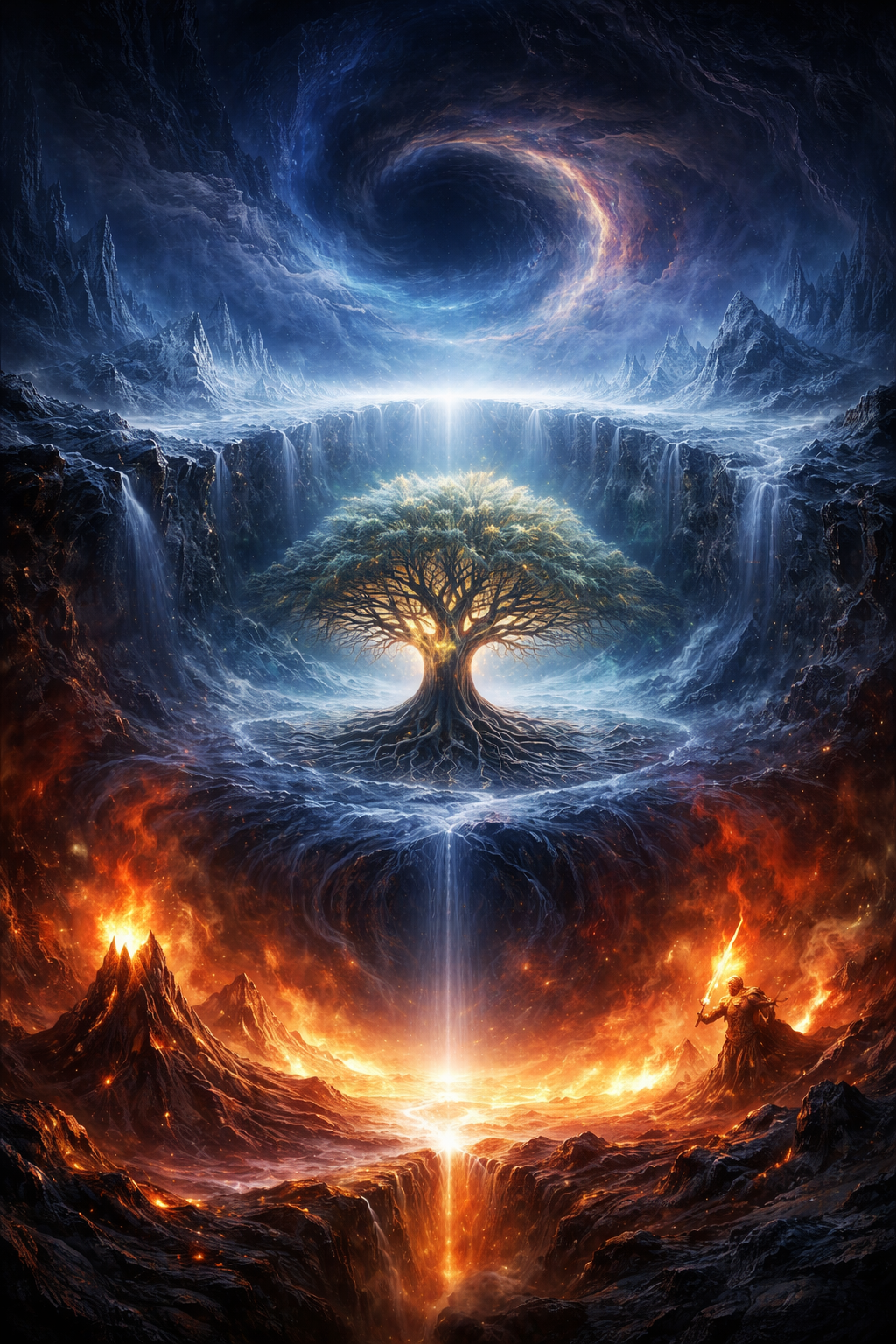
In Norse mythology, we often jump straight into stories of mighty gods, fierce battles, and grand adventures. We hear the names of Odin, Thor, Loki, and Freyja, and imagine a world filled with magic, monsters, and heroic deeds. Yet, when we go back to the very beginning, to a time before any god or creature had drawn a breath, we find something far more silent and mysterious. We find Ginnungagap. This was the place where everything began, not with noise or chaos, but with a quiet, endless emptiness. Before the first dawn, before the first spark of creation, there lay a vast gap stretching out in all directions.
Ginnungagap is described in old Norse texts as a great void, open and yawning, without shape, matter, or meaning. It was not a dark space filled with danger, nor was it a peaceful Eden. It was simply nothing. No wind, no stars, no ground, no sky. Imagine standing somewhere where there is no light to see by, no sound to comfort you, and no sense of direction or time. This is close to how the Norse people pictured the beginning of everything. They did not believe the universe started with light or power, but with stillness. The world did not burst into existence; it slowly grew out of opposing forces that drifted into this empty space.
The ‘Vikings’ believed that on one side of this gap lay Niflheim, a realm of ice, frost, and deep cold. On the other side burned Muspelheim, a blazing land of fire and fierce heat. These two worlds represent extremes, and for a long while they remained apart. But over time, their energies reached into the empty gap between them. Ice from Niflheim began to spread outwards, while hot sparks from Muspelheim flew across the void. Where cold and heat finally met inside Ginnungagap, the ice began to melt. Drops formed, and from those drops of melted ice came the first living things in Norse myth. Out of nothing, life emerged. The giant Ymir was the first to take shape, and soon after, the great cow Audumbla appeared. From her nourishment and actions, the ancestors of the gods themselves were born. So, from this silent void came giants, then gods, then the world as we know it.
It is interesting to note that Ginnungagap is not described as chaos, like the Greek concept of Chaos, but more as an open space full of potential. It was empty, yet ready to become something. Many myths from around the world describe creation beginning in darkness or water or void. The Norse version adds a powerful idea: creation happens when two great forces meet, when hot and cold collide, when difference creates life. This may reflect the landscapes known to the Norse (icy glaciers and burning volcanoes, winter darkness and summer light) opposite forces shaping the world around them.
Although Ginnungagap is only mentioned briefly in the surviving Norse texts, its presence is vital. It appears in both the Poetic Edda and Prose Edda, two key sources for understanding Norse myth and belief. These texts were written down in medieval Iceland, but they preserve stories that were told centuries earlier. We can imagine storytellers and poets sitting by the fire, retelling the origin of the world to curious listeners, beginning with that vast and silent gap.
Today, Ginnungagap continues to fascinate scholars, historians, and anyone with an interest in mythology. It raises big questions about how ancient people understood creation, space, and existence. Was Ginnungagap meant to be a real place somewhere beyond the edges of reality, or was it a metaphor for the unknown? Did the Norse imagine it as a literal gap between worlds, or as a symbol of time before time? The myths leave space for interpretation, which may be why the idea is still so captivating. It is a reminder that every story, every world, every god must begin somewhere, even if that beginning seems empty at first glance.
In this blog, we will look more closely at this mysterious gap. We will explore where it appears in the sagas and Eddas, what its name might have meant to the people who first spoke it, and how different scholars have tried to explain it over the centuries. We will also consider how the story of Ginnungagap fits into the wider Norse creation myth, and what lessons or meanings we might take from it today. By going back to the very start of everything, we gain a better understanding of the world the Vikings imagined and the stories they passed down through generations. All of it begins with Ginnungagap, the empty space where fire met ice, and where nothing became something.
What Is Ginnungagap?
Words have a strange way of carrying history inside them. They survive long after voices and faces are gone, holding echoes of how people once thought and felt. Ginnungagap is one of those words. It looks heavy on the page, ancient in the mouth, and a little intimidating when you first encounter it. But the moment you sit with it, you begin to sense why it sat at the very start of the Norse creation story. It sounds like something vast. Something old. Something that came before anything else.
Ginnungagap is an Old Norse term made from two pieces: ginnung and gap. The second half is easy enough. Gap means exactly what you’d expect - a great opening, a chasm, a space where something should be but isn’t. When you hear it, you can almost imagine a cliff edge or a tear in the world. The first part, ginnung, is where mystery creeps in. It’s not a word that survived into modern speech, so its meaning has to be guessed from fragments and related terms. That alone gives it a mythical quality. It sits on the edge of understanding, just like the void it describes.
Some scholars suggest ginnung carried a sense of immense, overwhelming power - something magical or sacred. If that is true, then Ginnungagap is more than just emptiness. It is a charged emptiness. A nothing pregnant with possibility. Others notice a connection to words associated with wonder or bewilderment. A space that leaves you wide-eyed, silent, unsure of where to look. A gap so deep and ancient it inspires both curiosity and fear.
Of course, myth rarely settles for one meaning when it can hold many at once. The most natural way to think of Ginnungagap is to imagine all these ideas together. Not a dull blankness, not a simple empty room, but a vast stretch of silent space that feels alive, waiting, almost aware. The kind of nothingness that makes you imagine something just beyond sight. The kind of stillness that could give birth to creation if the right spark arrived.
It’s important to remember that these stories were not originally written for books or classrooms. They were told aloud, from memory, shaped and reshaped for listeners over long nights. A storyteller did not need to stop and explain what Ginnungagap meant. The word itself would have painted the picture. Every person listening around the fire would have felt its weight in their imagination - that endless, yawning depth before the world existed. These myths passed through centuries of voices, and with each retelling, ginnung may have carried new shades of meaning. Words in oral tradition behave like rivers. They shift, they erode, they widen, they take on colour from the land they pass through.
There are hints that versions of this word existed in other old Germanic tongues. That suggests the idea of a primal gap might be far older than the ‘Viking age’, perhaps a cultural memory carried across generations and landscapes. Maybe long before anyone spoke of Odin or Thor, people were already imagining a silent space at the beginning of everything, where nothing moved and time had not yet begun. It’s fascinating to think that Ginnungagap may be one of the oldest ideas in the surviving Norse worldview - a root buried deep beneath the later myths of gods, giants, and heroes.
When you say the word slowly, it almost performs its meaning. Ginn-un-ga-gap. The sound opens and stretches like a cavern. You can imagine ancient skalds letting it roll across a hall full of listeners, voices low, fires crackling, snow pressing against the walls outside. A story beginning not with thunder or war, but with silence. With a space so huge that even gods would one day seem small within it.
This is why quick translations never quite do it justice. People often render Ginnungagap as the yawning void, the great emptiness, the mighty gap and all of those are correct in their own way. But they miss the atmosphere. The tension. The sense that inside that emptiness lay potential. Not chaos, like ancient Greeks imagined, nor peaceful stillness, but something in between. An untouched stage. A pause before the first note of a song.
Ginnungagap marks the boundary between nothing and something. It is the hinge point of existence. A space without form that somehow contained the possibility of all forms. It held darkness but waited for light. It held silence but waited for sound. It held no life, yet was the place where life would first appear when ice met fire. The name itself feels like that moment – a mouth opening before speaking, a world on the brink of beginning.
When we read or say Ginnungagap today, we aren’t just naming a location from myth. We are touching the edge of a thousand-year-old thought: that before creation, there must have been a breath of nothingness. A waiting. A gap.
And from that gap, everything came.
The creation story inside Ginnungagap
Once we understand what the word suggests, the story that unfolds within Ginnungagap becomes even more striking. After all, legends rarely begin in silence. Many mythologies start with a burst of light, a god speaking the world into being, or a cosmic battle. The Norse story begins differently. It begins with nothing, and then with a slow, inevitable meeting of forces that could not stay apart forever.
Picture Ginnungagap as a vast space stretching between two extreme realms. To the north lies Niflheim, a world of biting cold, deep mists, and layers of ice older than memory itself. It is still, dark, and heavy with frost. To the south burns Muspelheim, the realm of fire and raw creation. It blazes with heat, sparks flying like stars, and rivers of flame roaring against the unseen edges of existence. These two places are opposites in every sense - one shaped by ice, the other by fire. In the middle sits Ginnungagap, wide and empty, holding both at a distance like a breath between two words.
For a long time, nothing changed. Then, slowly, energies began to move. Frost from Niflheim drifted into the void, carried by winds that had not existed a moment earlier. Great sheets of ice stretched forward, creaking and cracking in the silence. From the south came sparks and scorching winds from Muspelheim, sweeping out into the same empty darkness. When ice and fire finally met within Ginnungagap, creation stirred as though waking from a dream.
The melting ice gave birth to the first life. From the drops and frost emerged Ymir, the ancestor of all giants. He was vast, powerful, and strange - neither god nor man, but something raw and primal. The myths do not explain exactly how he felt or thought, only that life formed from the meeting of extremes. Alongside him appeared Audumbla, a cosmic cow formed from the same melting ice. Her milk fed Ymir and kept him alive in those early days, when the universe was still forming around them.
Audumbla herself found nourishment by licking the salty ice blocks within the gap. As she licked, she uncovered something hidden within them - a shape, a figure, a being. Day after day she continued, until a form began to emerge. It was Buri, the first of the gods, ancestor of Odin. In this way, the gods did not form from nothing. They grew out of time, out of patience, out of that slow thaw within the void. Life was not commanded into existence - it developed like winter giving way to spring.
From Ymir’s body came the giants, massive beings who roamed the early world in its raw state. From Buri’s line came Odin and his brothers, who would eventually slay Ymir and use his body to build the world. His flesh became the earth, his blood the seas, his bones the mountains, his skull the sky. Even the clouds were shaped from his brain. It’s a brutal image, but it fits the harsh reality of Norse myth. Creation was not gentle. Life came from struggle, from change, from the meeting of fire and ice within a silent gap.
All of this (every river, every spark of flame, every root of Yggdrasil that would later grow) began inside Ginnungagap. The void served as the cradle of existence, a space where opposing forces could finally touch and produce something new. It wasn’t a battlefield or a workshop. It was simply there, open and waiting, until conditions were right for life to appear. That detail is easy to miss, but it says something about how the Norse saw the world. Creation is not planned. It happens when balance shifts, when heat softens ice, when silence is broken by movement.
Even after creation, Ginnungagap remains a mysterious presence. It is the space outside the worlds, the backdrop to everything. Like a memory of the moment before time. Some have imagined it lingering beyond the edges of reality, a reminder that everything once came from nothing, and could return there one day. Others think of it more symbolically - the unknown, the space between thoughts, the quiet place where ideas form before they become real.
The creation story within Ginnungagap shows us a universe born not from perfection, but from tension. Fire needed ice. Ice needed fire. Without the void between them, nothing could happen. It was the stage, the womb, the waiting room of existence. When fire and frost finally met, the story began.
Where is Ginnungagap Mentioned?
For how important Ginnungagap is to the Norse creation story, it is surprising how little the surviving texts speak about it directly. The void sits at the very beginning of everything, yet it is mentioned only briefly in the material we have today. This is partly because most Old Norse knowledge was passed through spoken tradition, and much of it was never written down. What we know survives mainly in two key works: the Poetic Edda and the Prose Edda. Both give us glimpses into how the ‘Vikings’ imagined the earliest moments of existence.
The Poetic Edda is a collection of old poems, some of which may be far older than the manuscripts themselves. Within it lies Völuspá, one of the most important poems in Norse mythology. It tells the story of creation through the voice of a seeress who speaks to Odin. Her words are often brief and layered with meaning, but in one line she recalls the beginning of time and says that Ginnungagap existed before the world took shape. It is a passing reference, just a single phrase, but it carries the weight of everything that follows. That short line tells us that before gods or men or land or sea, there was only the gap.
The Prose Edda, written later by Snorri Sturluson in the 13th century, goes into more detail. Snorri was a Christian living long after the Viking Age ended, but he had a fascination with the old myths and attempted to record them before they faded completely. His work is not perfect, and some scholars warn that his retellings may have been shaped by his own worldview. Even so, it remains one of the clearest windows we have into the Norse imagination. In the Prose Edda, Snorri devotes parts of Gylfaginning to describing the creation of the world, and here Ginnungagap is presented as the empty space between Niflheim and Muspelheim. He explains how frost spread southward from Niflheim while sparks flew north from Muspelheim, meeting within the gap. Creation unfolds from this encounter, just as the earlier oral tradition suggests.
Despite these references, the texts never tell us exactly what Ginnungagap looked like or how vast it was. They give almost no descriptive detail. Instead, the stories rely on the listener to imagine it. This is typical of Norse myth. The sagas rarely paint elaborate landscapes the way later fantasy stories do. They leave space for imagination, trusting the audience to feel the scale through the story itself. When Snorri says that Ginnungagap was a great void, yawning and empty, that alone was enough for an ancient listener to sense the enormity of it.
There are scattered hints elsewhere too, though less direct. Some later sagas mention the creation of the world or hint at the early giants, but they rarely name the gap itself. This suggests that by the time these stories were being written down, the details of the beginning were already fading. People remembered Odin, Thor, and Loki more vividly than the empty space that gave birth to them. It is similar to how we often remember the adventures of heroes, not the quiet dawn before their stories start. Beginning moments are fragile. They are easy to lose.
Because of this, modern understanding of Ginnungagap leans heavily on interpretation. Translators debate how the original lines should be read. Historians discuss how much weight we can give Snorri’s account, knowing he wrote centuries after the old religion began to decline. Some argue that Ginnungagap may have taken different forms across regions and generations. Others think it may once have been a more central concept that only survives now as a shadow of its former importance.
Even so, the presence of Ginnungagap in the Eddas is enough to place it firmly at the heart of Norse cosmology. It may only appear in a handful of lines, but those lines act as the foundation of the entire mythic world. Everything (gods, giants, men, worlds) grows from that first silent space. In a way, the lack of detail makes it feel even more ancient. Myths often become more poetic when the edges blur.
There is a kind of beauty in how little is said. The sagas don’t overexplain. They simply say: before anything, there was Ginnungagap. Before shape, there was emptiness. Before story, there was space.
From a modern perspective, this leaves room for the imagination to wander. What did the Vikings picture when they heard the word? A starless night? A dark ocean of air? A boundary between existence and the unknown? Each reader may see it a little differently, which keeps the myth alive rather than fixed in place. It asks the mind to fill in what the texts do not.
And perhaps that is fitting. Ginnungagap itself is an absence waiting to become something. The gaps in the text mirror the gap in the universe - silent, mysterious, open.
Symbolism and deeper meaning behind Ginnungagap
When we step back from the story and look at Ginnungagap not just as a place but as an idea, it begins to open up. Myth is rarely literal. It carries meanings beneath the surface, like roots beneath a tree. Ginnungagap is no exception. It is more than a gap between worlds - it is a symbol of beginnings, change, potential and the unknown.
One of the most striking elements of the Norse creation story is how life begins through the meeting of opposites. On one side is Niflheim, a realm of stillness, cold, silence, and ice. On the other is Muspelheim, blazing with heat and movement. Alone, neither world can create anything. Cold freezes. Fire destroys. But where they meet, something new forms. It is in the middle (in Ginnungagap) that balance is found.
This detail reveals something about the Norse view of existence. Creation is not neat or gentle. It happens when extremes clash. When frozen stillness meets burning change. When tension finally breaks. In a northern climate, where ice and volcanic fire literally shape the land, this understanding feels rooted in experience. A glacier melts into a river. Lava cools into solid ground. Opposites create the world around them.
Many cultures have a concept of a primordial void, but the Norse version is unique because it is defined by this meeting of forces. The Greek Chaos is a formless nothing. The Egyptian Nun is endless water. In Hindu belief, the universe sleeps and wakes in cycles. But Ginnungagap is a space of possibility shaped by contrast. It is not simply empty. It is waiting (quietly, patiently) for something to happen.
In a symbolic sense, Ginnungagap can be read as the space before creation, but also the space before any beginning. The moment before a decision is made. The silence before inspiration strikes. The breath held before action. Every story, every idea, every life begins in its own Ginnungagap - a place of uncertainty where anything might take shape.
There is also a darker shade to it. Voids can be unsettling. People fear what they cannot see or understand. A gap is a risk, a step into something unknown. To stand in Ginnungagap is to stand at the edge of what hasn’t happened yet. In that sense, it reflects fear of the unknown and fascination with it at the same time. The ‘Vikings’ were no strangers to uncertainty. They lived in a world of storms, hunger, and war. Yet they also celebrated exploration, discovery, and bold action. Ginnungagap sits where these attitudes meet: danger and possibility intertwined.
Some modern interpretations go even further. Scholars and writers have suggested that Ginnungagap could represent consciousness before thought, or the universe before the Big Bang. When science describes an expanding universe from a single point, one can’t help but hear an echo of fire and ice touching in an empty space. Of course, this is not to say the Norse understood cosmology the way we do today, only that myths sometimes run parallel to ideas we now express differently.
Psychologically, the void can symbolise potential within a person - talent waiting to be realised, ideas forming beneath the surface, change preparing to take place. Some see Ginnungagap as a creative state. Not chaos, but fertile silence. The blank page before writing begins. The empty canvas. The quiet of the mind where thoughts are not yet words. Creation requires space. Without space, nothing new can grow.
Spiritually, it may also represent a liminal zone - a threshold. Myths often speak of in-between places where magic happens. Dawn between night and day. Shore between land and sea. Crossroads. Dreams. Ginnungagap is the first and greatest threshold, the line between non-existence and existence. It is the ultimate in-between.
In the wider structure of Norse cosmology, it sits at the centre like an ancient scar or memory. Even after the gods shape the worlds, after Yggdrasil grows and the nine realms take form, the gap still lingers conceptually. It is not gone. It is simply no longer empty. Perhaps that is a reminder that nothingness is always close by. That creation is fragile. That the world is built on something that once was not.
And in a poetic sense, Ginnungagap makes the Norse cosmos feel alive. Creation is not neat or gentle; it is dramatic, forceful, inevitable. Fire pushes. Ice resists. The void listens. Then suddenly, something changes, and everything begins.
Modern theories and interpretations of Ginnungagap
Even though Ginnungagap comes from a world more than a thousand years behind us, it continues to spark debate and imagination in the present day. Scholars argue about its meaning. Writers draw on it for stories. Historians trace its roots through language and belief. And ordinary readers, encountering it for the first time, often feel something ancient stir in the mind - a fascination with a void that might be empty but never dull.
One of the key questions for academics is whether Ginnungagap was meant to be a physical space or a more abstract concept. In Snorri’s account it is described like a place with direction (northward cold, southward heat) which suggests something geographical or cosmic. Yet the Poetic Edda’s reference is so brief and poetic that it leaves room for interpretation. It could be metaphorical, spiritual, or something between the two. Perhaps the ‘Vikings’ never felt the need to separate physical space from mythic space. For them, the world was alive with meaning, and the line between literal and symbolic was thin.
Some researchers think Ginnungagap may have been shaped by actual landscapes familiar to northern people. Iceland and the North Atlantic are full of fire and ice - glaciers and volcanoes side by side, steam rising between them like breath. A land where frost and flame coexist could easily inspire a myth about creation through their meeting. It’s not difficult to imagine early storytellers watching lava run into snow, hearing it hiss and crack, watching it cool into new land, and wondering if this was how the world began.
Other scholars look at it from a linguistic angle. They trace ginnung back through proto-Germanic roots, comparing it to ancient words for holy power, magic, or overwhelming wonder. Through this lens, Ginnungagap becomes less of a physical space and more of a mystical one - a zone of pure possibility, a sacred emptiness. A place where creation is not forced but allowed. Some go even further, suggesting it might reflect early shamanic thinking, where the void is a space between worlds, a liminal realm reached in trance or vision.
Modern mythologists, especially those who compare global myth traditions, often notice how many cultures start their cosmologies with emptiness. Makeshift parallels are drawn to the Greek Chaos, the primordial waters of Mesopotamia, or the silence before creation in Judeo-Christian texts. These comparisons can be useful, though they also risk flattening differences. Ginnungagap is not quite the same as Chaos. It holds tension rather than randomness. It is shaped by fire and frost rather than formlessness. It feels less like disorder and more like waiting.
In more speculative conversations, people sometimes compare Ginnungagap to ideas in modern physics. The Big Bang theory describes a universe expanding from a singular point, preceded by something that may not have been matter or form at all. Some imagine Ginnungagap as a mythic way of grappling with the same idea the scientific mind faces: how does something come from nothing? Of course, these comparisons are poetic rather than scientific - but that does not make them meaningless. Myth often expresses emotional truths where science expresses measurable ones. They can speak to the same question through different languages.
Philosophically, the gap can be read as a metaphor for potential. Nothingness before creation. Silence before sound. The blank page before writing. Every beginning has its own Ginnungagap, even in daily life. It is the space where imagination lives, where possibility stretches out, where change is still unshaped. The ‘Vikings’ might not have used that language, but the idea is there beneath the story.
Some artists and writers think of Ginnungagap creatively. It becomes a symbol for inspiration - that strange and uncertain place where ideas form in the mind before they become real. A comics writer might use it as a cosmic doorway. A novelist as the breath before magic arrives. A poet might stand in it for a moment, listening, waiting for the first spark.
Among modern pagan and heathen groups, Ginnungagap also has spiritual meaning. Some see it as a meditative space, a place to imagine when clearing the mind. A few describe it as a place of stillness before transformation. Others honour it as the source of creation itself - the place where fire and ice touched, the first heartbeat of existence. The interpretations vary widely, which fits the nature of the void itself. Ginnungagap is a canvas onto which each person paints their own understanding.
Perhaps that is its lasting power: it refuses to settle. It is not a world like Asgard or Midgard, with landscape and detail. It is not a figure like Odin or Thor, with personality and deeds. It is space. Possibility. Mystery. The more we try to define it, the more it slips back into silence.
Yet we return to it, again and again, because every story needs a beginning. And there, at the very start of the Norse mythic universe, the gap waits. Open. Empty. Full.
Cosmic Location in Norse Cosmology
After creation begins within Ginnungagap and the first beings emerge, the Norse cosmos slowly takes shape around it. To understand where Ginnungagap sits in the greater map of the mythic universe, it helps to picture the world as the Norse imagined it: not as a planet hanging in space, but as a layered, living structure with worlds stacked, intertwined, and held together by the great ash tree Yggdrasil. The cosmos is organised, but not in the way we think of space today. It is physical and spiritual at once, more like a world-mountain or world-tree than a solar system.
Ginnungagap lies at the very heart of this structure or perhaps better said, beneath it. It is not one of the nine realms. It is older than them. It is the place from which they were born. Before Yggdrasil spread its branches, before Midgard was shaped from Ymir’s body, before gods or giants walked the world, there was only that open gulf. When creation unfolded and the worlds began to form, the gap did not simply disappear. It became the silent foundation beneath existence, like dark soil under growing roots.
On the northern side of Ginnungagap sits Niflheim, the realm of endless mist, ice, and ancient cold. It is a heavy, frozen world, home to frost and swirling fog. Rivers like venom flow from it, and at its farthest edge lies Hvergelmir, the roaring spring that feeds many rivers across the worlds. It is a place of shadowed stillness, where breath freezes, movement slows, and everything feels older than time.
Opposing it to the south is Muspelheim, blazing with fire and brilliant light. Unlike Niflheim’s slow cold, Muspelheim is alive with motion. Sparks leap like stars. Flames roar. The air itself seems to burn. Some sources suggest that Muspelheim is guarded by mighty beings of flame, with Surt at the forefront - a figure who will one day march out at Ragnarök, ending the world by fire as it once began by ice.
Between these two sits Ginnungagap, not as a land but as a gulf. It is the space where the forces of north and south move towards one another. Some descriptions imagine it vast and yawning, like a deep chasm stretching across infinity. Others picture it as an in-between place, an emptiness that holds possibility like an egg holds life. What matters is not its shape but its role: Ginnungagap is the middle ground between extremes, where fire softens ice and ice cools fire. Creation happens there, where tension meets balance.
Later, when Odin and his brothers slay Ymir and build the world from his body, Midgard (the home of humans) is placed within the new cosmic order. Above Midgard stands Asgard, home of the gods. Beneath it stretch other realms: Svartalfheim for the dwarves, Jotunheim for the giants, Helheim for the dead, Alfheim for the elves. The nine realms interlock like roots and branches, each connected through Yggdrasil’s living structure.
But Ginnungagap remains underneath everything, almost like the memory of the universe before form. Even when the worlds exist, the gap is still there in mythic thought, not gone but hidden behind creation. It is the nothing beneath something. A quiet reminder that the universe rose out of emptiness and may one day fall back into it, like breath returning to silence.
Some later interpretations even place Ginnungagap along the horizon - the point where sky meets sea, where the world appears to open into unknown distance. For seafarers like the Norse, that horizon was both a boundary and an invitation. Beyond it lay danger and discovery. In the same way, Ginnungagap sits beyond what is known, a blank beyond the world tree.
Thinking of the cosmos this way helps explain why the ‘Vikings’ saw the universe as fragile. The worlds hang together by roots, bridges, and balance. Creation was not a stable wall but a held breath. With Ginnungagap beneath and Ragnarök waiting ahead, the Norse cosmos feels alive, temporary, and cyclical. Everything grows, changes, and eventually returns to the void it came from.
In that sense, Ginnungagap is not just the beginning. It is the backdrop of existence. A space behind the stage where the world plays out its story - silent, patient, ancient.
Comparisons to Other Mythologies
Although Ginnungagap is a distinctly Norse concept, it is not unusual for ancient belief systems to begin with emptiness. Many cultures, separated by oceans and centuries, imagined the universe starting in darkness or void, waiting for life to emerge. This does not mean they shared ideas directly, but it shows that humans everywhere have wrestled with the same question: what came before everything else?
The most obvious comparison is with the Greek idea of Chaos. In Greek mythology, Chaos was the first state of existence, a formless void from which the first gods and elements arose. It was not a place so much as an absence of order. While Chaos and Ginnungagap both describe a beginning of nothingness, the feeling is different. Chaos is random, disorganised, almost turbulent. Ginnungagap is more still, more charged, a waiting gap where two forces eventually meet. Greek creation is spontaneous. Norse creation is slow, inevitable, shaped by tension between ice and fire.
In Egyptian mythology, we find Nun, the endless water from which the land emerges. Nun is deep, dark, and eternal, a limitless ocean of potential. The gods rise out of it like islands breaking through the surface. If Chaos is formless air and Ginnungagap is open space, Nun is liquid possibility. Yet all three reflect the same idea of creation born from a boundless nothing. Where Ginnungagap sits between worlds, Nun surrounds the beginning like a womb.
In Mesopotamian stories, we hear of the primordial sea Tiamat, a chaotic and powerful feminine force. The gods battle her, and from her body the world is made. This echoes the Norse creation through Ymir: a giant whose death becomes the structure of reality. Both myths see creation as something violent, shaped through conflict and sacrifice. This may reflect how ancient people saw nature - beautiful but harsh, creative but unforgiving.
Hindu cosmology takes a different approach. In some stories, the universe exists in cycles. It sleeps and wakes, dies and is reborn endlessly. Before each creation, there is a state of nothingness known as shunyata - emptiness, silence. The world dissolves back into it, only to emerge again in time. This idea of cycles resonates faintly with Norse myth. At Ragnarök the world ends in fire, but some traditions say it will rise anew. If creation began in Ginnungagap, perhaps it could return to something like it at the end. A breath out, a breath in.
Even in the Bible, the Book of Genesis begins with a formless void, darkness over the deep. Creation begins with the word: “Let there be light.” Again, the world is shaped from nothing, though through a divine voice rather than natural forces. The tone is different, but the pattern (emptiness before existence) remains.
When we compare these myths side by side, we see shared questions rather than shared answers. Each culture imagined the beginning in a way that reflected its environment and values. The Norse lived amid cold seas, harsh winters, volcanic fire, and shifting landscapes. Their creation myth reflects this reality - a world forged between ice and flame, shaped by conflict, fragile and powerful at once.
Where the Greeks pictured disorder, the Norse pictured tension. Where the Egyptians imagined water, the Norse imagined open air. Where Hindus imagined a cycle of birth and death, the Norse imagined a timeline that stretches from void to fire and back again. Different worlds, different beginnings - yet always the question of how existence arrived from silence.
Comparing Ginnungagap to other creation voids shows us something important. Humans everywhere, across time and culture, have tried to make sense of the moment before life. We reach for metaphors (darkness, ocean, space) because true nothingness is hard to picture. The mind fills the blank with imagination, and myth becomes the bridge between what we know and what we cannot.
Ginnungagap stands among these great origin concepts as one of the most intriguing. It is colder than Chaos, emptier than Nun, quieter than the Biblical deep. It is the pause, the breath, the gap before the world wakes up. And perhaps that is why it leaves such a strong mark on those who encounter it - because in some way, that gap exists in every beginning, whether cosmic or personal.
Connection to Ragnarök
If Ginnungagap marks the beginning of everything, then Ragnarök stands at the other end of the story - the moment when the world falls apart and returns to something deeply similar to that original void. In Norse myth, time does not move in a straight line. It stretches more like a circle: creation, growth, decline, destruction, and then renewal. To understand the beginning fully, it helps to look toward the end, and see how the story folds back on itself.
During Ragnarök, the worlds that were formed from Ymir’s body eventually burn, drown and collapse. Fire sweeps across creation. The seas rise. The great tree Yggdrasil trembles as if the universe itself feels pain. Fenrir breaks free, the Midgard serpent rises from the depths, and Surtr, the fire giant from Muspelheim, strides forward with a flaming sword said to be brighter than the sun. In the chaos that follows, gods and monsters fall, one by one, until everything that once was is swallowed by flood and flame.
This image stands in sharp contrast to the quiet stillness of Ginnungagap and yet the two moments mirror each other. Ginnungagap was the space between ice and fire, holding potential before creation. Ragnarök is the clash of fire and water again, but this time tearing creation apart. It’s as if the universe breathes in at the beginning and out at the end. Fire and ice made the world, and fire and water unmake it.
After Ragnarök, some traditions say that the world is not gone forever. When the flames die and the waters sink, a fresh earth rises green and clean from the sea. Survivors (a small handful of gods and two humans) step into a new dawn. Grass grows. Light returns. In that new silence, we hear an echo of the old one. A new version of Ginnungagap, perhaps not literal but symbolic, opens once more: an empty moment before renewal.
This cyclical idea runs quietly through Norse thought. Nothing lasts forever, not even the gods. Creation is a temporary arrangement of chaos. Existence sits between two voids - one at the start, one at the end. Some storytellers imagine the universe collapsing back into a state like the original gap, holding again all that potential, waiting for fire and frost to touch a second time. Just as frost melted in the void and life began, so fire consumes the world at Ragnarök and the cycle resets.
In that sense, Ginnungagap and Ragnarök are not opposites at all. They are partners in the same cosmic rhythm. One opens the story, the other closes it. One is silence before creation, the other is silence after destruction. Both are thresholds - doors the universe passes through when it changes shape.
This link gives Ginnungagap an even deeper significance. It’s not just the first scene in a myth, but the ground the whole story stands on. The world rises from it, returns to it, and may rise again. It reminds us that Norse mythology wasn’t a tale of fixed order but of constant movement: frost and flame, life and death, beginnings and endings. Even the gods are caught in that cycle, powerful but not eternal.
Some readers view this as tragic; others find it strangely comforting. If the world can be remade once, it can be remade again. If life comes from emptiness, emptiness is never truly the end. The gap is always there beneath everything, quiet and patient, waiting to open once more.
So when the Eddas describe Ginnungagap at the dawn of time, they are not only describing where creation started. They are describing a pattern - a shape to existence that bends like a loop. From the gap to the world, from the world to the fire, from the fire to whatever comes next. The void is both the first page and, perhaps one day, the last.