
Gríðr: The Hand That Shelters the Storm
“There are forces that do not conquer, yet without them, even gods would fall. In the quiet strength of the unyielding, the storm finds its path.” - Fragment attributed to late skaldic tradition, c. 12th century
Pause. Not in stillness but in recognition. There are presences in the old stories that do not demand attention. They do not arrive with thunder, nor carve their names into the bones of the world. Yet without them, the great arcs of myth collapse inward. Gríðr is one of these. Not absence. Not silence, but support so fundamental it becomes invisible. Before you continue, understand this: Gríðr is not a figure of spectacle. She is not the storm itself. She is what allows the storm to pass without ending everything.
And perhaps that is why she is so easily overlooked. We are drawn to noise, to conflict, to resolution. But the conditions that allow those things to exist the quiet preparations, the unseen interventions, fade into the background. Gríðr lives in that background, not diminished by it, but defined through it.
**NOTE**
Before exploring this blog, it is important to clarify that Gríðr is a figure from Norse cosmology, most notably referenced in the Prose Edda. She is described as a giantess (jötunn), associated with strength, foresight, and crucially, aid given to the god Thor on his journey to confront the giant Geirröðr. Gríðr is not a historical individual, but a mythic presence emerging from the symbolic and narrative traditions of old norse literature. What follows is a mythopoetic synthesis, faithful not to a single source, but to the spirit, symbolism, and internal logic of the Norse cosmological worldview. So pause here, just for a moment. Because Gríðr does not arrive loudly. And if you rush, you may miss her entirely.
To read her story properly is to adjust your focus. Not toward the clash, but toward what makes the clash survivable. Not toward the hero alone, but toward what allowed the hero to stand at all. In that shift, gríðr begins to emerge not as background, but as foundation.
Origins of Quiet Strength
Before the clash, before the weapon is raised, before the hero steps into danger, there is preparation. There is the unseen hand that ensures survival is possible at all, a presence that does not intervene at the last moment, but long before the danger becomes visible. Gríðr exists in that threshold. She is not born from chaos alone, nor from order, but from the necessity that something must endure. Among the jötnar often cast as adversaries she stands apart, not through opposition, but through discernment. She does not reject her nature; she refines it. Not opposing the gods blindly, nor serving them without thought, she chooses her moments with precision. And in that choice, something rare emerges... alignment without submission, strength without domination. To encounter gríðr is to encounter the force that steadies the world before it fractures. Some forces do not appear in the story because they are the reason the story exists at all.
Her strength is not loud, and because of that, it is often misunderstood. It does not erupt or overwhelm, it stabilizes. It creates conditions where something can continue rather than collapse.
Not everything that matters announces itself. This kind of strength rarely receives recognition, yet it is the kind most necessary for anything to last.
On the Name Gríðr
In Norse cosmology, names are never idle. They carry weight, implication, and often contradiction. They are not labels, but compressed meaning forces in linguistic form. “Gríðr” is associated with peace, truce, or sanctuary yet she is a giantess, a being often tied to primordial chaos. This is not a contradiction to be resolved, but one to be understood. She embodies a paradox - the refuge found within what is feared. Gríðr is not safety as comfort. She is safety as resilience, a place not where danger disappears, but where you are given what you need to face it, fully aware that it will not lessen.
This duality is essential. It reminds us that safety does not always come from gentleness, and danger does not always preclude protection. Sometimes the strongest refuge is found within forces that understand destruction intimately and choose, deliberately, not to wield it.
Comparative Mythology: The Pattern of the Hidden Helper
Gríðr is not unique in her function, only in her placement within the Norse imagination. Across mythologies, there are figures who operate in the same structural role: not as central actors, but as enablers of central action. They do not claim the narrative, yet without them, the narrative cannot proceed.
In greek tradition, athena often occupies a related space but with a crucial difference. Where Athena guides openly, strategizing alongside heroes like Odysseus, Gríðr does not accompany or advise. She intervenes once, decisively, and withdraws. Her presence is less pedagogical and more infrastructural. She does not teach the hero how to think; she ensures he can still act.
In Hindu cosmology, the idea of shakti offers another lens not as a single figure, but as the underlying force of enabling power itself. Yet where Shakti is cosmic and continuous, Gríðr is local and momentary. She is not the eternal principle of empowerment, but the precise interruption that prevents collapse at a specific threshold.
Even within morse myth itself, parallels can be drawn to the dwarves who forge the gods’ greatest weapons. Like gríðr, they are not celebrated for presence in battle, but for what exists before battle becomes possible. The difference is intent: dwarves create objects of fate; Gríðr creates conditions of survival.
Across these systems, a pattern emerges. Myth repeatedly returns to the same hidden architecture: there must always be something or someone that does not seek glory, but without whom glory cannot occur at all.
Gríðr belongs to this architecture. She is not an exception to myth. She is one of its recurring structures.
Gríðr and Víðarr: The Quiet Inheritance of Endurance
Some strands of later mythic interpretation and modern reconstruction imagine a quieter continuity within the Norse divine landscape gríðr, the one who enables survival, and víðarr, the one who survives what ends the world.
Víðarr is the god of endurance at the end of things the one who stands after fenrir’s jaws close around odin during ragnarök. He does not prevent the collapse; he remains after it. His strength is not expressed in intervention, but in continuity. In this reading, if gríðr represents the force that makes survival possible, víðarr represents survival after impossibility.
Between them is a conceptual inheritance rather than a literal lineage preparation and persistence, threshold and aftermath.
Gríðr equips the moment before impact. Víðarr embodies what survives impact itself.
One acts where fate can still be influenced. The other acts where fate has already completed its motion.
Seen together, they form a quiet continuum often missing from heroic myth: not victory, not conquest, but the two most overlooked forms of strength being able to endure the threshold, and being able to exist beyond it.
If Thor’s story is the moment of confrontation, then this pairing suggests something deeper beneath the mythic surface that every act of strength depends not only on those who fight, but on those who make fighting survivable and those who remain when fighting is no longer possible.
Gríðr does not appear in the end of the world. Víðarr does.
But both belong to the same grammar of endurance.
Prologue: The Moment Before Impact
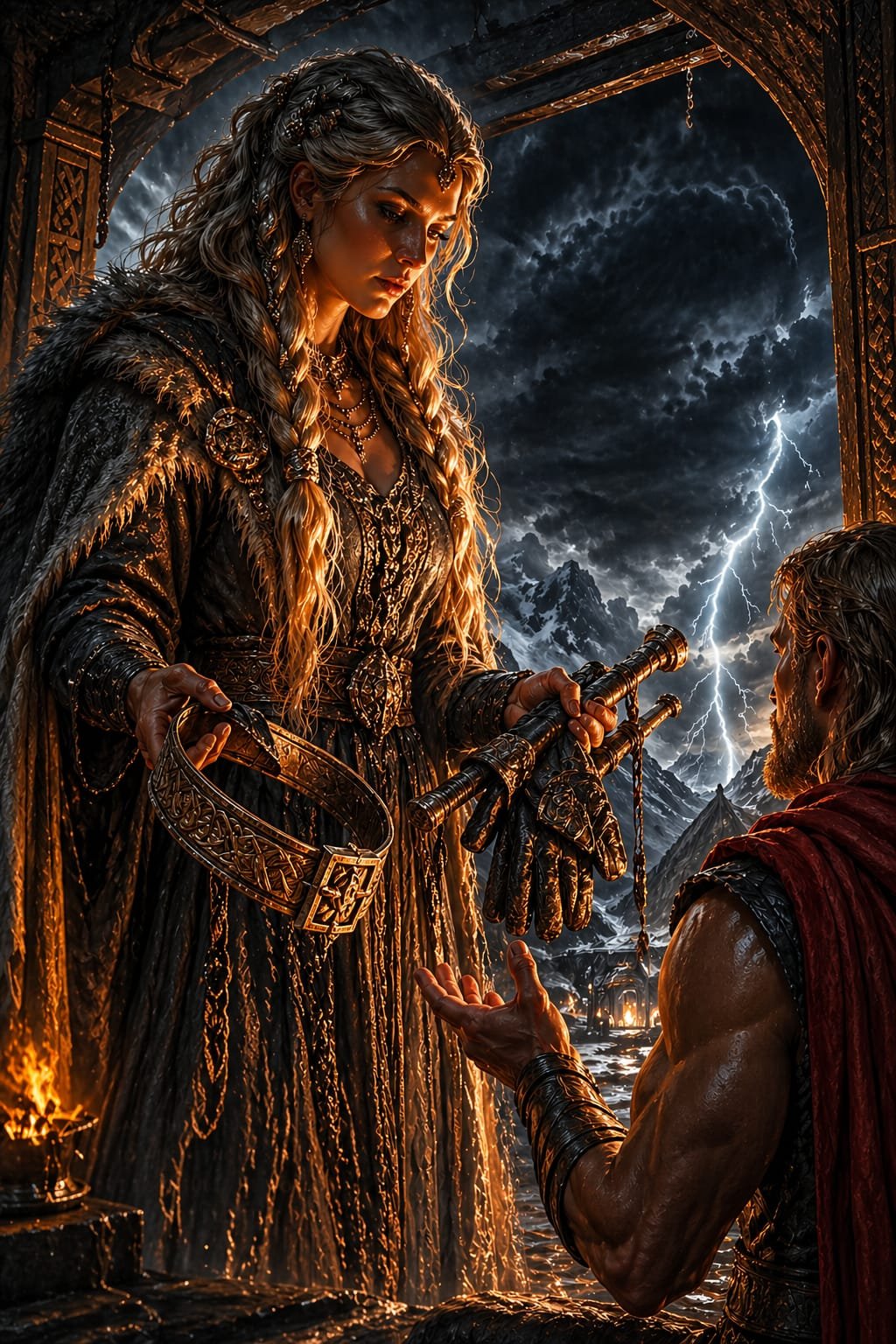
There is always a moment before the world changes a breath before the strike lands, a silence before consequence. It is easy to overlook this moment, to rush past it in anticipation of what comes next, but this threshold holds more power than the outcome itself. Thor, on his journey to confront geirröðr, stands in such a moment, stripped of his hammer, deprived of certainty, moving toward a force designed to destroy him. And in that moment, gríðr appears. Not summoned, not commanded, not bound by allegiance or obligation. She intervenes because she chooses to. Not to fight for him, not to replace his strength, but to ensure that strength has meaning. She offers him three things: a belt of strength, iron gloves, and a staff. These are not gifts of victory; they are conditions for survival. She does not remove the danger. She makes it possible to endure it.
This moment defines her role entirely. She does not alter fate, she alters readiness. The outcome still depends on Thor, on his action, his resilience, his will. But without her intervention, there would be no meaningful chance at all. She does not change the story’s direction, she ensures it can continue.
The Nature of Aid
Gríðr’s gift is not power; it is capacity. There is a difference, and it matters. Power overwhelms, imposes, and ends conflict quickly, often without understanding it. Capacity sustains, allowing something to continue, to adapt, to respond. In a world of gods who seize, command, and conquer, Gríðr gives without binding. She equips without claiming ownership of the outcome, without inserting herself into what follows. This is rare in myth, rarer still beyond it. Because true aid does not create dependence; it creates possibility. Gríðr does not walk beside Thor into the hall of geirröðr, nor does she remain to witness the result. Her role is complete the moment he is ready.
The loudest power changes what happens. The quietest power changes what is possible
There is a quiet integrity in this. She does not linger to be thanked, does not ensure her presence is remembered. Her purpose is fulfilled in the act itself. This is aid without ego, something both powerful and easily forgotten in a world that often ties help to recognition.
The Shelter Within the Wild
Gríðr’s hall is not described in grandeur. There are no golden roofs, no endless feasts, no spectacle to mark its importance. And yet, it is one of the most important places in the mythic landscape. It represents something often overlooked: sanctuary is not always found in the expected places. Sometimes, the place that saves you is not the one you were meant to trust. A giantess shelters a god. An outsider preserves the fate of Asgard. This is the quiet inversion at the heart of gríðr’s story. The boundary between ally and enemy is thinner than it appears, and often more permeable than we are willing to admit.
This inversion challenges more than the myth, it challenges perception. It asks us to reconsider where we look for support, and how often we dismiss it because it does not fit expectation. Gríðr’s hall stands as a reminder that survival does not always come from what is familiar.
Interactions with Gods and Giants
Gríðr does not move through the cosmos as a wanderer like odin, nor as a force like Thor. She remains....rooted, observant, a point of stillness in a moving world. Yet stillness does not mean absence of influence. Her presence touches both gods and giants alike, not through conquest or confrontation, but through awareness. She understands the nature of both sides not as abstractions, but as realities that must coexist. Where others see opposition, she sees interdependence. Her aid to Thor is not betrayal of her kind. It is recognition that destruction without balance serves no one.
In this way, she occupies a rare position, not between sides, but beyond them. She is not neutral in the sense of indifference, but in the sense of clarity. She acts where needed, not where expected, and in doing so, reshapes the outcome without reshaping the conflict itself.
The Philosophy of Intervention
Gríðr does not intervene often. This restraint is not hesitation; it is discipline. Constant interference weakens the world, but the absence of intervention allows it to collapse. She acts only when balance demands it, when the outcome threatens more than a single moment. And when she acts, she does so without ambiguity. There is no hesitation in her giving, no negotiation, no demand for return. This raises a difficult question what compels someone to help when they gain nothing from it? In gríðr’s case, the answer is simple because the world must continue.
This philosophy is not comfortable. It requires awareness, timing, and the willingness to act without reward. It is easier to do nothing or to do everything. Gríðr does neither. She chooses precisely, and that precision is what gives her intervention its power.
The Tools She Gave
The objects gríðr gives thor are more than artifacts; they are principles carried in physical form. The belt reflects that strength can be reinforced and expanded. The gloves remind us that power must be handled with care. The staff acknowledges that even the strongest require support when the ground shifts beneath them. These are not relics of myth alone, but reflections of something enduring we do not face the impossible alone. Even when we must act alone, something has made that action possible.
Each object speaks to limitation as much as ability. Strength needs reinforcement. Power needs mediation. Stability requires support. These are not weaknesses, they are conditions of survival. Gríðr does not remove limitation; she teaches how to work within it.
The Unseen Contribution
Gríðr does not appear in the victory. When Thor survives, when strength is restored, when the story is told, her name fades. This is not an omission but a pattern. Some forces are not meant to be remembered loudly, because their purpose is not recognition, it is continuation. Yet absence of recognition does not mean absence of importance. Without gríðr, the story does not reach its ending. It ends earlier.
This is the part history forgets
This is the nature of foundational acts. They disappear into the structure they support. Their presence is felt only in their absence. Gríðr’s role is not to stand in the spotlight, but to ensure there is a stage at all.
Gríðr and the Human Mirror
Look closely, and her presence becomes familiar. She is the person who prepared you for something they would never see you overcome. She is the moment of clarity that came just before everything shifted. She is the quiet support that expected nothing in return. Gríðr does not demand reverence. She exists in the background of survival itself. In every unseen act that makes endurance possible, she is there.
These reflections are not symbolic alone, they are lived. Gríðr is present wherever preparation meets necessity, wherever someone gives without being seen. She is less a figure to be worshipped, and more a pattern to be recognized.
The Limits of Strength
Even Thor, strongest among the gods, required help. This is not contradiction but truth. Strength is not diminished by support; it is made usable by it. Gríðr’s story dismantles the illusion that strength must be self-contained. No force exists in isolation. To accept help is not to diminish power, it is to make it real.
This lesson cuts against instinct. There is a tendency to equate independence with strength. But gríðr’s presence reveals something deeper strength that cannot receive support is strength that cannot endure.
The Lasting Lesson
Gríðr teaches that not all power announces itself, that the most important interventions often go unseen, and that true aid prepares rather than protects. Strength can be shared without being lost. She is not the storm. She is what allows the storm to pass without ending the world.
And perhaps most importantly, she teaches that continuation itself is a form of victory. Not all triumph is loud. Sometimes it is simply the fact that something did not end when it could have.
The Quiet Persistence
While odin seeks knowledge and thor wields force, gríðr ensures that both journeys remain possible. She does not chase glory or claim victory. She makes both knowledge and strength survivable. A world without her would still have conflict and power but it would lack the means to endure either.
Her persistence is not active in the way others are. It does not move outward it holds steady. And in that steadiness, everything else is allowed to move.
Invocation of Endurance
When you stand before something that feels beyond you, remember Gríðr. Not as a savior, not as a shield, but as the force that equips. Ask not for the storm to pass, but for what you need to face it. And when you receive it, recognize it, because it may not come from where you expect.
And once you recognize it, consider what you will do with it. Preparation carries responsibility. To be equipped is to be called into action, not away from it.
The Eternal Threshold
Gríðr lives in the moments before transformation, in the quiet preparation before action, in the unseen support before survival. You may not notice her when things are easy, but when everything depends on whether you can endure, that is where she stands, just before the point where giving up becomes possible.
She does not cross that threshold for you. She does not carry you through it. She ensures that crossing it remains possible. The step is still yours to take.
And still, nothing collapses.
Final Reflection - “The Hand That Does Not Claim”
Gríðr does not ask to be remembered. She does not wait for gratitude. Her presence is measured not in recognition, but in outcomes that continue. If you have ever made it through something that should have broken you, consider what made that possible. What unseen force gave you the means, even if not the answer? That is where Gríðr resides. Not in the victory, but in the fact that victory was possible at all.
And if you look closely, you may find that you have stood in her place as well. That you have, at some point, been the one who prepared, who equipped, who made survival possible for someone else. In that moment, whether recognized or not, you carried her current forward.
Gríðr: The Hand That Shelters the Storm
Not conqueror. Not ruler. But the quiet force that ensures the story continues. If you were given what you needed to endure would you recognize it? And more importantly… would you pass it on?
Wyrd & Flame 🔥🌿✨
