
Draumr: What Dreams Really Meant in the Sagas and Eddas
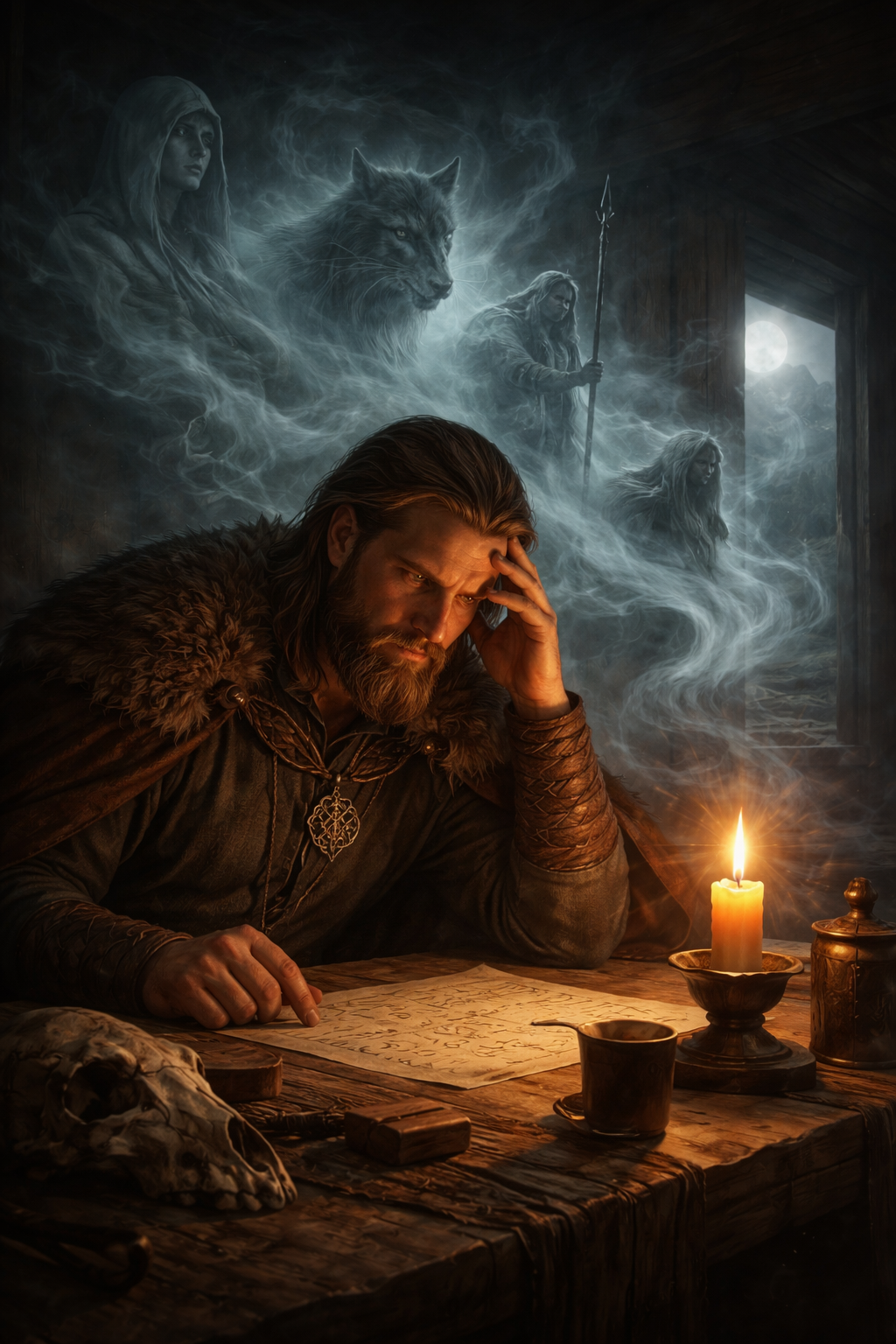
The Old Norse word draumr is usually translated simply as “dream.”
But like many words carried over from Old Norse, that translation flattens what it actually represents.
A draumr is not defined in the sources as something mystical, divine, or separate from ordinary experience. It is not given a fixed structure, a set meaning, or a clear origin. It is, first and foremost, something a person experiences in sleep - something seen, felt, or encountered while the body rests but the mind remains active.
What makes it notable is not that it happens… but how it is treated.
In the Norse material, dreams appear as part of life. They are described in the sagas, sometimes remembered in detail, sometimes mentioned briefly, often without explanation. People speak of them when they feel unusual, when they linger, or when they seem connected to something that later unfolds. But they are not separated out into a defined system, and they are not presented as a reliable method of gaining knowledge.
There is no consistent rule for what a dream is.
No clear statement that it comes from the gods.
No framework that explains exactly how it should be understood.
No expectation that it must carry meaning every time it occurs.
Instead, draumr sits in a middle space.
It is not dismissed as nothing… but it is not elevated into something absolute.
Some dreams appear to reflect events before they happen. Others are unclear, symbolic, or never understood at all. In some cases they are taken seriously, in others they are ignored. The sources show variation, not certainty.
That alone tells us something important.
A draumr is not defined by meaning.
It is defined by experience.
It is something that happens within the person - shaped by their state, their thoughts, their condition, and whatever sits beneath the surface of their awareness. It may carry weight, but that weight is not guaranteed. It may connect to something real, but that connection is not always clear.
To understand draumr properly, it has to be approached from that position.
Not as a message.
Not as a system.
Not as something separate from the self.
But as something experienced… within it.
And only once that is clear can anything else be understood.
What Draumr Means in Old Norse
The word draumr appears throughout Old Norse literature with a straightforward meaning - a dream, something experienced during sleep. It comes from Proto-Germanic *draumaz, and is linguistically consistent across related Germanic languages, always referring to the same core idea: a dream state, not a specialised or ritual concept.
In the texts, draumr is used plainly.
It is not introduced as a technical term.
It is not framed as something reserved for ritual specialists.
And it is not given a defined category beyond the experience itself.
When a dream is mentioned in a saga, it is usually described in simple terms - what was seen, what was felt, and sometimes how the person reacted to it. The word itself does not carry an automatic implication of meaning, importance, or origin. It simply identifies the experience as something that occurred in sleep.
This is important to hold onto.
Because nothing in the word draumr suggests that a dream is divine, prophetic, or sent from outside. Those ideas are not built into the term itself. Any significance a dream may have comes from how it is later understood, not from the word.
You also do not see draumr separated into categories in the way modern systems often try to do.
There is no distinction between “ordinary dreams” and “spiritual dreams” in the language itself.
No specific term used for “messages” as opposed to “random dreams.”
No structured vocabulary that tells us certain dreams are one type and others are another.
It is all draumr.
That lack of categorisation reflects how the Norse approached it.
Dreams were not placed into a fixed system. They were not automatically sorted into meaningful or meaningless. They existed as part of human experience, and any weight they carried was judged case by case, not assumed from the start.
Even when dreams appear vivid, symbolic, or later seem to align with events, the word used does not change. It remains draumr. The language does not elevate those moments into a separate class of experience - it leaves them within the same category, without redefining what they are.
That tells us something clear.
Meaning is not built into the dream itself.
It is something applied afterward and not always correctly.
So when we start from the word draumr, we are not starting with something mystical.
We are starting with something simple.
An experience in sleep.
And everything else comes from how that experience is handled… not what it is called.
Draumr in the Norse Sources
When we look at the Norse material, draumr appears regularly - but never as a structured system.
There is no section in the sources that explains what dreams are in a fixed way.
No set method for interpreting them.
No instruction that they should be followed, trusted, or even understood.
What we have instead are accounts.
In the sagas, people dream. They describe what they saw. Sometimes the dream is spoken about with others. Sometimes it is left alone. In certain cases, it appears to connect to something that later happens. In others, it leads nowhere at all.
That variation is consistent across the material.
Dreams are present… but they are not controlled.
For example, in the Íslendingasögur (the family sagas), dreams often appear before conflict, travel, or death. A person may see animals, figures, or strange situations that feel out of place. These are sometimes treated as significant, especially if they linger or feel difficult to ignore. But even then, the response is not fixed.
Some characters take their dreams seriously.
Others dismiss them.
Some misunderstand them completely.
There is no universal reaction.
In , dreams appear at key moments, often tied to tension and approaching conflict. They are discussed and sometimes interpreted, but not always correctly. The dream itself does not provide clarity - it requires judgement, and that judgement can fail.
In , dreams also appear, sometimes hinting at future events or reflecting emotional and social tension. Again, they are not treated as guaranteed truth. They are experiences that may or may not hold meaning.
In , dreams become more frequent and more intense, particularly as the character’s situation worsens. They reflect inner strain, fear, and inevitability. Whether they are prophetic or psychological is never clearly separated and that lack of clarity is part of how draumr is presented.
This is the pattern across the sources.
Dreams are not explained - they are shown.
They appear in moments where something is already building. Conflict, pressure, decision, consequence. The dream does not exist in isolation. It sits alongside what is already happening in the person’s life.
That matters.
Because it shows that draumr is not treated as a separate channel of knowledge.
It is part of experience.
Even when a dream seems to align with what later unfolds, it is not presented as a clear message being delivered. There is no moment where the source states: this came from the gods, and this is what it means. That kind of certainty is absent.
Instead, there is uncertainty.
People question dreams.
They discuss them.
They sometimes get them wrong.
And that is consistent.
If dreams were meant to be understood as reliable communication, we would expect to see a clearer structure around them. We would expect repeated patterns of correct interpretation, or explicit explanations of their origin.
But we do not see that.
What we see is something far more grounded.
Dreams exist within life, not above it.
They can reflect something real, but they do not explain it clearly. They can feel important, but that feeling does not confirm what they are. And they always require the person experiencing them to decide what to do next.
That responsibility never leaves them.
And that is where draumr sits in the Norse sources - not as a system, not as a method, but as an experience that must be weighed… not assumed.
Saga Evidence of Draumr
If we want to understand draumr properly, the clearest place to look is the sagas.
Not because they give us a system…
But because they show how dreams were actually experienced.
Across the Íslendingasögur, dreams appear again and again - but always in context. They do not happen randomly in the narrative. They tend to surface when something is already building. Conflict. Pressure. Change. The dream does not create the situation. It reflects it.
In , dreams appear before major turning points, especially around conflict and violence. They often involve symbolic imagery - blood, animals, or distorted scenes that do not make immediate sense. These dreams are sometimes discussed, sometimes interpreted, but rarely understood with certainty at the time. In several cases, their meaning only becomes clear after events have already unfolded.
That delay matters.
It shows that even when a dream carries weight, it is not presented clearly in the moment. It does not explain itself. The person still has to interpret it and that interpretation is not guaranteed to be correct.
In , dreams often reflect emotional and social tension. They appear around relationships, loyalty, and conflict between individuals. Again, they are not treated as direct instruction. They are something experienced, sometimes shared, sometimes questioned. What they mean is not fixed, and different people may understand the same dream in different ways.
In , dreams become more frequent as the character’s situation worsens. They are darker, more intense, and often carry a sense of inevitability. Figures appear. Situations repeat. The dreams feel heavy, almost pressing. But even here, they are not clearly explained. They reflect something deeper - whether that is fate, fear, or internal state is never separated out in a simple way.
This is consistent across the sagas.
Dreams:
Appear when something is already unfolding
Use symbolic or distorted imagery
Are not immediately clear
Are sometimes misread or misunderstood
There is no point where a dream is presented as a clean, direct message with an obvious meaning.
And importantly, people do not always act on them.
Some characters ignore their dreams completely.
Some pay attention but do nothing.
Some act… and still do not avoid what is coming.
That tells us something clear.
A draumr does not override what is already in motion.
Even when it seems to point toward something, it does not change the outcome. It does not give control. It does not provide a way out. At most, it reflects what is already building - whether that is understood or not.
This is where modern interpretation often shifts too far.
People look at saga dreams and see “prophecy.”
But what the sagas actually show is uncertainty.
A dream may align with events.
But that alignment is not always recognised at the time.
And it does not come with explanation.
The dream is experienced first.
Understanding comes later… if it comes at all.
So when we look at saga evidence, what we see is not a system of dream interpretation.
We see people encountering something unclear, trying to make sense of it, and not always succeeding.
That is draumr in practice.
Not certainty.
Not instruction.
But something that sits alongside life… and must be judged within it.
Draumr in Eddic Material
When we move from the sagas into the Eddic material, draumr is still present - but the way it appears shifts slightly.
The does not give us a system for dreams any more than the sagas do. There is still no framework, no method of interpretation, and no explanation of where dreams come from. What it offers instead is something more symbolic and mythic.
Dreams in the Eddic poems tend to carry atmosphere rather than clarity.
They are often tied to:
Fear
Omen
Fate already in motion
But even then, they are not explained directly.
The clearest example sits in .
Baldr begins to dream of his own death. The dreams are heavy, disturbing, and persistent. They do not come with explanation. They do not tell him exactly what will happen or how it will unfold. They create a sense of threat - a weight that something is wrong.
What follows is important.
The response to the dream is not: “this is the message, and this is what it means.”
Instead, there is uncertainty.
Odin seeks knowledge elsewhere.
Questions are asked.
The dream itself is not enough to fully understand what is coming.
Even in one of the strongest examples of a dream carrying weight, it is still not self-explanatory.
That matters.
Because it shows that even when a draumr appears significant, it does not function as a clear communication.
It creates awareness… not understanding.
Across the Eddic material, this pattern holds.
Dreams:
Are symbolic rather than direct
Create feeling more than explanation
Sit alongside fate, not above it
They are part of the unfolding, not a tool used to control or avoid it.
There is also no indication that dreams are a regular method of communication from the gods.
If that were the case, we would expect repeated, clear examples of gods speaking through dreams with instruction or guidance. But that pattern is not there. Even when divine figures are involved, the dream itself does not act as a straightforward message.
It remains unclear.
It remains open.
And it still requires something else to make sense of it.
This is where the Eddic material reinforces what we see in the sagas.
A draumr can carry weight.
It can reflect something real.
But it does not explain itself, and it does not remove uncertainty.
Even at the mythic level, dreams are not presented as answers.
They are part of the tension… not the resolution.
Baldrs Draumar: A Key Example
If there is one place people point to when speaking about dreams in Norse material, it is .
And it is often misunderstood.
In the poem, Baldr begins to dream of his own death. The dreams are described as heavy and troubling. They do not show a clear sequence of events. They do not explain what will happen or how it can be avoided. What they create is a sense of inevitability - that something is already in motion.
That is the first thing to notice.
The dream does not provide clarity.
It provides pressure.
Baldr’s dreams do not tell him what to do. They do not offer a solution. They do not function as guidance. They simply reflect that something is wrong, and that what is coming cannot be ignored.
The response to this is also important.
The gods do not treat the dream as a complete answer.
Frigg seeks oaths from things in the world to protect Baldr.
Odin rides to Hel to question what is coming.
In other words, they look elsewhere for understanding.
The dream itself is not enough.
Even with all that is done, the outcome does not change. Baldr still dies. The dream did not prevent it. It did not provide a way out. It did not give control over what was unfolding.
This is where modern interpretation often shifts too far.
People look at this and see prophecy.
But what the poem actually shows is something more limited.
The dream reflects what is already set.
It does not change it.
It does not explain it fully.
And it does not remove the uncertainty surrounding it.
Even Odin, who seeks knowledge directly, does not receive a simple or complete answer. What he learns confirms the direction of events, but it does not stop them.
That tells us something clear about draumr in this context.
A dream can carry weight…
But it is not a tool of control.
It does not function as a clear message that can be acted on to change the outcome. It sits alongside fate, not above it.
There is also no suggestion here that Baldr’s dreams are a standard or repeatable experience.
They are not presented as something that happens regularly.
They are not given as an example of how dreams should be used.
They are part of a specific moment, tied to a specific event.
This is a key point.
Because even in one of the strongest examples of a dream carrying significance, it still does not form a system.
It does not teach interpretation.
It does not create rules.
It does not establish dreams as a reliable method of communication.
It simply shows that sometimes, a draumr can reflect what is already unfolding.
Nothing more.
And that is where it needs to stay.
Because once it is treated as something more than that (as instruction, as guidance, or as something that can be used to control outcome) it moves beyond what the source actually shows.
Snorri and Dream References
When we move into later material, particularly the , dreams still appear but the context has shifted.
Snorri is writing in the 13th century, in a Christianised Iceland, long after the older belief systems had begun to change. His work preserves a great deal of earlier material, but it is not untouched. It is shaped by a different worldview, and that affects how certain things are presented.
That includes how dreams appear.
Dreams are still mentioned, and in some cases they seem to carry weight. They can reflect events, hint at outcomes, or sit alongside moments of tension. But just like in the earlier sources, they are not given a structured explanation.
There is still:
No fixed method of interpretation
No system of meaning
No consistent claim that dreams come from the gods
Even in a later text, where we might expect more explanation, that structure is not added.
That absence is important.
Because if dreams were widely understood as a clear form of communication, especially by this period, we would expect to see it stated more directly. We would expect explanation, classification, or at least some form of guidance.
But that does not appear.
What we see instead is continuity.
Dreams remain something experienced.
Sometimes noted.
Sometimes connected to events.
But never fully explained.
There is also the influence of Christian thought to consider.
By Snorri’s time, ideas about dreams as divine messages already existed within Christian tradition. Dreams could be seen as communication from God, as warnings, or as visions with clear meaning. That framework was present in the culture Snorri lived in.
And yet, even with that influence, the Norse material he preserves does not fully adopt that structure.
Dreams are not turned into a clear system of divine messaging.
They remain uncertain.
They remain open.
They remain something that must be considered, not assumed.
This reinforces what we see in earlier sources.
Across both pre-Christian and later written material, draumr does not become more defined. It does not evolve into a structured method. It does not gain a consistent explanation of origin or meaning.
It stays where it has always been.
As part of experience.
Something that can carry weight…
But does not explain itself.
Something that can reflect what is unfolding…
But does not control it.
And something that still requires judgement, regardless of the time it is written in.
Even in the hands of a later writer, with a different worldview surrounding him, draumr is not turned into certainty.
It remains what it has always been.
Unclear.
Contextual.
And dependent on how it is understood… not what it is.
The Norse View of the Self
To understand draumr properly, it cannot be separated from how the Norse understood the self.
Because in the sources, a person is not a single, fixed thing.
There is no clear idea of one unified soul acting alone. What we find instead is a layered structure - different aspects, each carrying its own role, each influencing how a person experiences the world.
That matters when it comes to dreams.
Because what appears in a draumr is not coming from one single source.
One of the central aspects is the hugr.
This is the inner state — thought, intention, mood, and will. It shapes how a person perceives, how they act, and how they respond. It is not static. It shifts constantly, influenced by experience, pressure, and direction. And it does not stop when a person sleeps.
It continues.
Alongside this is the fylgja.
Often described as a following presence, it is connected to a person’s nature or fate. In the sources, it can appear in dreams, sometimes taking animal form. But it is not separate in the way people often assume. It does not act as a guide giving instruction. It reflects something tied to the individual, not something external reaching in.
Then there is hamingja.
This is often understood as fortune, strength, or luck connected to family and reputation. It is built through action, carried through lineage, and affected over time. It does not appear as a voice or figure in dreams, but it shapes the wider context a person exists within.
Other aspects are also present.
Hamr, relating to form and presence.
Önd, the breath or life force.
Óðr, tied to inspiration, emotion, and heightened states.
Each of these reflects a different part of what makes up a person.
But none of them create a system where experience comes from one clear source.
That is the key point.
The self is not unified in a simple way.
It is layered.
And those layers interact.
When a person dreams, it is not just “them” in a straightforward sense experiencing something. It is the result of these interacting aspects — their state, their tension, their awareness, their condition at that moment.
That is why dreams can feel:
Fragmented
Symbolic
Difficult to understand
They are not coming from one clear voice.
They are shaped by a complex inner structure.
This is where modern assumptions often go wrong.
If you assume there is one single source behind a dream, it becomes easy to label it as something external. Something sent. Something separate from you.
But once you understand that the self itself is made up of multiple interacting parts, that assumption no longer holds.
There are many internal sources shaping what appears.
And most of the time, that is where the answer sits.
Not in something reaching in from outside…
But in something already within you, taking form in a way that can finally be seen.
Hugr and the Formation of Draumr
The strongest connection to draumr sits with the hugr.
If the hugr is the inner state (thought, intention, mood, and will) then it does not stop when the body rests. It continues. It shifts. And without the structure of waking awareness holding it in place, it begins to show itself differently.
This is where draumr forms.
What you carry in your hugr shapes what you experience in sleep.
If something is unsettled, it does not disappear.
If something is being ignored, it does not stay buried.
If something is already forming, it does not pause.
It continues… and in sleep, it takes form.
That form is not always clear.
The hugr does not present things in direct, logical steps when you are asleep. It uses images, situations, and symbolic patterns. A place may stand for a situation. A person may represent conflict or connection. A path may reflect direction. The structure is different, but the source remains tied to what is already there.
That is why dreams can feel so real.
Not because they are always coming from something outside of you…
But because they are coming from something within you that already carries weight.
Without the filtering of waking thought, things become more direct in feeling, even if they are less clear in form.
This is also why dreams can appear distorted.
A small concern can become a full situation.
A passing thought can take on intensity.
Something avoided can appear in a way that cannot be ignored.
The hugr is not adding something new.
It is presenting what is already there… without restraint.
At the same time, this does not mean every dream carries meaning.
The hugr is active constantly. It processes, reflects, and responds to what a person experiences throughout their life. Some dreams are simply that process continuing. They do not need to be interpreted. They do not need to be followed. They are part of how the inner state moves and settles.
This is where balance sits.
Because there is a tendency to move too far in one direction.
Either dismissing dreams completely…
Or assuming every dream must mean something important.
The Norse material supports neither.
What it shows is that dreams can reflect something real, but that reality is often tied to the self.
Not something external giving instruction.
This is why awareness of the hugr matters.
If your hugr is unsettled, your dreams may reflect that instability.
If you are under pressure, it may appear in exaggerated or unclear forms.
If you are already leaning toward a decision, your dreams may present that direction more clearly than you are willing to accept while awake.
Without awareness of your own state, it becomes easy to misread what you are seeing.
You may take something internal and treat it as something external.
You may assign meaning where there is none.
Or miss what is actually being shown because you are looking in the wrong place.
Hugr and draumr are not separate.
They meet in the same space.
One shapes the other.
And more often than not…
What appears in a dream is not something being given to you.
It is something already within you… taking form.
Fylgja and Dream Appearances
One of the main reasons people assume their draumr is something external is because of what they see in it.
Animals.
Figures.
People who feel separate.
Presences that seem to act on their own.
It is easy to experience that and think - that must be something coming to me.
This is where the concept of fylgja is often misunderstood.
In the sources, the fylgja is described as a following presence connected to a person’s nature, character, or fate. It is not something a person controls, and it is not something that arrives to give instruction. It is tied to the individual, not separate from them.
And importantly…
It can appear in dreams.
Often, this appearance takes the form of an animal.
But that form is not random.
It reflects something about the person - behaviour, tendency, strength, restraint, aggression, awareness. The form is a representation, not a separate being acting independently with its own intent.
This is where confusion begins.
Because when something appears in a dream that feels “other,” it is natural to assume it must be external. It moves on its own. It feels present. It does not feel like something you are controlling.
But the Norse material does not support jumping to that conclusion.
The self is not simple.
It has layers.
And those layers can take form.
The fylgja is one of those forms.
It reflects something tied to who the person is, not something reaching in from outside. It does not speak with instruction. It does not guide in a direct way. It appears — and what it represents must be understood within the context of the person.
This is also why the forms can vary.
An animal may appear because it reflects a trait.
A figure may appear because it reflects a role or situation.
A presence may feel separate because it is not consciously controlled.
But none of that confirms that it is external.
It confirms that it is being experienced.
In the sagas, when fylgjur appear, they are not treated as something to follow blindly. They are observed. Sometimes discussed. Sometimes understood, sometimes not. But they are never presented as clear communicators delivering instruction.
That distinction matters.
Because without it, every dream figure becomes something “other.”
And once that happens, interpretation moves away from the self entirely.
Understanding fylgja brings it back.
It shows that something can appear separate… without being external.
That form does not define origin.
And that what is seen in a draumr is not always something coming to you…
But something tied to you… taking shape.
Why Dreams Feel Symbolic
One of the main reasons people assume their draumr carries meaning from outside is because of how it feels.
Dreams do not feel distant while you are in them.
They do not feel imagined.
They feel immediate, present, and real.
You can feel fear, urgency, recognition, or connection in a way that does not feel constructed at all. And when you wake, that feeling often remains. It lingers. It holds weight.
That is what leads people to think - that must have meant something.
But the feeling alone does not tell you where it came from.
The structure of dreaming is different from waking thought.
When you are awake, your mind works in sequence. There is order, logic, and control. Thoughts follow each other in a way that can be tracked and understood. When you are asleep, that structure is reduced.
What takes its place is something more direct.
Images.
Situations.
Emotions.
Presented without the same filtering.
The hugr is still active, but it is not being held in the same way.
Because of that, things become amplified.
A small concern can become a full scene.
A passing thought can turn into a complete situation.
Something ignored can appear in a way that cannot be avoided.
The intensity does not come from something being added.
It comes from something no longer being restrained.
This is also why dreams appear symbolic.
Not because they are always meant to be decoded like a message…
But because the mind does not present things in straight lines during sleep.
It uses forms that carry meaning in a different way.
A place may represent a situation.
A person may reflect a relationship or internal conflict.
An action may stand for a decision or direction.
But these are not fixed symbols.
There is no set system where a certain image always means the same thing. The meaning is shaped by the person experiencing it - their understanding, their state, and what they associate with what they see.
This is where things often go wrong.
People take a symbolic dream and immediately try to decode it using fixed meanings. They assign it to something external. They treat it as if it was sent to them with a clear intention.
But what they are responding to is the intensity of the experience…
Not the origin of it.
A dream can feel meaningful without being a message.
It can feel important without being instruction.
It can feel clear in the moment, but lose that clarity when looked at properly afterward.
That does not make it useless.
It means it needs to be approached with awareness.
Recognising that how something feels is not the same as understanding what it is. Recognising that symbolic form does not confirm an external source. Recognising that intensity does not equal truth.
When that line is held, draumr becomes easier to place.
Not as something mysterious or unreachable…
But as something shaped by the same inner state that moves through you while awake.
When Dreams Were Taken Seriously
Although not every draumr was treated as meaningful, there are clear moments in the sources where dreams were taken seriously.
These are usually the examples people remember.
In the sagas, certain dreams stand out. They are not ordinary in how they are experienced. They may repeat. They may carry a strong sense of unease. They may stay with the person long after waking. Sometimes they appear close to important events - conflict, death, or turning points.
When this happens, the response shifts.
The dream is spoken about.
It is considered.
Sometimes it is interpreted by others.
But even here, there is no certainty.
The dream is not treated as a clear answer.
It is treated as something worth paying attention to… but still unclear.
In , dreams appear before major conflict, and some are recognised as significant. But their meaning is not always understood at the time. In some cases, interpretation comes too late - only becoming clear after events have already unfolded.
In , dreams become more intense as the character’s situation worsens. They carry weight, but they do not provide direction. They reflect what is already building, not what should be done.
This is the key point.
Even when a dream is taken seriously, it is not treated as instruction.
It does not remove the need for judgement.
It does not replace decision-making.
And it does not guarantee understanding.
There are also examples where dreams are misunderstood.
A person may interpret a dream one way, only for events to unfold differently. This shows that even when a dream carries weight, it is not automatically clear. The problem is not always the dream itself - it is how it is read.
That uncertainty is part of it.
A dream might point toward something, but it does not explain it fully. It still requires awareness, distance, and the ability to question what is being seen.
There is also no indication that these kinds of dreams were constant.
They do not appear as everyday occurrences.
They are not described as something everyone experiences regularly.
They show up at specific moments, often tied to pressure or change.
That alone sets them apart.
So while some dreams were taken seriously, they were not treated as a system.
They were not relied on.
They were not followed blindly.
At most, they were something to consider.
Something that might reflect what is coming, or what is already present - but never something that removed the need to think, to weigh, and to take responsibility for what comes next.
That is where the balance sits.
Not dismissing all dreams…
But not elevating all dreams either.
Recognising that some may carry weight - but that weight must be handled carefully.
Without assumption.
Without certainty.
And without losing sight of the fact that understanding is never guaranteed.
Misreading Draumr (Then and Now)
One of the most consistent things we see, both in the sources and today, is not the problem of dreaming…
But the problem of interpretation.
A draumr can feel clear while you are in it.
It can feel direct, meaningful, even certain.
But that feeling does not mean it has been understood properly.
In the sagas, people misread dreams.
They take something symbolic and treat it as literal.
They assume meaning too quickly.
Or they fail to recognise something that later proves to carry weight.
In each case, the issue is not the dream itself.
It is how it is understood.
This comes back to the state of the hugr.
A person does not interpret a dream from a neutral position. They interpret it through their own condition. If they are fearful, they may read threat into something unclear. If they are hopeful, they may see confirmation where there is none. If they are unsettled, they may try to force meaning onto something simply because it felt strong.
The dream does not change.
But the interpretation does.
This is where modern practice often mirrors the same mistake.
A vivid dream happens.
It feels real.
It stays with the person.
And the meaning is decided immediately.
It is labelled.
Assigned to the gods.
Treated as instruction.
Once that happens, questioning stops.
And that is where misreading begins.
Not because the dream was unclear…
But because the person became too certain.
The Norse material does not support that kind of certainty.
Even when dreams were taken seriously, they were still discussed, questioned, and sometimes misunderstood. There was space for uncertainty. There was an understanding that interpretation could be wrong.
That awareness is important.
Because once it is removed, every dream becomes something that must be believed… rather than something that should be considered.
And that leads to problems.
It can push a person in the wrong direction.
It can create false certainty.
It can cause someone to act on something that was never meant to be taken as instruction.
Over time, it weakens judgement rather than strengthening it.
This is why restraint matters.
Not in ignoring dreams…
But in how they are approached.
A draumr should not be taken at face value straight away. It should be looked at with distance. With awareness of your own state. With the understanding that what you are seeing may not be as direct as it felt in the moment.
Because most of the time…
The risk is not that a dream has no meaning.
The risk is that it is given the wrong one.
Not Every Dream Is a Sign
This is where it needs to be said clearly.
Not every draumr carries meaning.
Not every dream is a sign.
And not everything seen in sleep comes from something outside of you.
This idea is common now, but it is not supported by the Norse sources.
There is no indication that dreams were treated as constant communication from the gods. No expectation that what is seen in sleep must be interpreted, followed, or acted on. And no system that separates “ordinary dreams” from “meaningful ones” with certainty.
What the material shows instead is far more grounded.
Dreams happen.
Some are remembered.
Some are not.
Some feel important.
Others pass without weight.
The experience itself does not define meaning.
A dream can feel strong and still mean nothing.
It can stay with you and still not require action.
It can appear clear and still be misunderstood.
That is consistent across the sources.
Even when dreams seem to align with events, they are not presented as reliable guidance. They do not provide instruction. They do not offer a way to control outcome. They sit alongside what is already unfolding, not above it.
This is where modern understanding often shifts too far.
A dream feels real, so it must be a message.
It lingers, so it must mean something.
It involves a figure, so it must be external.
But those assumptions are not grounded in the material.
They come from later ways of thinking, where dreams are treated as direct communication. When that is brought into Norse practice, it creates a false expectation — that meaning should always be there, and that it must come from outside.
That is not how draumr is presented.
Most of the time, what appears in a dream is shaped by the self.
Thought.
Tension.
Direction.
Conflict.
It reflects what is already there, not something being given.
That does not make dreams meaningless.
It places them correctly.
Because meaning, when it is present, is not something that can be assumed.
It has to be recognised carefully… without forcing it.
And that requires restraint.
Once everything becomes a sign, there is no way to tell what actually matters. Everything carries weight, and because of that, nothing can be weighed properly.
That is where understanding breaks down.
Holding the line means accepting that most dreams do not carry meaning beyond the experience itself.
And recognising that when something does carry weight, it will stand apart - not because it felt strong, but because it connects to something real.
Until then…
A draumr is just that.
A dream.
Experienced… but not automatically understood.
Draumr vs Spá
It is important to separate draumr from spá.
Because they are not the same thing.
A draumr is an experience.
Something seen or felt in sleep.
Unclear.
Often symbolic.
Shaped by the state of the person experiencing it.
It happens without structure, without control, and without guaranteed meaning.
Spá is something else entirely.
It is not something that simply happens to a person.
It is something that is spoken.
It carries weight because it is given form through words. It is brought out of uncertainty and placed into something others can hear, react to, and act upon. That act alone makes it different.
A dream does not carry that responsibility.
Spoken insight does.
This is where confusion often happens.
A person experiences a dream.
It feels strong.
It lingers.
And it is immediately treated as spá - as something that has meaning, direction, or authority.
But the sources do not support that shift.
There is no indication that dreams were automatically treated as foresight. No system where what is seen in sleep is assumed to be something that should be spoken as truth. The two are not interchangeable.
A draumr may reflect something.
But it does not define it.
And it does not carry the same weight as something deliberately spoken.
That difference matters.
Because once a dream is treated as spá, it is no longer just an experience. It becomes something that can influence others. It can shape decisions, create expectation, and carry consequences beyond the person who had it.
That is where responsibility enters.
And that responsibility is not present in the dream itself.
It comes from what is done with it.
In the sources, dreams are experienced and sometimes discussed. But they are not automatically elevated into statements of truth. They are not treated as reliable foresight that must be followed or acted on.
They remain uncertain.
Even when they seem to align with events, that alignment does not turn them into spá.
It simply shows that something reflected what was already in motion.
That is the line that needs to be held.
A draumr is not foresight.
It is not authority.
And it is not something that should be treated as truth the moment it is experienced.
If something is to be spoken, it carries weight beyond the dream itself.
And without that understanding, it becomes easy to turn experience into certainty… and certainty into something that was never grounded to begin with.
The Role of Interpretation
A draumr on its own does not carry fixed meaning.
What gives it meaning is how it is understood.
And that is where most of the difficulty sits.
A dream can feel clear while you are in it. It can feel direct, as if it makes complete sense. But that sense of clarity often fades when you wake, or shifts depending on how you think about it afterward. What felt obvious becomes uncertain. What felt certain becomes open to more than one reading.
That is because the dream itself is only part of the process.
The rest sits with the person interpreting it.
Interpretation is not neutral.
It is shaped by the state of the hugr.
If your hugr is unsettled, your understanding will reflect that. You may see threat where there is none. You may see confirmation of something you already want to believe. You may take something symbolic and treat it as literal simply because it felt strong in the moment.
The dream has not changed.
But your reading of it has.
This is why interpretation cannot be separated from self-awareness.
Without awareness of your own state, you are not interpreting the dream clearly. You are filtering it through what you are already carrying — your expectations, your concerns, your direction. That does not make your interpretation useless, but it does mean it may not be accurate.
And accuracy matters.
Because once meaning is assigned, it can influence what you do next. If the interpretation is wrong, the action that follows may also be wrong. This is how misreading a dream moves from thought into consequence.
The Norse material reflects this.
Dreams are sometimes discussed with others, not because someone else holds a fixed answer, but because interpretation benefits from distance. Another perspective can reveal something that has been missed, or question something that has been assumed.
Even then, there is no guarantee.
Interpretation is not about finding certainty.
It is about weighing what is there.
Looking at the dream without rushing to define it. Considering your own state at the time. Asking whether what you are seeing reflects something already present. And recognising that not everything needs to be turned into a clear message.
This is where restraint becomes important.
Not every dream needs to be explained immediately. Not every image needs to be broken down. Sometimes the most accurate approach is to leave it, observe it over time, and see whether it connects to anything real as events unfold.
Because meaning is not always immediate.
And forcing it too quickly often leads to the wrong conclusion.
Understanding draumr is not just about the dream itself.
It is about the ability to interpret without assumption.
To question your own reading.
And to recognise that the strongest feeling is not always the clearest truth.
Modern Misunderstandings
Most of the confusion around draumr today does not come from the sources.
It comes from how people are approaching them.
There is a strong tendency in modern spaces to treat every vivid or emotional dream as something external. Something sent. Something meaningful in a direct and personal way. And more often than not, that meaning is immediately assigned to the gods.
“I had a dream, so it must be a sign.”
That mindset is not Norse.
It comes from later religious frameworks, where dreams are treated as direct communication, guidance, or instruction. When that way of thinking is brought into Norse practice, it reshapes how draumr is understood. It creates an expectation that dreams should be clear, purposeful, and sent from outside.
But the sources do not support that.
They do not show a culture where people regularly received messages through dreams. They do not show a system where dreams were relied on for guidance. And they do not show people assuming that what they experienced in sleep must be something divine.
What they show is far more grounded.
Dreams were experienced.
Sometimes considered.
Sometimes ignored.
Not automatically believed.
This is where modern interpretation moves too quickly.
A strong dream happens.
It feels real.
It stays with the person.
And instead of asking what does this reflect, the question becomes who sent this to me.
That shift matters.
Because it takes the focus away from the self and places it onto something external without evidence.
Over time, this builds a pattern.
People begin to rely on dreams for direction. They start looking for signs instead of understanding their own state. They place weight on things that may not carry meaning, while missing what is actually present in their waking life.
This does not strengthen practice.
It weakens it.
Because it removes responsibility from the person and places it onto something assumed rather than understood.
There is also a tendency to overcomplicate dreams.
To assign fixed meanings to symbols.
To build systems that claim certainty.
But the Norse material does not give us that.
There is no set meaning for specific images.
No universal system that applies to everyone.
Meaning is not fixed like that.
It is shaped by the individual, their state, and their situation.
This is why caution matters.
Not in rejecting dreams…
But in how they are approached.
Recognising that a dream can feel important without being instruction. Recognising that not everything needs to be turned into a sign. Recognising that most of what appears in sleep is connected to what is already within you.
Because once everything becomes a message…
Nothing is understood clearly.
Bringing things back to a grounded position does not remove meaning.
It makes it more accurate.
And it brings the focus back to where it should be - not on what might be reaching in from outside, but on what is already there, waiting to be understood properly.
Staying Grounded in Practice
Understanding draumr means nothing if it is not applied properly.
This is where most people lose their footing.
They either dismiss dreams completely…
Or they treat every dream as something important, something sent, something that must be followed.
Both of those positions miss what the sources actually show.
The Norse material sits in the middle.
And staying grounded means holding that position.
The first step is simple.
Do not assume.
Just because a dream felt strong does not mean it carries meaning. Just because it stayed with you does not mean it came from the gods. The feeling is part of the experience - not proof of where it came from.
That pause… is where grounding begins.
The next step is looking at yourself first.
Before asking what does this mean, ask what state was I in. What has been on your mind? What have you been carrying? What direction have you already been leaning toward?
Most of the time, the dream reflects something already present.
Not something being given to you…
But something already there being shown more clearly.
If that step is skipped, understanding is skipped.
And that is where misinterpretation begins.
It is also important not to rush.
A dream does not need to be understood the moment you wake. In many cases, it is better to leave it. Let time pass. See if it connects to anything real in your waking life. If it does, that connection will become clearer. If it does not, then it may not have carried meaning in the first place.
Forcing meaning too quickly often leads in the wrong direction.
Another key point is restraint in action.
Even if a dream feels important, it should not be treated as instruction. The sources do not show people acting blindly on dreams. They still think. They still weigh. They still decide.
The dream does not remove responsibility.
You still choose what to do.
This is where grounding protects you.
Because without it, a person can begin making decisions based on assumption rather than understanding. They can start seeing patterns that are not there, or following something that was never meant to be followed.
Over time, that creates confusion rather than clarity.
Staying grounded also means accepting something simple.
Not every dream matters.
Some are just the mind working through things.
Some are fragments.
Some are nothing more than what passes through while you sleep.
There is no need to turn everything into something more than it is.
Knowing when to leave something alone is just as important as knowing when to pay attention.
In the end, grounded practice is not complicated.
It is awareness.
It is patience.
It is restraint.
And it is the ability to recognise that what you experience in a draumr is not automatically something coming from outside of you.
Most of the time…
It is something already within you, being shown in a different way.
And understanding that properly is what keeps your path steady.
Looking Inward First
When everything is treated as a sign, nothing is understood clearly.
That is where most people end up with draumr.
They stop looking at themselves… and start looking outward for answers. Every dream becomes something sent. Every image becomes something to decode. Every feeling becomes something to follow. And over time, that pulls them further away from what is actually happening.
Because the focus shifts.
From awareness… to assumption.
The Norse material does not support that shift.
It does not show a world where people relied on dreams for direction. It shows a world where people were expected to think, to weigh, and to take responsibility for how they understood what they experienced. Dreams were part of that experience - but they were never something that replaced judgement.
That is the line that needs to be held.
A draumr can reflect something real.
But that reality is often within you.
Your state.
Your direction.
Your tension.
Your awareness or lack of it.
If you do not understand your own hugr, you will not understand your dreams. You will read into them what you want to see, what you fear, or what you expect. And once that happens, the dream is no longer being understood…
It is being shaped by assumption.
That is where people lose their footing.
Looking inward first does not mean dismissing everything.
It means starting in the right place.
It means recognising that what you experience in a draumr is connected to you before anything else. That meaning, if it is there, is not something to grab onto immediately — but something to approach with awareness and restraint.
Because understanding does not come from forcing meaning.
It comes from recognising what is already there.
The Norse did not build their understanding of the world on assumption.
They built it on awareness.
On consequence.
On the ability to stand steady in uncertainty.
That applies here just as much as anywhere else.
So when a dream comes, the question is not:
Who is speaking to me?
It is:
What does this reflect?
And more importantly:
What am I carrying that made this appear?
Because more often than not…
What you are seeing is not something reaching in from outside.
It is something within you… finally being seen for what it is.