
Sigrblót: The Early Summer Sacrifice for Victory in Old Norse Tradition
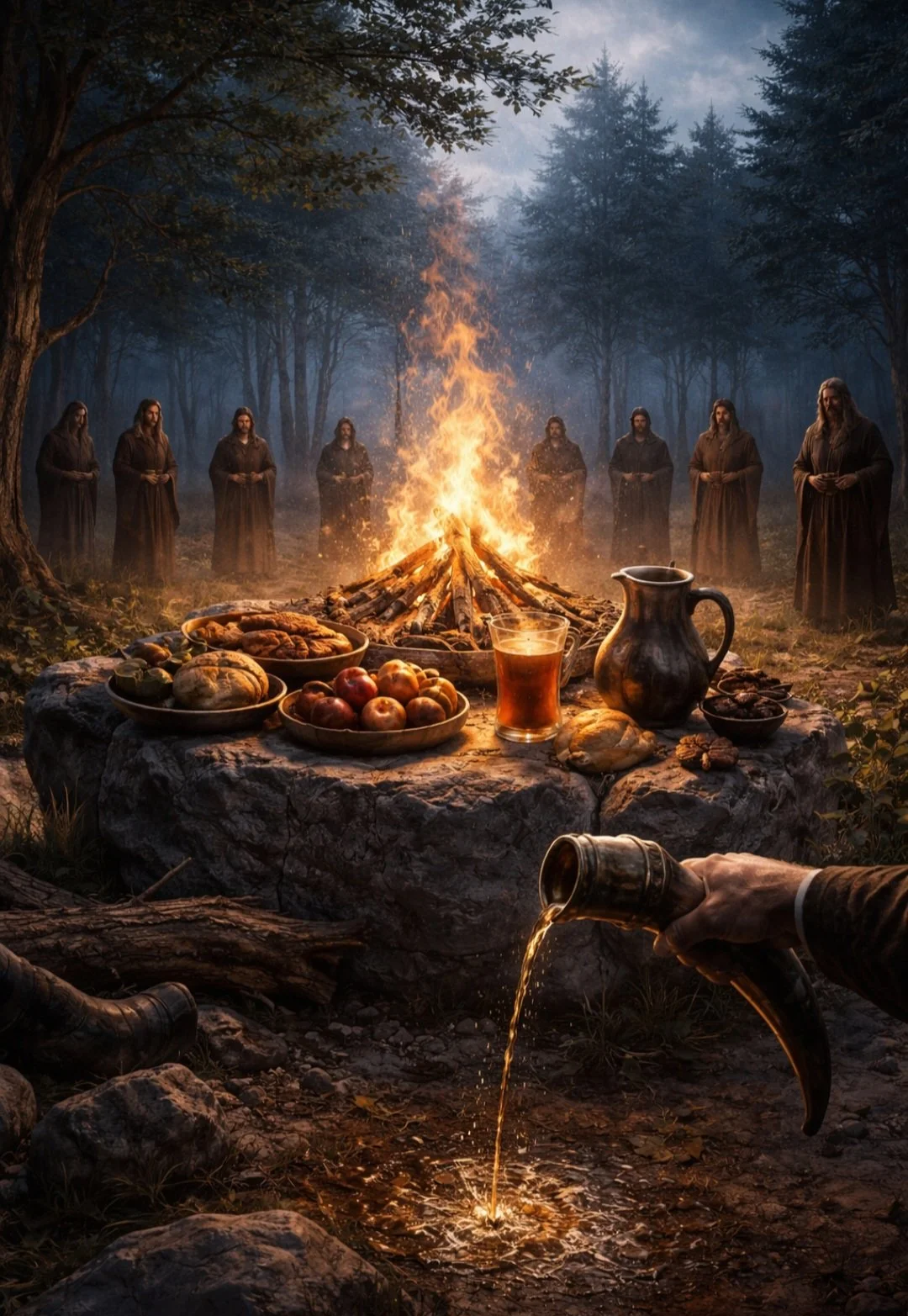
Sigrblót is recorded in the Old Norse sources as a sacrifice performed for sigr, meaning victory. It is named in the ynglinga saga, where it appears as part of a sequence of recurring sacrifices observed over the course of the year. In this account, three primary rites are described: one held at the onset of winter, one for a good year and harvest, and one for victory. Sigrblót belongs to this final category.
The term blót refers to a sacrificial offering made within the religious framework of pre-Christian Scandinavia. Such rites involved the giving of offerings and the formal acknowledgement of divine powers, and were carried out at both communal and household levels. The written material preserves the existence of these practices, though it rarely provides full descriptions of their form.
Beyond its naming and purpose, Sigrblót is not described in detail in the surviving sources. No specific procedure is outlined, and no single deity is directly tied to it. What is preserved is its identification as a sacrifice for victory within the broader cycle of ritual observance.
Sigrblót in the Written Sources
Sigrblót is mentioned directly in , where it is listed as one of three sacrifices carried out over the year. The text states that one sacrifice was held at the beginning of winter, one for a good year and harvest, and one for victory. This last one is Sigrblót.
That is, realistically, all the source gives us.
There is no step-by-step account of how it was performed. No description of the offerings. No named deity tied specifically to it. Just its purpose, and its place within a wider cycle of sacrifice.
What does matter is that it is included at all. It is not described as a one-off act, but as something that belonged to an established pattern. That tells us it was recognised, repeated, and understood within the structure of Norse religious life.
The saga itself presents these sacrifices as being organised at a societal level, attributed to early rulers. Whether taken as history or tradition shaped later, it still reflects how these rites were remembered: not as isolated personal acts, but as part of a wider, ordered system.
Beyond this, the sources are largely silent. Sigrblót is not expanded on elsewhere in any detail. What survives is brief, but clear -there was a sacrifice, it was called Sigrblót, and it was carried out for victory.
The Meaning of Blót in Old Norse Practice
The word blót is used in Old Norse sources to refer to a sacrificial offering. It appears across a range of texts and is tied to acts of giving to the gods, often in return for something sought - such as a good year, peace, or victory. The term itself is directly connected to the act of sacrifice, not to prayer alone or symbolic gesture, but to the giving of something of value.
In Ynglinga Saga and other saga material, blót is shown as a recognised and repeated part of religious life. It is not described as informal or optional, but as something structured and expected within the community. These rites could be held publicly, led by figures of authority, or carried out at a household level, depending on the context.
Accounts such as that of the temple at Uppsala, recorded by Adam of Bremen, describe sacrificial gatherings where offerings were made and rituals observed over set periods of time. While written from an outside perspective, these accounts still align with the broader understanding that blót involved communal participation and the formal giving of offerings.
The sources do not present blót as a single fixed ritual with one uniform structure. What they show instead is a consistent principle: something is given, something is acknowledged, and the act itself holds weight within the relationship between people and the divine.
Seasonal Placement: The Beginning of Summer
Sigrblót is placed at the beginning of summer in Ynglinga Saga, where it is identified as the sacrifice made for victory. Its position within the yearly cycle is clear: it follows the winter sacrifice and the offering made for a good year, marking the shift into the next season.
In Old Norse timekeeping, the year was divided into two main halves - winter and summer. Summer was not understood in the modern sense of heat alone, but as the active half of the year. It marked the period when movement resumed, whether in travel, trade, or warfare. The beginning of summer was therefore a defined and recognised turning point.
This transition is also reflected in the term sumarmál, used in the sources to describe the opening of summer. It signals not just a change in weather, but a change in function. What could not be done during winter could now begin again.
Placed at this boundary, Sigrblót belongs to that moment of transition. It stands at the point where the year turns from stillness into activity, and where the actions that follow carry greater consequence.
History of Sigrblót
Sigrblót enters the written record through Ynglinga Saga, where it is listed as one of three sacrifices observed over the course of the year. The passage is brief, but it gives three fixed points: a winter sacrifice, a sacrifice for a good year and harvest, and a sacrifice for victory at the beginning of summer. Sigrblót belongs to this final category.
The importance of that reference is not in detail, but in placement. It shows that Sigrblót was not treated as an isolated act, but as part of a recognised cycle. That cycle reflects a structured approach to time, where different points in the year carried different needs, and sacrifice was directed accordingly. Victory is not treated as constant or assumed - it is something sought at a specific moment, tied to the transition into the active half of the year.
The source itself, however, must be understood for what it is. Ynglinga Saga was written in the 13th century, in a Christian context, and describes a pre-Christian past at a distance. It does not function as a direct record of ritual being carried out at the time of writing. Instead, it preserves how earlier practices were remembered, organised, and explained. This matters, because it means Sigrblót survives as part of a tradition that had already passed out of use.
There are no surviving contemporary accounts from the pre-Christian period that describe Sigrblót directly. The societies that practised these rites did not leave written records of their ritual structures. What survives comes through later texts, often written by authors working within a different religious framework. Because of this, the historical evidence for Sigrblót remains limited to short references rather than detailed descriptions.
Even so, its inclusion alongside other seasonal sacrifices aligns with what is known more broadly about ritual life in Scandinavia. Sacrifice was not random or occasional. It was tied to specific times of year, often marking transitions or points of uncertainty. Winter, harvest, and the beginning of summer all represent moments where outcomes were not yet secured, and where collective action (through offering) was directed towards shaping what came next.
Archaeological evidence supports the wider context of sacrificial practice, even if it cannot name Sigrblót specifically. Across Scandinavia, sites have been found containing animal remains, weapons, tools, and other deposited items interpreted as offerings. Wetland deposits, in particular, show repeated acts of placing valuable objects into the landscape. These finds demonstrate that sacrifice was a consistent and widespread practice, though they do not preserve the names or exact purposes of individual rites.
Because of this, Sigrblót cannot be reconstructed in full detail. There is no surviving description of how it was performed, what words were spoken, or what offerings were considered appropriate. What can be established is more limited, but still grounded: it was a named sacrifice, carried out for victory, placed at the beginning of summer, and understood as part of a recurring and structured ritual cycle.
The Concept of Sigr (Victory) in Context
The Old Norse word sigr is used in the sources to mean victory, most often in the context of success in conflict. It appears frequently in skaldic poetry and saga material, where it is associated with battle outcomes, reputation, and the standing of individuals and groups. A person who achieved sigr was not simply one who survived, but one who prevailed in a way that carried recognition.
Victory in this context was closely tied to warfare. Raiding, territorial conflict, and the defence of kin and resources were all part of life in the periods described in the sources, and success in these areas had direct consequences for status and survival. To seek victory was therefore not abstract - it was connected to real outcomes that affected both individuals and communities.
The term is also found in connection with divine influence. In poetry and narrative, victory is at times attributed to the favour of the gods, particularly in relation to figures such as Oðinn, who is associated with battle and the fate of warriors. However, this does not appear as a guaranteed or consistent relationship. The sources do not present victory as something automatically granted through ritual alone, but as something uncertain, shaped by multiple factors.
Runic inscriptions also preserve the term in a direct form. The word appears as sowilō or sigel in earlier linguistic stages, and later as sigr in Old Norse. In some inscriptions and formulaic expressions, variations of the word are used in a way that suggests an association with success or favourable outcome, though these uses are brief and not explanatory.
Outside of battle, the meaning of sigr can extend more generally to success or favourable outcome in a given situation. This broader use aligns with its inclusion in a seasonal sacrifice such as Sigrblót. While the sources do not define the term in this specific context, its established meaning supports the understanding that the rite was directed towards securing success in the actions that followed.
The sources do not provide a philosophical explanation of victory. They show its use, its importance, and its consequences, but do not define it in abstract terms. What remains consistent is that sigr refers to a successful outcome, most clearly in conflict, and that it held recognised value within the societies described.
Deities and the Absence of Specific Attribution
In the surviving sources, Sigrblót is not linked to any named deity. In Ynglinga Saga, where the rite is recorded, it is identified only by its purpose (victory) and its place within the yearly cycle. No god or goddess is specified as the recipient of the offering.
This absence is consistent with how sacrificial rites are often presented in the material. While some rituals are clearly associated with particular deities in later literary or poetic sources, many are described without that level of detail. The focus is placed on the act itself (what is being sought and when the offering is made) rather than on a fixed divine recipient.
Within the wider tradition, however, certain deities are repeatedly connected to victory and the outcomes of conflict. Oðinn is associated with battle, strategy, and the fate of warriors, and is often linked in poetry to the granting or withholding of victory. Týr is connected to conflict, law, and decisive action, and appears in contexts where victory is tied to order and resolution. Freyja is also associated with the slain in battle, receiving a portion of those who fall, which places her within the same sphere of conflict and its outcomes.
These associations suggest which deities may have been relevant in a ritual concerned with victory, but they are not stated in connection with Sigrblót itself. The sources do not confirm that the rite was directed to any one of them specifically.
What can be said is limited. Sigrblót is recorded as a sacrifice for victory, but the recipient of that sacrifice is not named. Any connection to particular deities comes from broader patterns in the material, not from a direct statement in the sources.
Archaeological and Literary Context of Sacrificial Rites
The written sources that describe sacrificial practice are limited in detail, but they are supported by a wider body of archaeological evidence that confirms such rites were a regular part of life in pre-Christian Scandinavia.
Texts such as Ynglinga Saga and the account of the temple at Uppsala recorded by Adam of Bremen both refer to sacrificial gatherings. These descriptions speak of offerings being made, often in a communal setting, and sometimes over set periods of time. While written from different perspectives and at a later date, they align in presenting sacrifice as an established and repeated practice.
Archaeology provides a different kind of evidence. Across Scandinavia, sites have been found where objects have been deliberately deposited in ways that indicate ritual activity. These include animal remains, weapons, tools, and personal items. In many cases, these deposits are found in wetlands such as bogs and lakes, where objects were placed rather than lost, suggesting intentional offering rather than discard.
At certain locations, evidence points to repeated use over time. Layers of deposited material show that these acts were not isolated, but part of ongoing practice. Some sites also indicate communal activity, with large quantities of remains suggesting gatherings rather than individual acts.
However, these finds do not carry names. There is nothing in the archaeological record that identifies a specific deposit as belonging to Sigrblót or any other named rite. What they show is the presence of sacrifice as a consistent feature of the culture, not the precise form or identity of each ritual.
Taken together, the literary and archaeological material support the same conclusion. Sacrificial rites were structured, repeated, and tied to both communal life and seasonal change. Sigrblót sits within that wider context, even though its specific details are not preserved.
Modern Sigrblót
There is no continuous tradition of Sigrblót that survives from the pre-Christian period into the present. What is called Sigrblót today is a modern reconstruction, built from a single brief reference in Ynglinga Saga and supported by wider evidence for sacrificial practice in Old Norse society. Because the sources do not preserve a description of how the rite was performed, everything in modern practice is shaped through interpretation rather than direct transmission.
The one element that remains consistent between past and present is timing. In the sources, Sigrblót is placed at the beginning of summer, and modern observance follows that same seasonal point. This is usually aligned with mid-April in the modern calendar, corresponding to the Old Norse division of the year into winter and summer. The importance of this timing lies in its function: it marks the shift into the active half of the year, when movement, work, and conflict resume.
Modern observances tend to centre around this same idea of transition. The rite is often treated as a point of preparation before action, rather than an act detached from what follows. Offerings are commonly made, usually in the form of food or drink, reflecting what is known more generally about blót. These offerings are not uniform, and there is no historical basis for prescribing a fixed type. Instead, they reflect the broader principle that something of value is given.
In many cases, modern practitioners incorporate spoken intention into the rite. This is typically framed around success in the coming season - whether in work, personal matters, or specific challenges. While this aligns with the idea of sigr as a favourable outcome, the sources themselves do not preserve any spoken formulas or required structure for such statements. Their inclusion is a modern addition based on general understanding of ritual behaviour.
Deity association is another area where modern practice expands beyond the sources. Because Sigrblót is not linked to a specific god in the surviving material, practitioners often turn to figures associated with victory or conflict in a broader sense. Oðinn is frequently included due to his connection with battle and outcome, Týr for his role in conflict and order, and Freyja for her association with the slain. These connections are not stated in relation to Sigrblót itself, but are drawn from wider patterns in the material.
The structure of modern Sigrblót also varies widely. Some observances are carried out individually, while others take place in group settings. Some follow a simple format (offering and acknowledgement) while others incorporate more developed ritual frameworks influenced by modern traditions. There is no standard form, and no historically attested template to follow.
Because of this, modern Sigrblót sits in a clear position. It is not a continuation of an unbroken practice, but an attempt to engage with a historically attested rite using the limited information that survives. Its foundation lies in the source reference and the seasonal timing; its form is shaped by reconstruction.
The distinction is important. Historically, Sigrblót is a named sacrifice for victory at the beginning of summer, with no preserved detail. Modern Sigrblót builds on that foundation, but cannot claim to reproduce the rite as it was originally carried out.
How to Celebrate Sigrblót
There is no preserved method for how Sigrblót was carried out in the sources. What can be done today is therefore a reconstruction, built from the brief reference in Ynglinga Saga and from what is more broadly understood about blót as a form of sacrifice. It should be approached with that distinction in mind - grounded, but not claimed as a direct continuation.
Sigrblót is best observed at the beginning of summer, which falls around mid-April in the modern calendar. In the Old Norse system, this marked the turning of the year from winter into the active season. The timing is not incidental. The rite belongs to that moment where movement resumes and where what is done next carries weight.
The setting does not need to be elaborate. The sources do not suggest that sacrifice required fixed temples or formalised spaces in every case. A hearth, a fire, or a quiet place outdoors is enough. What matters is that the act is carried out with clarity, not distraction. The focus is on the offering and its purpose, not on presentation.
At the centre of the rite is the offering itself. This reflects the core meaning of blót - to give. Food, drink, or something of personal value may be used. There is no recorded requirement for what must be given in the case of Sigrblót, only the principle that what is offered holds worth and is not taken back once given.
The purpose of the rite should be stated plainly. Sigrblót is directed towards sigr - victory, or a favourable outcome in what lies ahead. This is not general or undefined. It is tied to real action, whether that be work, conflict, decision, or movement into something that carries consequence. The sources do not preserve exact wording, but they do show that ritual acts were direct in intent.
The question of which powers are addressed is not defined in the sources. Sigrblót is not assigned to a specific deity in the surviving material. Some may choose to acknowledge figures associated with victory or conflict, such as Oðinn, Týr, or Freyja, based on their wider roles. Others may keep the act general. Both positions reflect the lack of direct attribution.
The offering is then given. This may be done by pouring drink onto the ground, placing food in a natural setting, or committing it to fire. The act should be deliberate. Once given, it is not reclaimed.
There is no preserved closing formula. The rite ends when the act is complete, with a simple acknowledgement sufficient. Sigrblót does not conclude something - it marks a beginning. Its place in the year is at the point where action starts again, and its meaning sits in what follows.