
Lodurr: The Flame That Awakens
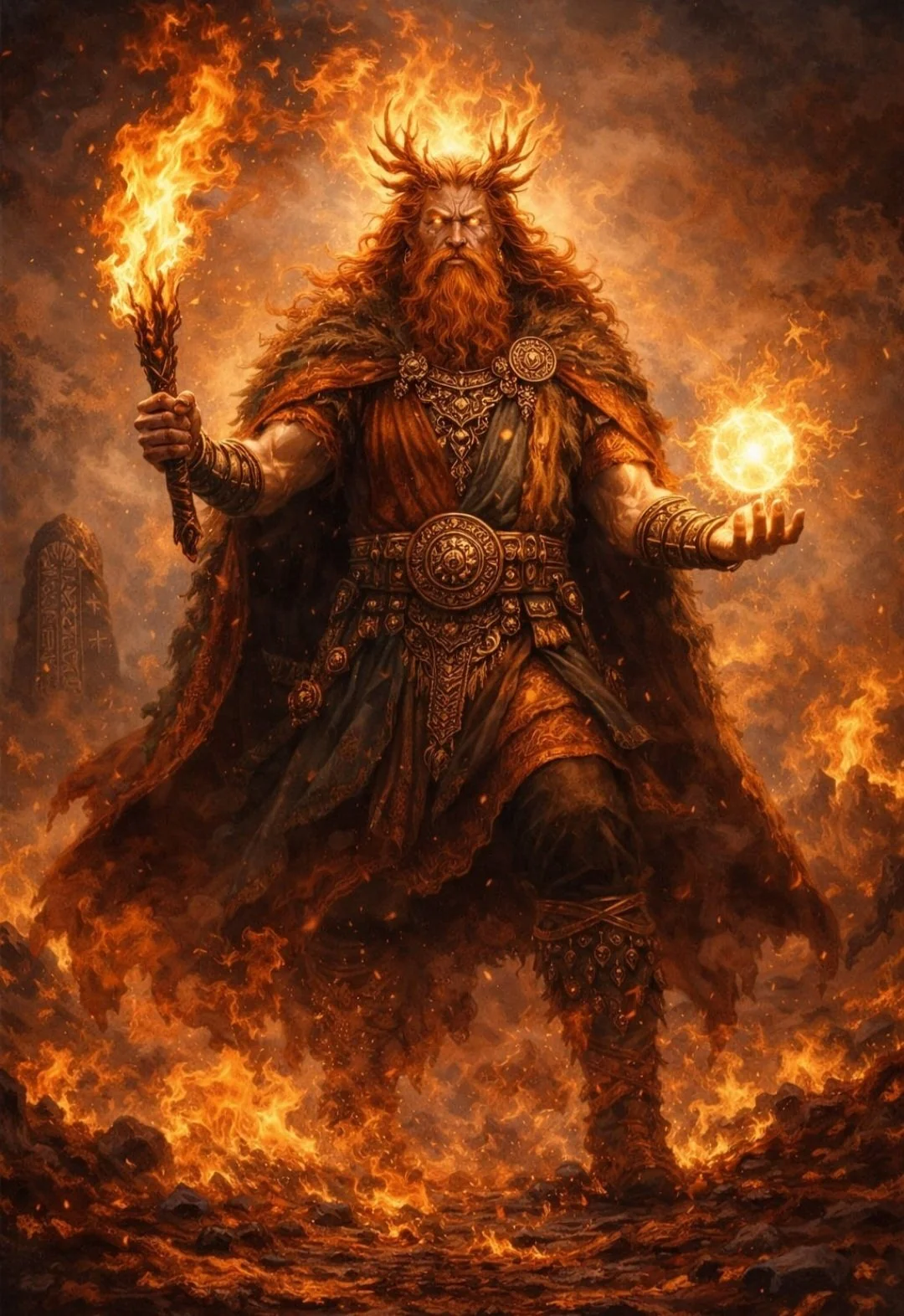
“Three came to the shore where the ash-tree waited. Two gave breath and mind. The third gave color, warmth… and the restless spark.”
- Fragment attributed to the Völuspá tradition
Pause. Feel your pulse. There is something beneath it. Before speech, before thought, before memory, there is heat. Lodurr is that heat. Not the wildfire that devours forests nor the lightning that fractures mountains, but the ember pressed quietly into flesh that makes it alive.
That ember does not shout. It does not announce itself in thunder. It hums beneath the ribs, a subtle insistence that you are more than structure and more than breath. It is the quiet refusal to remain inert. When the world feels distant and your own hands feel unfamiliar, it is that warmth that reminds you that you are still here, still burning.
Long before names were spoken around hearth-fires, before stories were carved into wood and bone, there was this warmth moving unseen through the architecture of existence. Lodurr is not the blaze at the end of things. He is the heat at the beginning.
Prologue: Before the Spark
Before the first heartbeat struck against the ribs of the world, before breath moved through newly formed lungs, before thought took shape in the hollows of the mind, there was waiting. The cosmos had structure. It had motion. It had intention. But it did not yet have intensity.
The gods could carve form from formlessness. They could summon wind and measure the arc of stars. Yet something in creation remained pale.
Introduction: The Flame Among the Three
In the sacred moment recorded in the Völuspá, three figures approach the driftwood forms of Ask and Embla. Odin grants breath. Hœnir grants mind. Lodurr grants blood and good color. It is a simple sequence in verse, almost understated in its telling.
Yet in that simplicity lies magnitude.
For breath animates, and mind direct, but heat compels. Lodurr’s gifts ensured that humanity would not merely exist within the structure of the cosmos. It would press against it. It would ache, yearn, revolt, adore, create.
He stands among the three not as ruler, not as architect, but as catalyst. if Odin is wind and Hœnir is clarity, Lodurr is the ember that makes wind roar and clarity cut deep.
Birth: Of Flame, Not Flesh
Lodurr’s origins are not recorded as a birth in the way other gods are named. There is no lineage sung clearly in surviving texts. He appears already present, already potent, already woven into divine company.
Perhaps that is fitting.
Fire is rarely born in ceremony. It emerges from friction. From spark. From contact between forces already in motion. Lodurr feels less like a being who began and more like a force that has always been latent within the bones of the cosmos.
If he has a birth, it is the first time heat separated from cold in the yawning gap of Ginnungagap. The first time friction created light. The first time something moved because it wanted to.
The Shore of Becoming
Before cities rose and kings carved their names into stone, there was a shoreline. The sea had carried two trees onto the sand, ash and elm, silent and unknowing. They possessed shape without striving, form without hunger. Odin saw possibility in them. Hœnir perceived structure and latent awareness. But Lodurr felt the absence.
Where there was breath without urgency and thought without heat, he stepped forward. Odin gave breath. Hœnir gave mind. Lodurr gave what made those gifts dangerous. He gave warmth to the limbs, redness to the blood, color to the skin. He gave the trembling beneath stillness, the ache of longing, the surge of joy.
The shore itself seemed to hold its breath in that moment. Wind moved across still bark. Salt clung to wood that had never known pulse. And then warmth entered what had only been matter. The world did not change with thunder, it changed with a heartbeat.
That first warmth did not simply animate; it complicated. It ensured that the beings rising from driftwood would not merely function. They would yearn. They would fear. They would choose. And in choosing, they would alter the world that shaped them.
The First Heartbeat
Imagine Ask and Embla standing at the edge of the sea. They breathe. They think. They stand upright beneath the sky. But something is missing. Then Lodurr steps close and presses unseen warmth into silent veins.
For the first time, there is a heartbeat. Not wind. Not thought. Rhythm. The sound of becoming. The sound of mortality beginning its dance.
A heartbeat is a promise and a limit. It marks time. It measures existence. Each pulse is both presence and countdown.
In giving rhythm, Lodurr gave humanity awareness of fragility. To burn is to eventually burn out. And yet the flame is worth it.
The Gift of Color
The Völuspá tells us Lodurr gave “blood and good color,” but this is no small offering. Color is distinction. It separates the living from the lifeless, the ember from ash. Lodurr’s gift was existential.
He gave humanity the ability to blush, to rage, to love, to feel shame, pride, hunger, and devotion. Without him, breath would remain mechanical and mind would remain cold. He made awareness vivid and embodied.
Color is also visibility. With blood in the veins and warmth in the skin, humanity became something that could be seen... by gods, by beasts, by one another. To have color is to be exposed to the gaze of the world.
And exposure is risk. To flush is to reveal feeling. To burn is to be known. Lodurr ensured that humanity would never be neutral.
On the Name Lodurr
Names in Norse cosmology are vessels of force. Lodurr appears only briefly in surviving texts, yet the name lingers like low flame against wood. Some hear Loki in its echo, sensing a primordial fire beneath later myths. Others hear generative warmth, fertility, sacred heat.
Whatever the debated identity, his function is unmistakable. Where Odin awakens consciousness and Hœnir stabilizes perception, Lodurr ignites. He brings vividness to awareness and urgency to thought. He ensures that mind is not sterile and breath not hollow.
A name spoken rarely can still shape a world. Lodurr’s scarcity in the texts does not diminish him; it intensifies him. Like an ember beneath ash, he is present even when unseen.
In many ways, the brevity of his mention mirrors his nature. Fire does not linger in explanation. It appears, transforms, and leaves marks behind.
Role: The Igniter of Becoming
Lodurr’s role in Norse cosmology is foundational yet intimate. He is not the shaper of worlds nor the keeper of runes. He is the force that ensures what is shaped will move.
He represents embodied vitality - the sacred heat within living form. Without him, humanity would have breath and mind but no urgency. No passion. No defiance.
He is the divine reminder that existence is not passive.
It surges.
Skills: Mastery of Heat and Presence
Lodurr’s primary skill is not weaponry nor prophecy. It is animation through intensity. He awakens what lies dormant. He turns potential into motion.
He understands the language of blood - the quickening pulse, the flush of emotion, the rise of courage. He can stir bravery in stillness and desire in calm.
His mastery lies in presence. In proximity. He does not reshape reality with grand gestures; he alters it by changing the temperature of the room.
Talents: The Art of Awakening
Among Lodurr’s talents is the ability to awaken longing. Not dissatisfaction alone, but the hunger to become more. He stirs creativity, rebellion, devotion, and love.
He fuels artistry as much as warfare. A sculptor shaping stone feels his warmth in their hands. A healer working through the night draws from the same flame.
His talent is not destruction.
It is ignition.
Lodurr and the Body
Odin’s gift can be contemplated. Hœnir’s can be reasoned with. Lodurr’s must be lived. He resides in blushing cheeks, sweating palms before confession, the heat of embarrassment, the glow of pride.
He gave humanity not only vitality but vulnerability. To burn is to be visible. To feel is to risk exposure.
The body becomes sacred not despite its heat, but because of it. Every sensation is proof of animation.
Through the body, spirit experiences the world. Lodurr bound the two together with warmth.
Interaction with Gods: The Quiet Catalyst
Among the gods, Lodurr does not dominate the sagas. He does not seek the throne, nor bind himself to endless quests for knowledge. His power is subtler and therefore more pervasive.
When Odin seeks sacrifice, it is Lodurr who ensures the sacrifice matters. When Thor’s rage burns across the sky, it echoes a deeper principle Lodurr embodies, that force must be felt to be real. Even Freyja’s passions and Freyr’s fertility resonate with the heat Lodurr carries.
He interacts not by command, but by amplification. Where others move, he intensifies. Where others hesitate, he ignites. In this way, his influence threads quietly through divine action, shaping outcomes without claiming credit.
Stories and Tales: Embers in the Margins
Few direct tales survive bearing his name alone. Yet absence in myth does not equal absence in meaning. Lodurr exists in the margins of the stories we know - in the heat of conflict, in the fervor of vows, in the trembling before transformation.
Imagine a skald standing before a king, voice shaking yet unyielding. Imagine a shieldmaiden gripping her blade not from obedience, but conviction. Imagine a god making a choice that will alter fate itself. In each of these moments, there is heat beneath the act.
These are Lodurr’s stories.
Not always written.
But always burning.
Oaths: Sworn in Warm Blood
Oaths in the Norse world are not light promises. They are binding forces, often sworn on rings, weapons, or sacred spaces. But an oath without heat is hollow.
Lodurr is present in every vow sealed with racing pulse and steady gaze. In the warmth of clasped forearms. In the flush of commitment.
An oath sworn without fire fades.
An oath sworn with Lodurr’s heat endures because it is felt.
And what is felt carves deeper than what is merely spoken.
The Dangerous Gift
Lodurr’s fire is why humans love fiercely, rage deeply, create art that wounds and heals. Passion can become wrath. Desire can become obsession. Warmth can become destruction.
Yet stagnation is a quieter death. A world without Lodurr would not collapse in flame; it would fade into gray repetition. Passion makes humanity unpredictable. It makes it alive.
Fire is both forge and weapon. It tempers steel and razes halls. Lodurr’s gift contains both possibilities.
The danger was never accidental. The gods knew that to give warmth was to give volatility. But they gave it anyway.
The Shadow of Fire
Every gift carries its edge. Passion can blind as easily as it can illuminate. Fire untended spreads. Yet extinguished fire leaves only cold ash.
The gods did not grant humanity comfort; they granted intensity. Lodurr made existence vivid.
With vividness comes consequence. The brighter the flame, the deeper the shadow it casts.
Wisdom must guide heat. Otherwise, the ember becomes inferno.
The Flame in Flesh
Lodurr does not lecture. Fire does not argue; it transforms. His presence is felt in the racing pulse before battle, in the warmth between lovers, in the righteous anger that challenges injustice, in the creative fever that refuses sleep.
He is ignition. And ignition is never neutral. It sets events into motion, sometimes toward glory, sometimes toward ruin, but always toward change. Without ignition, even wisdom lies dormant.
In flesh, fire manifests as urgency. It tightens muscles, sharpens breath, intensifies sight. It draws a line between before and after.
Once lit, something cannot return to what it was. Lodurr’s gift makes humanity irreversible.
The Question of Loki
Some traditions wonder whether Lodurr and Loki share a root. If so, it is not the later trickster alone, but the deeper catalytic flame beneath him. The force that unsettles what has grown rigid.
Whether they are one or separate matters less than what Lodurr embodies: transformation through intensity. He is the sacred discomfort of being alive.
Trickery itself requires heat...a quick mind, a sharper pulse. If there is a connection, it lies in motion, not malice.
Lodurr is the spark before the scheme. The energy before the disruption.
Death: The Flame’s Dilemma
Unlike Kvasir, Lodurr’s death is not recorded in myth. No dwarf slays him. No prophecy names his fall.
This absence raises a question: can fire die in the same way flesh does?
Flame extinguishes, yes. But its principle remains. Heat transfers. Embers reignite. Sparks travel unseen.
If Lodurr falls at Ragnarök, it would not be as ash - but as heat released into the collapsing world, ready to seed the next.
Disappearance: Into the Veins of Humanity
Perhaps Lodurr did not vanish.
Perhaps he diffused.
After gifting humanity with blood and color, what if he became inseparable from that gift? Not a distant god in Asgard, but a presence woven into mortal pulse.
His disappearance from myth may mirror his integration into flesh. He no longer needs to be named because he is carried.
Every quickened heartbeat is a trace.
Every surge of courage, a whisper.
The Eternal Ember
Even now, Lodurr walks the metaphorical shore. Every generation stands as driftwood before the sea of becoming. Breath is given. Mind awakens. Yet something still waits.
When you feel that restless heat beneath your ribs, that refusal to remain numb, that ache to create, to love, to fight, to transform, that is Lodurr.
The ember is ancient, but it is also immediate. It flares in new forms each age.
It survives because humanity carries it forward.
Invocation of Flame
When life feels cold or colorless, remember Lodurr. Move. Create. Love with enough intensity to matter.
Let your blood remind you that you are not wood abandoned on the sand. You are fire given form.
Feed the flame with purpose. Guard it from both suffocation and frenzy.
Stand close enough to feel its warmth and far enough to shape it.
Lessons of Lodurr
Lodurr teaches that vitality is sacred, that emotion is power in motion, that the body is not separate from spirit but its furnace.
Fire must be tended, guided, and respected. To deny it entirely is to wither. To unleash it without wisdom is to burn without purpose.
Balance is not the absence of flame but the wise shaping of it.
To live well is not to extinguish intensity, but to channel it.
Final Reflection - “The Heat Within”
Lodurr lives in the flush beneath your skin, in the courage to feel fully, in the refusal to fade in a vivid world.
Odin may have given you breath. Hœnir may have given you mind. But Lodurr made them burn.
Not conqueror. Not judge. But the sacred flame pressed into mortal clay.
If the heat is rising now, what will you dare to ignite?
If the heat is rising now, what will you dare to ignite?
Wyrd & Flame 🔥🌿✨
