
Dísablót: The Norse Rite of the Ancestral Dísir
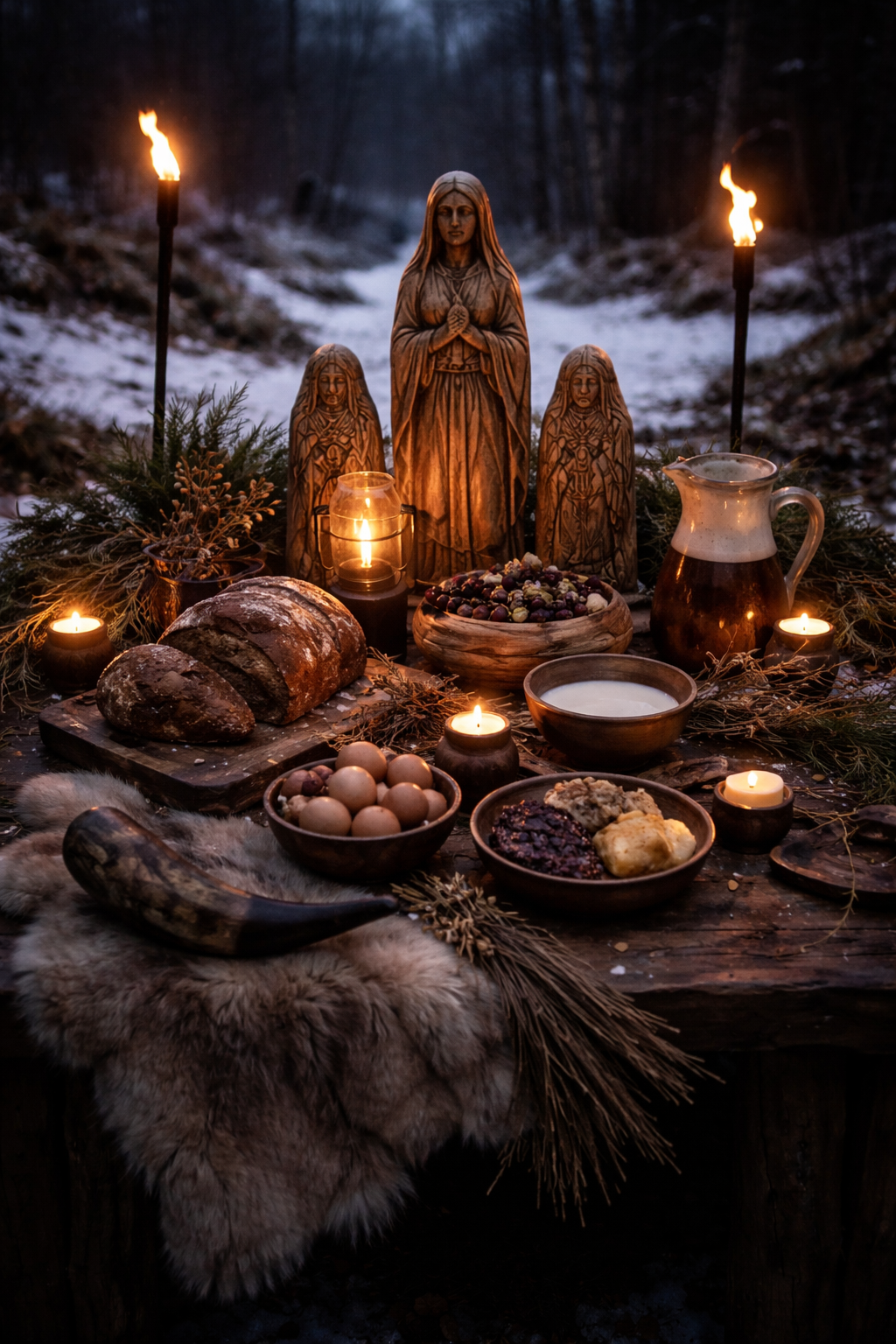
There is a tension in late winter that cannot be ignored. The light has begun to return, yet it has not fully claimed the sky. The ground remains hard. The stores are lower than they once were. What remains must be measured carefully, and what is to come is still uncertain. It was in this narrowing stretch of the year that Dísablót was held.
Dísablót was the offering made to the dísir - powerful female beings bound to lineage, survival, fertility and continuity. In its fullest form, this was not a quiet private devotion. It was a public seasonal rite woven into law, kingship, trade and the security of the people.
The Norse world did not separate survival from the sacred. Winter was not poetic symbolism. It was real. It pressed against homes and bloodlines alike. To honour the dísir at this time was to acknowledge the unseen forces that guarded family lines through hardship and carried them toward renewal.
The word itself carries weight. Dís referred to a powerful woman, a lady, a protective female presence. Blót meant offering - a deliberate act of exchange. Together, Dísablót was not simply remembrance. It was reinforcement. A strengthening of continuity before the year turned fully toward growth.
This was a rite rooted in necessity. It recognised that no family stands alone and no lineage survives without protection. The dísir represented those quiet, enduring forces that stand behind the living - whether ancestral, divine, or something between.
Meaning of the Word
The structure of Old Norse ritual language is rarely accidental. Words were direct. Functional. Rooted in lived reality.
The term Dísablót combines two elements that each carry their own weight.
Dís is an old word used throughout Norse literature as a title for powerful women. It could refer to goddesses, noble women, or other female beings of influence and authority. The term appears in both mythic and human contexts, which suggests it was less a specific category and more a recognition of power.
In poetic usage, even figures such as Freyja are referred to as a dís. The word itself implies dignity, strength and presence. It is not fragile or passive in tone.
Blót, on the other hand, is unambiguous. It means offering or sacrifice. It describes the act of giving something of value in exchange for favour, protection, fertility or fortune. Blót was not symbolic theatre. It was a transaction carried out with seriousness.
When these two words are joined, Dísablót becomes more than seasonal remembrance. It becomes a deliberate act of offering to powerful female presences associated with protection and continuity.
Who Were the Dísir?
The dísir are among the more elusive figures in the Norse world, and that elusiveness is revealing. They are not introduced in the sources with a single origin story or a fixed genealogy. They do not stand neatly arranged in a divine hierarchy. Instead, they appear across poems and sagas as presences - powerful female beings whose influence is assumed rather than explained.
The Old Norse word dís was used broadly. It could describe a goddess. It could refer to a noble woman. It could also imply a supernatural female presence of strength and authority. The term carries dignity. It implies power without needing definition. That fluid use suggests that the boundary between divine woman, ancestral protector, and mythic female force was not rigid in the Norse mind.
In several literary contexts, even established goddesses are referred to as dísir. This indicates that the term was not limited to one class of beings. It functioned more as a recognition of potency - a title rather than a species. To call a being a dís was to acknowledge her as a force to be reckoned with.
What emerges from the scattered references is a pattern. The dísir are repeatedly associated with protection, prosperity, fertility and continuity. They are tied to the wellbeing of households and the stability of lineage. They are not wanderers of the wild or distant cosmic architects. They are close to the human sphere.
There is also evidence that the dísir were connected to specific families. Some scholars suggest they may have been understood as protective ancestral women - matriarchal figures who continued to guard their descendants beyond death. This interpretation aligns with the emphasis on kinship and bloodline in Norse society. A family did not begin and end with the living. It stretched backward and forward through time.
Yet the dísir were likely more than simply remembered ancestors. Their influence appears active. They are invoked for fortune. They are honoured for protection. They are approached at critical moments in the year. That suggests an ongoing presence rather than passive memory.
It is important not to collapse them entirely into other categories. They are not Valkyries, though both are female and powerful. The Valkyries are more clearly associated with battle and the slain. The dísir seem oriented toward preservation - toward ensuring survival rather than selecting the dead.
They are also distinct from the Norns, who are explicitly tied to the shaping of fate at a cosmic level. While the dísir may have had connections to personal destiny, their sphere appears more intimate - focused on the continuity of kin and the stability of life within the community.
In this way, the dísir occupy a space that is deeply rooted in the Norse worldview. They reflect a society in which lineage mattered, survival was uncertain, and female power was acknowledged as central to the endurance of the family line.
They were not abstract symbols of feminine energy. They were protectors of continuity…And in a world defined by harsh winters, fragile harvests, and the constant possibility of loss, such protection was not symbolic. It was essential.
Historical Sources
Our understanding of Dísablót does not come from ritual manuals or preserved temple records. It comes from fragments - references preserved in medieval texts written after the Christianisation of Scandinavia. These sources must be read carefully. They were recorded by Christian authors describing a pre-Christian past, yet they remain invaluable.
One of the clearest references appears in Heimskringla, written in the 13th century by Snorri Sturluson. In this work, Dísablót is described as taking place in Sweden and being connected to a large seasonal gathering. The account links the rite to royal authority and public assembly, suggesting that this was not a marginal observance but one woven into the structure of society.
Another reference appears in Víga-Glúms saga. In this saga, a man performs sacrifice to the dísir for personal luck and strength. This account is important because it shows that devotion to the dísir was not limited to kings or major cult centres. It could occur at the household level. The rite had both public and private dimensions.
The sources do not give us detailed ritual instructions. They do not describe exact words spoken or gestures made. What they reveal instead is context. Dísablót existed. It was known. It was significant enough to be remembered and recorded.
The fact that it was associated with seasonal gathering and kingship in Sweden points toward its importance in maintaining stability. The fact that it appears in a family saga suggests it was also embedded in everyday life.
We must accept that some detail is lost. But what survives is enough to show that Dísablót was not a minor or invented festival. It was part of the living structure of pre-Christian Norse society.
Dísablót at Gamla Uppsala
Dísablót is most strongly associated with Gamla Uppsala in Sweden, one of the most significant cultic and political centres in pre-Christian Scandinavia.
Gamla Uppsala was not a minor village shrine. It was a royal seat. A gathering place. A centre of law, trade and ritual. Archaeological evidence shows large burial mounds, monumental halls, and signs of long-term elite activity. It was a place where kings ruled and where sacred authority and political authority intertwined.
According to Heimskringla, Dísablót was held there and attended by the king. This detail matters. The presence of the king suggests that the rite was not simply devotional. It was structural. The wellbeing of the people, the fertility of the land and the legitimacy of rule were bound together.
The rite coincided with a great seasonal assembly known as the Disting. Markets were held. Trade occurred. Disputes were settled. Law was spoken. In the Norse world, these spheres were not separate. Governance, economy and sacred observance were interwoven.
To perform Dísablót at Gamla Uppsala was to publicly reinforce continuity. The king honoured the protective female powers of the land and lineage, and in doing so affirmed his responsibility to safeguard the people through the final stretch of winter.
This was not private mysticism. It was communal reinforcement.
The association with Gamla Uppsala also suggests that the dísir were not understood as minor spirits. A rite held at one of Scandinavia’s greatest centres indicates weight and recognition.
It is important not to romanticise the setting into something theatrical. The reality would have been practical. Offerings given. Words spoken. Food shared. Authority reaffirmed.
Yet within that practicality lay something fundamental: the acknowledgement that protection did not rest solely in human hands.
At Gamla Uppsala, Dísablót stood at the meeting point of land, lineage and leadership.. And that meeting point was sacred.
Seasonal Timing - Late Winter and Góa
Dísablót was held in late winter, during the month known in Old Norse as Góa, which roughly corresponds to February/March in the modern calendar.
This timing is not incidental. It is essential to understanding the rite.
Late winter in Scandinavia was not symbolic hardship. It was material hardship. Food stores were reduced. Livestock were weakened. Travel remained dangerous. Illness could spread quickly in enclosed halls. The land was still locked beneath frost, and the success of the coming season remained uncertain.
This was the narrow edge of survival.
By the time Góa arrived, the worst of winter may have passed, but its pressure had not. The light had begun to return, yet it did not guarantee harvest. Spring was anticipated, not assured.
To hold Dísablót at this time was to act before renewal, not after it. It was a strengthening rite - a deliberate reinforcement of protection before the turning of the agricultural year.
In agrarian societies, timing carried weight. Rites were not scattered randomly through the calendar. They were placed where pressure was greatest and where reinforcement was most needed.
The dísir, as protectors of lineage and continuity, were honoured precisely when continuity felt most fragile.
This late winter placement also aligns Dísablót with themes of fertility, though not in a romantic sense. Fertility here means survival of livestock, health of families, viability of crops. It means the assurance that life will continue.
Góa stands at a threshold. It is neither the depth of winter nor the security of spring. It is the testing ground between endurance and renewal.
Dísablót belonged to that threshold.
It acknowledged that survival was not assumed. It was guarded.
The Role of Kingship and Assembly
In the Norse world, sacred rites were not separate from governance. Authority was not only political. It was also ritual.
The king was not simply a military leader or law speaker. He was responsible for the wellbeing of the land and the people. Prosperity, fertility and stability reflected upon his legitimacy. If harvests failed repeatedly or hardship persisted, his authority could be questioned. Sacred obligation and rulership were intertwined.
Dísablót, when performed at the level of royal assembly, reinforced this connection.
By participating in the rite, the king publicly acknowledged the protective female powers associated with lineage and survival. He did not stand above them. He honoured them. In doing so, he affirmed his duty to safeguard continuity - not only of his own line, but of the wider community.
Assemblies held alongside Dísablót were not coincidental. Seasonal gatherings allowed disputes to be settled, trade to occur, alliances to be reinforced. These were moments when society rebalanced itself after the strain of winter.
The rite functioned as a stabilising force.
It affirmed that protection was shared - between ruler and ruled, between living and ancestral powers, between human effort and unseen guardianship.
This is important to understand.
Dísablót was not a peripheral women’s rite isolated from the centre of society. It stood within the framework of communal life. It acknowledged that continuity depended on cooperation - political, agricultural and sacred.
Kingship without fertility failed. Fertility without protection failed. Protection without continuity failed.
The rite addressed all three.
In this way, Dísablót reveals something fundamental about the Norse world: survival was collective. Authority was accountable. And sacred exchange underpinned both.
Were the Dísir Ancestors?
Whether the dísir were understood as ancestral women, divine beings, or something between the two is a matter of ongoing debate.
Some scholars suggest that the dísir may have originated as honoured foremothers - powerful matriarchal figures remembered and elevated beyond death. This interpretation fits comfortably within a society where lineage defined identity. In the Norse world, a person was rarely described without reference to their father, mother, or kin. Bloodline was not background. It was structure.
If ancestral women were believed to continue influencing the wellbeing of their descendants, then honouring them through Dísablót would have been an act of reinforcement. It would acknowledge that the living do not stand alone, but remain connected to those who came before.
However, the evidence does not allow us to reduce the dísir entirely to ancestral spirits.
In several references, the term dís is applied to goddesses. This suggests that the category was broader. The dísir may have included divine female powers alongside ancestral protectors. The boundary between divine and ancestral was not rigid in Norse cosmology. Influence flowed across generations, and sacred presence was not confined to one realm.
It is possible that the dísir functioned as collective female guardians attached to lineage and territory. They may have been understood as protective presences of a family, clan, or region - not necessarily individual spirits, but forces tied to continuity itself.
What is clear is their role. The dísir were associated with protection, prosperity, fertility and the safeguarding of kin. Whether ancestral, divine, or a blending of both, their function remained consistent.
They guarded the line.
In a world where survival depended on the endurance of family and land, such guardianship was not symbolic. It was essential.
Offerings Traditionally Associated with Dísablót
While the surviving sources do not provide a detailed ritual script, we can infer the nature of offerings from broader blót practice and from the timing of the rite itself.
Blót was an act of exchange. Something of value was given in acknowledgement of protection or favour. It was not symbolic theatre. It was material.
Given the late winter timing of Dísablót, offerings would likely have reflected what remained available during that season. Grain, bread, ale, mead, preserved meat, dairy products - these were not extravagant luxuries. They were stores carefully kept through winter. To offer from them was a genuine act of giving.
In larger communal rites, animal sacrifice is mentioned in broader Norse sources, though it is impossible to state definitively that this occurred at every Dísablót. Where it did occur in pre-Christian Scandinavia, the act was communal and structured, with portions shared and portions dedicated.
More commonly at the household level, offerings would have been simpler. A cup of ale poured. Bread broken and set aside. Words spoken in acknowledgement of protection and continuity.
It is important not to project modern excess backward onto the past. The Norse world valued usefulness. An offering was meaningful because it came from real stores, real labour, real survival.
The power of the rite did not lie in spectacle. It lay in the seriousness of the exchange.
In honouring the dísir, the living gave from what sustained them and in doing so affirmed that survival was shared between effort and guardianship.
Protection, Fertility and Continuity
Dísablót was not a festival of abstract symbolism. Its themes were direct: protection, fertility and continuity.
Protection in the Norse world was not passive. It was active preservation. It meant livestock surviving the winter. It meant children living past infancy. It meant illness passing without taking a life. It meant raids avoided, stores lasting, alliances holding.
To invoke protection was to ask that the fragile threads of daily survival not be severed.
Fertility, likewise, must be understood in its original context. It was not romanticised abundance. It was viable soil. Strong animals. Healthy offspring. Fields that would respond when the frost finally released them. Fertility ensured that continuity was possible.
Continuity itself was the deeper principle beneath both.
The Norse world was structured around lineage. A person’s identity was tied to their forebears and their descendants. To lose continuity was to lose more than property. It was to lose name, memory and standing.
The dísir, as protective female powers connected to kin and survival, stood at the centre of this structure. They guarded not only individuals, but the endurance of the line.
Dísablót therefore functioned as reinforcement at a vulnerable time of year. It acknowledged that survival was not guaranteed. It affirmed that fertility required safeguarding. It recognised that continuity depended on more than human effort alone.
In honouring the dísir, the community reinforced its connection to what stood behind it - whether ancestral, divine, or interwoven.
The rite did not promise abundance.
It asked for endurance.
Dísablót in Modern Practice
Today, Dísablót is observed by many modern Heathens and Norse Pagans as a late winter rite of honour and reinforcement. While we cannot reconstruct the ritual in exact historical detail, we can understand its structure and principle.
Modern observance tends to centre on honouring protective female powers - whether understood as the dísir collectively, as ancestral women, or as guardians of lineage and land.
The emphasis remains the same: continuity.
Some choose to honour named foremothers - grandmothers, great-grandmothers, known women of their line. Others focus more broadly on ancestral female strength. Some approach the dísir as collective protectors rather than specific ancestors.
There is no single correct format. What matters is clarity of intent.
A modern Dísablót may include the lighting of a single steady flame to mark presence. An offering of bread, ale, mead, milk or grain may be set aside. Words of acknowledgement are spoken - not elaborate invocations, but deliberate recognition.
It is appropriate to speak gratitude for survival through winter. It is appropriate to ask for protection moving into the growing season. It is appropriate to reflect on the women who carried the line forward - whether by blood, by labour, or by guardianship.
What should be avoided is theatrical excess.
Dísablót was not originally a festival of aesthetic display. It was a rite rooted in necessity. A modern observance is strongest when it reflects that seriousness.
The focus should remain on:
Protection.
Endurance.
Continuity.
Even now, those principles remain relevant.
Winter may not threaten survival in the same way it once did, but continuity (of family, of community, of memory) still requires reinforcement.
In that sense, Dísablót has not lost its meaning.
It has only shifted its setting.
A Structured Way to Observe Dísablót Today
If you choose to observe Dísablót, keep it grounded and deliberate. The strength of the rite lies in clarity, not excess.
Preparing the Space -
Choose a steady surface. Keep it uncluttered. Light a single candle to mark presence. If you honour specific ancestors, you may place a simple object connected to them - not as decoration, but as acknowledgement.
This is not about atmosphere. It is about intention.
Suggested Offerings -
Offerings should reflect sincerity rather than spectacle. Traditionally appropriate items include:
Bread
Grain
Milk
Ale or mead
Simple cooked food
Set the offering down. Speak clearly. Acknowledge protection, endurance and continuity. If naming foremothers, speak their names aloud.
After the rite, return the offering to the land where possible. Do not allow it to sit and decay indoors.
Words of Honour -
There is no required script. Keep it direct.
You may acknowledge:
The women who carried your line
The protective forces behind your survival
Gratitude for endurance through winter
A request for strength moving forward
Speak plainly. The Norse world valued clarity.
Closing the Rite -
When finished, extinguish the flame deliberately. Do not rush. Let the moment settle. The act has been made. The exchange completed.
Dísablót does not require drama. It requires seriousness.